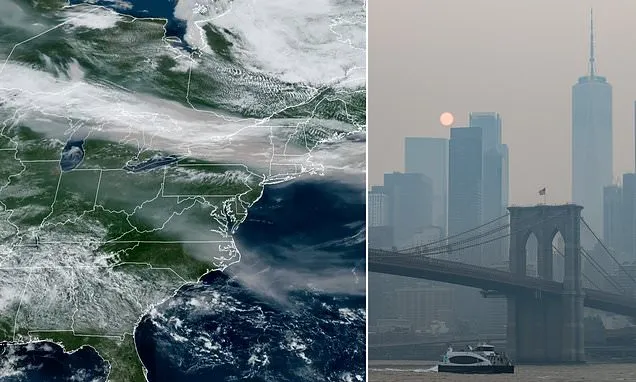
Vast plumes of smoke from Canadian wildfires have drifted south, blanketing major U.S. cities and creating hazardous air quality conditions. The toxic haze has transformed urban landscapes into surreal, orange-tinged vistas, prompting health warnings for millions of residents across the eastern half of the United States and parts of the Midwest.
Smoke Plumes Engulf Eastern U.S. Cities
As Canada grappled with over 850 active wildfires on a recent Thursday, the resulting smoke became a significant transboundary issue. The National Oceanic and Atmospheric Administration (NOAA) released striking satellite imagery illustrating the movement of this dense, grey haze. The graphic revealed a vast circulation of smoke extending across the eastern U.S. and Canada, with a particularly concentrated area forming above eastern Canada and the northeastern United States.
This atmospheric phenomenon was driven by a combination of strong winds and high temperatures, which lofted the smoke into the jet stream. This high-altitude air current then acted as a conduit, transporting the pollutants hundreds of miles south. Experts emphasize that wildfire smoke is considerably more toxic than typical urban air pollution. This is due to the presence of chemicals, metals, plastics, and synthetic materials released when structures and vehicles burn alongside natural vegetation.
New York City Faces ‘Very Unhealthy’ Air
New York City experienced a dramatic transformation, with its skyline obscured by a thick, orange haze. Air quality levels in the city reached ‘very unhealthy’ levels, prompting concerns for residents. Photos captured the eerie atmosphere, showing commuters and outdoor participants navigating the smoky conditions. Some individuals were observed wearing N95 masks as a precautionary measure, underscoring the severity of the air quality advisory. Health officials cautioned that prolonged exposure could pose risks even to those without pre-existing respiratory conditions.
Detroit, Minneapolis, and Chicago Report Severe Air Quality
Beyond New York, several other major American cities found themselves among those with the world’s poorest air quality. Detroit recorded an Air Quality Index (AQI) of 566, placing it as the most polluted major city globally at the time of the measurement. Residents described the pervasive smell as inescapable, akin to a constant bonfire, with smoke infiltrating buildings.
Minneapolis followed with an AQI of 289, and Chicago registered at 259. These readings fall within the ‘very unhealthy’ classification (201-300), where health authorities warn of potential adverse effects for all individuals exposed for extended periods. The smoke’s trajectory, influenced by strong winds sweeping across the Great Lakes region, was clearly visible in NOAA satellite data, showing large grey puffs over Minnesota and Michigan.
Statewide Alerts and Record-Breaking Pollution
The impact of the smoke extended across multiple states. Michigan issued a statewide air quality alert as plumes moved from the Upper Peninsula southward towards the Indiana border. In Minnesota, the Pollution Control Agency reported that hourly air quality readings in the Twin Cities surpassed previous records, with trace amounts of ash also detected.
Illinois experienced a ‘red air pollution action day’ declared by the state Environmental Protection Agency for Rockford and all six Chicago-area forecast zones. Emily Fischer, an atmospheric chemist at Colorado State University, described the situation as a ‘river of smoke pouring into the Midwest.’ Pennsylvania also implemented a Code Red alert, signifying unhealthy conditions for everyone, as smoke from Ontario and Minnesota drifted into the state.
Understanding Wildfire Smoke’s Toxicity
The danger posed by wildfire smoke stems from its complex composition. Unlike industrial pollution, which often consists of specific chemical compounds, wildfire smoke contains a broader and more unpredictable mix of particulate matter and gases. When fires consume buildings and vehicles, they release a cocktail of substances including heavy metals, volatile organic compounds, dioxins, and furans, in addition to the typical smoke components like carbon monoxide and fine particulate matter (PM2.5).
PM2.5 particles are particularly concerning because they are small enough to penetrate deep into the lungs and even enter the bloodstream. These particles can cause immediate respiratory irritation, coughing, and shortness of breath, and can exacerbate chronic conditions like asthma and bronchitis. Long-term exposure has been linked to more severe health issues, including cardiovascular disease and premature death.
Canadian Wildfires Intensify
The source of this widespread pollution remains the intense wildfire activity in Canada. Firefighters have been working tirelessly to contain the blazes, which have been exacerbated by a persistent heatwave. Randy Schroeder, a fire chief from Alberta, noted that the combination of extreme heat and dry conditions has made the fires exceptionally challenging to manage.
He observed that current fire behavior patterns, including increased intensity and duration, differ significantly from those seen in previous years under similar fuel and weather conditions. This suggests that climate change may be contributing to the escalating severity and frequency of such large-scale wildfire events.
Health Recommendations Amidst Haze
In response to the hazardous air quality, health officials universally recommend that residents, particularly those in affected areas, limit outdoor activity. Sensitive groups, including children, the elderly, and individuals with heart or lung conditions, are advised to stay indoors and minimize exertion. When venturing outside is unavoidable, wearing a well-fitting N95 mask can offer significant protection against inhaling fine particulate matter.
Ensuring indoor air quality is also crucial. Running air purifiers with HEPA filters and keeping windows and doors closed can help reduce indoor exposure. Staying informed about daily air quality reports and following local health advisories is essential for navigating this public health challenge.
Conclusion: A Stark Reminder of Environmental Interconnectedness
The widespread impact of the Canadian wildfires on air quality across the U.S. serves as a stark reminder of the interconnectedness of environmental systems. The event highlights the far-reaching consequences of large-scale natural disasters, amplified by climate conditions, and underscores the importance of robust air quality monitoring and public health advisories. As efforts continue to combat the fires in Canada, residents in affected U.S. regions remain under advisories, prioritizing health and safety amidst the lingering toxic haze.