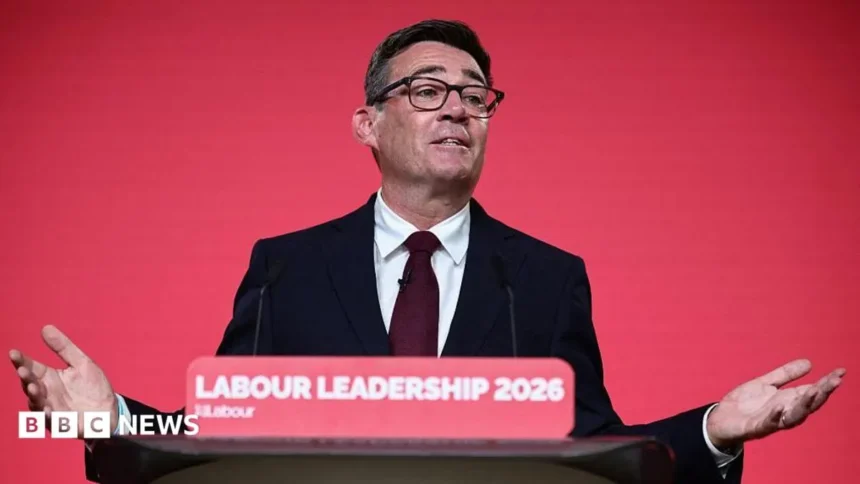
Andy Burnham has officially been confirmed as the new leader of the Labour Party, pledging to usher in a new era of political change and restore hope to working-class communities across the United Kingdom. In his inaugural speech following his confirmation, Burnham articulated a vision for a government focused on significant reform, aiming to deliver the most substantial transformation in British politics in four decades. He asserted that the political establishment had neglected the needs of ordinary people and committed to reversing this trend.
A New Direction for Labour
Burnham, the former Mayor of Greater Manchester, emphasized his commitment to decentralizing power, moving it away from Westminster and distributing it more equitably among the nation’s regions. He positioned himself as a leader dedicated to representing all parts of the country, not just specific areas. His ascension to the leadership follows a period of significant political maneuvering. Burnham secured his position as the sole candidate after receiving endorsements from 379 Labour Members of Parliament and all 11 trade unions affiliated with the party.
This leadership victory marks a significant milestone in Burnham’s political career. Having previously vied for the leadership twice before, his success this time is notably rapid, particularly following his recent by-election triumph in Makerfield. His path to leadership has been shaped by a desire to fundamentally alter the political and economic landscape of Britain.
Critique of Past Policies and Vision for Reindustrialization
Speaking at the TUC headquarters in central London, Burnham delivered a pointed critique of the “neoliberal” policies that have shaped the nation over the past 40 years, acknowledging Labour’s own role in implementing some of these measures. He declared his intention to reindustrialize the country, signaling a departure from what he described as a period where the nation lost control over essential industries and decision-making.
“Britain took a series of wrong turns in the 1980s – political power was centralised and economic power was privatised,” Burnham stated, reflecting on the historical shifts that he believes have disadvantaged many communities. “The country surrendered control of the essentials.”
His vision for a “distinctively Labour” government aims to reconnect with the party’s core values and address the perceived failures of recent decades. He stressed the importance of unity within the party, urging Labour MPs to foster a cohesive “one Labour team” culture. “We won’t beat Britain’s new right if we are consumed by infighting and pulling in different directions,” he cautioned.
Burnham outlined his governing philosophy as one centered on “problem-solving rather than point-scoring,” suggesting a pragmatic and constructive approach to leadership. This focus on practical solutions is intended to build trust and deliver tangible improvements for the electorate.
Navigating Political Challenges
The new Labour leader faces the immediate challenge of improving the party’s standing in opinion polls, where it has trailed the Reform UK party for approximately 18 months. Supporters are hopeful that Burnham’s leadership will mark a turning point and reverse the party’s recent electoral fortunes. Specific policy details and cabinet appointments are anticipated to be announced on Monday, coinciding with his official assumption of office.
Burnham’s rise comes in the wake of Sir Keir Starmer’s resignation as leader last month. Starmer concluded that he was not the most suitable person to guide Labour into the next general election. This decision followed significant setbacks for the party in the May local elections, compounded by Burnham’s decisive victory in the Makerfield by-election. These events intensified pressure from within the party for Starmer to step aside, paving the way for Burnham’s leadership bid.
A Mandate for Change
Burnham’s supporters view his leadership as a mandate for substantial change. His background as Mayor of Greater Manchester has provided him with experience in regional governance and a platform to advocate for devolution. His commitment to re-energizing working-class communities and challenging the status quo is expected to be a central theme of his leadership.
The coming weeks will be crucial as Burnham begins to implement his agenda and shape his shadow cabinet. The focus will be on how effectively he can translate his vision into concrete policies that resonate with voters and address the pressing economic and social issues facing the UK. His promise to bring “hope back” signals an ambition to reconnect with a disillusioned electorate and offer a compelling alternative to the current political direction.
Looking Ahead
The transition of leadership within the Labour Party signifies a potential shift in the political landscape. Andy Burnham’s emphasis on devolution, reindustrialization, and a problem-solving approach aims to re-establish Labour as a party for all working people. His success will depend on his ability to unite the party, articulate a clear policy platform, and effectively communicate his vision for a transformed Britain to the electorate.