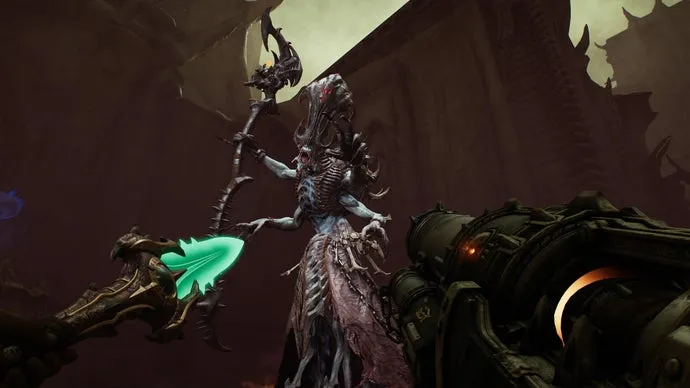
Following significant layoffs impacting Id Software, the studio behind the upcoming Doom: The Dark Ages, director Hugo Martin has spoken out to counter claims that the development team has been severely weakened. Martin addressed the situation during an official livestream for the game’s Revelations DLC, asserting that the studio’s core capabilities remain intact despite the recent workforce reductions.
Reports had circulated suggesting that Id Software had been drastically reduced in size, with some characterizing the studio as having been “nerfed into the ground” or “gutted.” Martin directly refuted these claims, stating, “There’s been reports that we’ve been ‘nerfed into the ground’ and ‘gutted’ and we have 50 people and that’s not true.” He clarified that the studio’s current staffing levels are comparable to when it developed the critically acclaimed Doom (2016).
A key point of reassurance from Martin was the continued strength and availability of the id Tech engine and its associated engineering teams. “We’re the size we were when we made Doom 2016 and id Tech is very much alive and well,” he explained. “You have to understand we have id Tech engineers both in Frankfurt and at MachineGames. We collaborate quite a bit. So, the IDTech is there, the Doom team is here, and we’re excited to share with you guys more of what we’re working on in in the future, when it is appropriate and approved.” This highlights a distributed model for the id Tech infrastructure, ensuring its continued development and support across different internal teams.
Joshua Boyle, a senior community lead at Id Software, joined Martin in expressing gratitude to the game’s fanbase. He specifically thanked players for their enthusiasm for the Revelations DLC and for their “overwhelming support of everyone that was affected in the layoffs, amplifying their stuff and championing the art.” This acknowledgment underscores the community’s role in supporting both the studio’s current projects and its former employees.
Martin further emphasized the importance of successful game releases, suggesting that commercial and critical success benefits everyone involved, including those who were laid off. “Look, the fact that we made a game that people like and is [critically] and commercially successful – like I said, it’s doing very well related to the forecast and stuff – that’s good for everyone,” Martin stated. “For the people at the studio, for the people who unfortunately we had to say goodbye to, I think that helps everyone and we really appreciate your support. But what matters the most is that the games are good and I’m so happy that people, I don’t know…it’s just a good thing for everybody, I know it’s going to help.” He concluded by focusing on the present, noting, “So, we are really here to just play the game now and celebrate the work.”
Context of Layoffs and Studio Morale
Martin’s comments regarding Doom: The Dark Ages performing well against forecasts are significant. Following the layoffs, which saw a substantial number of Id Software employees and others across ZeniMax Media (including Bethesda Softworks) affected, some former developers expressed concerns about a lack of clear communication from Microsoft regarding performance metrics and expectations. This uncertainty reportedly left employees unsure about the factors contributing to the studio’s perceived underperformance, which may have led to the job cuts.
The Communications Workers of America (CWA), which has been supporting unionized employees at Bethesda, ZeniMax, and Id Software, organized rallies outside the studios’ offices in solidarity with the laid-off staff. Information regarding the specific roles and seniority of some of the departed employees has emerged through official channels like WARN notices.
These workforce reductions have been part of a broader trend within Microsoft’s gaming division, Xbox. Reports and statements from affected employees and industry observers have pointed to a perceived culture of prioritizing rapid growth and cost-cutting, sometimes at the expense of long-term employee stability and morale. This has led to criticism that Xbox may be fostering a “disposable worker mentality.”
Id Software’s Development History and Future Projects
Id Software, a pioneering studio in the first-person shooter genre, has a storied history, most notably with the Doom and Quake franchises. The studio’s acquisition by ZeniMax Media in 2009, and subsequently by Microsoft in 2020 as part of the ZeniMax acquisition, has placed its operations under new corporate oversight. The recent layoffs at Id Software and other ZeniMax studios represent a significant shift in the operational landscape for these long-standing game developers.
Prior to the layoffs, reports indicated that Id Software had been exploring various project ideas. These reportedly included concepts for a new installment in the Perfect Dark series, a game inspired by the John Wick films, and further multiplayer-focused demon-slaying experiences. The impact of the recent staff reductions on the development and prioritization of these potential future titles remains a subject of speculation within the industry.
The studio’s continued work on the id Tech engine is crucial, as it powers not only their own games but is also utilized by other Microsoft-owned studios, such as MachineGames. The assurance that this foundational technology and its development team remain robust is a key message from Id Software’s leadership as they navigate this period of transition and focus on the upcoming release of Doom: The Dark Ages.