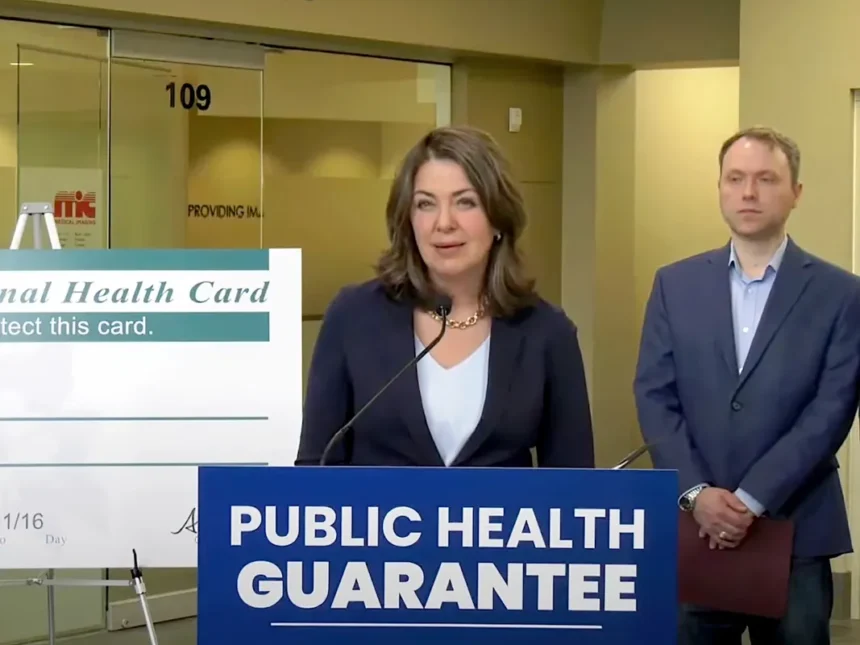
Alberta Premier Danielle Smith made a clear pledge during the 2023 election campaign: no Albertan would ever have to pay out of pocket to see a family doctor. This promise was central to the United Conservative Party’s (UCP) “Public Health Care Guarantee,” articulated in pre-election materials, including a video released on April 12, 2023. The campaign messaging emphasized a commitment to a publicly funded health-care system, assuring voters that medical services, including doctor visits and prescriptions covered by Alberta Health Insurance, would remain publicly funded without exception.
Key Election Promises on Health Care
In the lead-up to the May 29, 2023, election, the UCP’s “Public Health Care Guarantee” was prominently featured. A website supporting the initiative stated, “Under a re-elected UCP government, no Albertan will ever have to pay for a doctor out of pocket.” Premier Smith herself was quoted directly, asserting, “under the UCP’s Public Health Care Guarantee, we are committing to all Albertans that under no circumstances will any Albertan ever have to pay out of pocket to see their family doctor or to get the medical treatment they need.” The commitment extended to a pledge not to “delist any medical services or prescriptions now covered by Alberta Health Insurance. No exceptions.” These assurances were presented against a backdrop of UCP claims of improving health care, including reduced surgical wait times and enhanced ambulance response.
Allegations of Broken Promises and Policy Shifts
However, critics contend that subsequent government actions have contravened these explicit promises. Several legislative and regulatory changes enacted since the election have raised concerns about the erosion of public health care and the introduction of user fees and private sector involvement. These developments have led to accusations that the government is moving towards a two-tier or U.S.-style health-care system, contrary to its electoral commitments.
Specific Policy Changes Cited by Critics:
- COVID-19 Vaccination Fees: In the fall of 2025, the government reportedly introduced a $100 fee for COVID-19 vaccinations for most Albertans.
- Physician Fees for Speedy Care: Legislation passed in December 2025 allows physicians to charge patients out of pocket for expedited care, while still billing the public system. This measure is seen as potentially disadvantaging those unable to afford extra fees, pushing them to the back of the queue.
- Expansion of Private Health Care: The same December 2025 legislation reportedly paved the way for a private health insurance market, permitted private hospital operators, and introduced competition for revenue among public hospitals, measures critics argue will increase patient costs and lengthen wait times for those relying solely on the public system.
- Private Payment for Complex Tests: In May of the current year, legislation was passed permitting private companies to charge patients for complex medical tests without a physician’s referral. Concerns exist that this could divert specialists and resources from the public system, further straining its capacity.
- Reclassification of Preventive Services: In June, orders-in-council were issued that reclassify all preventive health testing services as non-insured extended health services. While the exact implications are debated, this move is interpreted by some as a step towards delisting services from public funding.
Premier’s Past Statements on Health Care Funding
Further scrutiny has focused on Premier Smith’s past statements and writings regarding health care funding. An article from 2021, published by the University of Calgary’s school of public policy, reportedly featured Smith advocating for a significant shift in how general practitioners are funded. In that piece, she is quoted suggesting that the entire budget for general practitioners should be covered by Health Spending Accounts, proposing a government contribution of $375 annually per person. Smith, who was then president of the Alberta Enterprise Group, a business advocacy organization, also stated in the 2021 article, “We can no longer afford universal social programs that are 100 per cent paid by taxpayers. The only option is to allow people to use more of their own money to pay their own way and to use the power of innovation to deliver better services at lower cost.” She further commented, “Once people get used to the concept of paying out of pocket for more things themselves then we can change the conversation on health care.”
Public Reaction and Future Implications
These policy shifts and past statements have led to accusations of bad faith and deception from critics, including organizations like Friends of Medicare. Chris Gallaway, director of Friends of Medicare, has described the situation as insulting, stating, “Telling Albertans to choose between cleaning out your retirement fund and waiting years in pain for a needed surgery is frankly insulting, and goes against the principles of equitability and universality on which our public medicare system is founded.” The federal government’s response, or lack thereof, to these changes, which some argue may violate the Canada Health Act, has also drawn attention. As Alberta approaches future elections, the question of public trust and the believability of campaign promises regarding health care remains a significant issue.