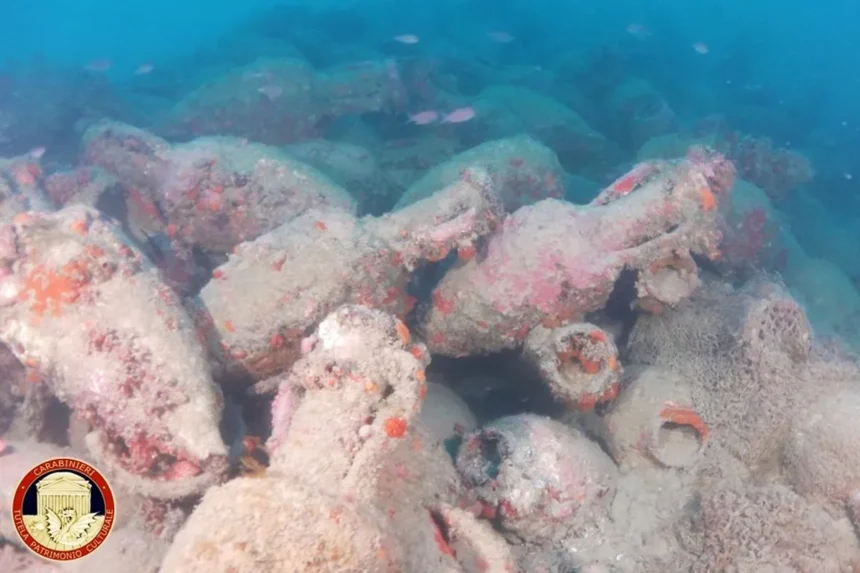
An ancient Roman shipwreck, estimated to be over 2,000 years old, has been discovered off the coast of Sicily. Italian authorities are hailing the find as one of the most significant underwater archaeological discoveries in recent memory. The vessel was located approximately 150 feet below the surface near Mazara del Vallo, a town on the western tip of the island.
Discovery Details
The discovery was made by specialist divers who were alerted to the potential find by local fishermen. Among the first to explore the wreck was free diver Giacomo De Mola. He described the vessel as being packed with hundreds of remarkably well-preserved ceramic jars, known as amphorae. These jars would have originally been used for the transport of goods such as wine, oil, and grain.
De Mola expressed his profound reaction to the find, stating on social media, “This is, without a doubt, the most incredible discovery of my life. It’s hard to describe what it feels like to be among the first humans, in nearly 20 centuries, to see that place again.” He further reflected on the sea’s capacity to reveal history, adding, “The sea never ceases to amaze us. This time we didn’t just find a wreck, we found a piece of our history.”
Historical Significance and Dating
Italy’s Ministry of Culture has officially dated the shipwreck to the 1st or 2nd century BC, placing it firmly within the Roman era. Minister of Culture Alessandro Giuli emphasized the importance of the discovery, calling it “one of the most important underwater archaeological discoveries of recent years.” He noted that the wreck offers a tangible connection to the past, stating, “The Mazara del Vallo wreck speaks to us of the people, the routes, and the exchanges that made the Mediterranean a crossroads of civilisations.” The ministry has committed to continued research to fully understand and preserve the vessel’s history for the community.
Ship and Cargo Description
According to reports from local media, the ship measured approximately 70 feet in length and 20 feet in width. The Ministry of Culture confirmed that the hull was filled with hundreds of slender amphorae, specifically identified as ‘Dressel 1A’ type, which were commonly used for transporting wine. Archaeologists who examined the find described its condition as “excellent.”
Following the initial discovery, the Superintendency of the Sea is set to undertake detailed documentation and study of the site. This process is crucial for establishing the archaeological context of the wreck and implementing necessary protective measures to ensure its long-term preservation.
Broader Context of Archaeological Finds
This significant Roman shipwreck discovery off Sicily comes at a time when unusual environmental conditions have led to the emergence of other historical artifacts in different parts of Europe. Notably, exceptionally low water levels in the Danube River, attributed to heatwaves and drought across the continent, have exposed previously submerged structures and objects.
Danube River Discoveries
In Bulgaria, archaeologists have been presented with a rare opportunity to study parts of the foundations of the ancient Constantine Bridge. The bridge, an impressive feat of Roman engineering, was revealed as the Danube’s waters receded.
Pavel Popov of the Regional Historical Museum in Pleven highlighted the value of such discoveries: “For archaeologists, these moments are extremely valuable because nature briefly reveals an object that is hidden beneath the Danube for most of the time. It gives us a rare opportunity to observe, document and study it in its real environment.”
The Constantine Bridge, commissioned by Emperor Constantine I and inaugurated in AD 328, was a monumental structure that connected the ancient Roman city of Ulpia Oescus with Sucidava, located in present-day Romania. Spanning over 2 kilometers, it was considered one of the longest bridges of antiquity. Historical records indicate that the bridge was largely destroyed around AD 367.
Recently, a team from the Pleven museum conducted aerial photography and documentation of the visible remains of the bridge’s foundations near the village of Gigen in northern Bulgaria. These concurrent discoveries underscore the rich, often hidden, history that can be brought to light by both deliberate exploration and changing environmental conditions.
Conclusion
The recovery of the ancient Roman shipwreck off Sicily represents a major advancement in our understanding of maritime trade and Roman life in the Mediterranean. Coupled with the recent revelations from the Danube River, these finds offer invaluable insights into the past, reminding us of the enduring legacy of ancient civilizations and the constant potential for new historical discoveries.