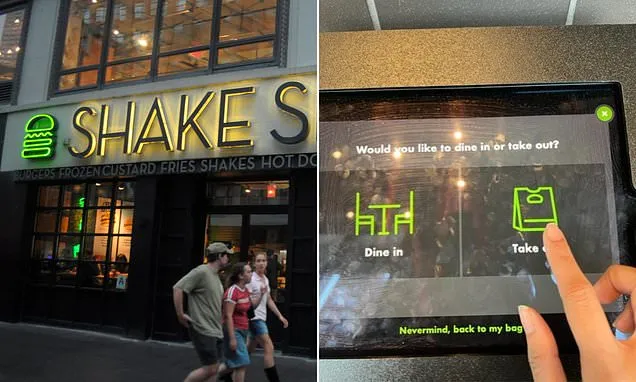
Shake Shack has addressed a viral video that appeared to show customers being charged more for their orders after declining to leave a tip. The fast-food chain clarified that the incident was due to a technological error, not a deliberate policy to penalize customers for not tipping.
The controversy gained traction after a TikTok user, identified as BD Powell, shared a video detailing an experience at a Shake Shack location within Salt Lake City International Airport. The footage depicted Powell’s order total increasing by $1.50 after he selected ‘no tip’ on the self-service kiosk. The video rapidly spread across social media, amassing millions of views and sparking widespread criticism.
In response to the viral video, Shake Shack spokesperson Corey Gee stated that the issue stemmed from an error within the kiosk technology at a restaurant owned and operated by their licensee, HMSHost. “It is not Shake Shack policy, nor that of our licensees, to increase the price of menu items when no tip is added,” Gee explained. “The pricing issue shared online occurred at an airport Shack that is owned and operated by our licensee HMSHost. HMSHost investigated the matter and determined it was an error within their kiosk technology unrelated to tipping.”
Gee further confirmed that the problem has since been resolved and that the company is committed to ensuring a positive customer experience.
Details of the Kiosk Incident
The user BD Powell documented the situation while attempting to purchase three Classic Shakes, each priced at $5.99. Upon proceeding to checkout and declining the tip option, Powell encountered an error message. The message read: “Uh Oh! There has been a pricing update on one or more of your cart items. Please review these changes in your cart.”
Upon reviewing his order, Powell observed that the price of each of the three milkshakes had increased by 50 cents, raising the total from $18.46 to $19.96 without any clear explanation provided by the kiosk.
Public Reaction and Social Media Uproar
The video quickly ignited a firestorm of reactions on social media platforms. Many users expressed frustration and disbelief, questioning the practice of tipping on self-service orders and criticizing the apparent attempt to inflate prices for customers who did not tip.
Even after Shake Shack’s official account commented on the post to offer an explanation, many users remained unconvinced. One widely shared comment read: “I’d probably tip the 1 cent to get my food while I’m there, and then never come back or go to another Shake Shack ever again. I’ll add that the company putting out PR and ‘fixing’ the problem won’t make me come back.” Another user stated, “You need to send a message, which in this case is a message to ALL other companies. Don’t EVER do this s*** because I’ll never come back even if you ‘fix’ the issue.”
The sentiment was echoed by others who questioned the necessity of tipping for orders placed at self-checkout kiosks. “Why are we even tipping on an order which you place yourself at a self-checkout? What am I missing?” one commenter asked.
Some suggested that the company should offer price reductions to compensate customers for the erroneous charges. “If they’re sorry, they’d cut prices to make up for the extra money they ‘accidentally’ stole,” proposed one individual.
Shake Shack’s Stance on Tipping and Pricing
Shake Shack’s official statement, as relayed by spokesperson Corey Gee, emphasized that the pricing anomaly was an isolated technical glitch. The company reiterated that it is not their policy, nor that of their licensees, to adjust menu prices based on a customer’s tipping decision.
The incident at the Salt Lake City airport location, which is managed by HMSHost, was investigated, and the kiosk technology was identified as the source of the error. HMSHost has since implemented a fix to prevent recurrence.
Broader Context: Tipping Culture and Customer Expectations
This recent event occurs against a backdrop of ongoing discussions and evolving customer expectations regarding tipping culture in the United States. The practice of tipping, traditionally applied to service staff, has expanded to various service points, including self-checkout stations and counter service, leading to confusion and debate.
Shake Shack has previously faced scrutiny related to customer service and pricing. In another instance, an open letter shared online detailed a customer’s dissatisfaction with their experience at a New York City location. The letter criticized the chain for what the customer perceived as high prices and an overreliance on tipping to cover staff wages, suggesting that the focus should instead be on delivering exceptional service and value within the stated menu prices.
Similar to the reactions seen in the recent tipping kiosk controversy, the customer in the open letter indicated a potential loss of business due to their negative experience. These incidents highlight the sensitivity surrounding pricing, service, and the evolving norms of tipping in the fast-casual dining sector.
Conclusion
Shake Shack has clarified that the increased charges experienced by customers who declined to tip at a Salt Lake City airport location were the result of a kiosk technology error, not a company policy. The issue has been resolved, and the company has reassured customers that such practices are not in line with their operational standards. The incident underscores the complexities of modern tipping culture and the importance of transparent pricing and reliable technology in customer interactions.