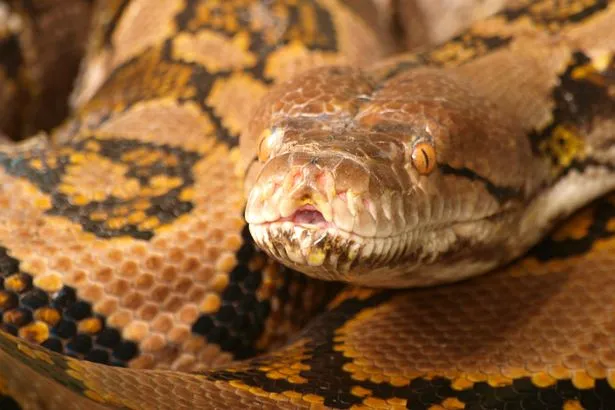
A rubber plantation worker in Indonesia’s Jambi province was tragically killed and swallowed whole by a 16-foot python as she was on her way to work. The victim, identified as Jahrah, a woman in her early 50s, disappeared on a Sunday morning in 2022. Her absence prompted a search by villagers when she failed to return home.
Discovery of the Serpent and the Victim
The search party’s grim discovery began when they encountered a large python exhibiting a noticeably distended stomach. This alarming sight led locals to suspect the snake might be involved in Jahrah’s disappearance. The villagers subsequently killed the reptile and, upon cutting open its belly, made the horrifying discovery of Jahrah’s body inside.
Betara Jambi police chief AKP S Harefa confirmed the finding, stating that the victim’s body was largely intact within the snake’s stomach. The initial alarm was raised by Jahrah’s husband, who had found some of her work clothes and tools on the evening she went missing, prompting him to organize the search party.
The 16-foot python was reportedly seen on the Monday following Jahrah’s disappearance. Villagers managed to trap the snake, hoping it would lead them to her. “After they cut the belly apart, they found it was Jahrah inside,” Mr. Harefa recounted.
Python Predation and Similar Incidents
Nia Kurniawan, an expert from Brawijaya University, commented on the python’s capabilities, explaining that a snake of this size would typically prey on large animals and primates. Pythons of this species are known to reach considerable lengths, sometimes up to 32 feet. In some regions of Indonesia and Southeast Asia, these large snakes are regarded with a degree of reverence.
This incident echoes a similarly tragic event that occurred in Indonesia in 2018. In that case, the body of a mother of two, Wa Tiba, was found inside a colossal 23-foot-long python. Her remains were discovered covered in slime after the snake’s swollen body was cut open.
Wa Tiba, aged 54, had gone missing after heading out to tend to her garden. Her family raised concerns when she did not return. Her sons eventually made the horrifying discovery of the python, which was barely able to move due to its enormous, swollen belly, located just a few meters from a patch of bushes where her sandals were found.
The position of Wa Tiba’s body within the snake – her head near the tail and feet towards the mouth – suggested she had been consumed headfirst. An eyewitness, Ayu Kartika, described the scene and the community’s reaction: “Everyone was crying, everybody was shocked. The poor woman. This is like a horror movie. People are terrified. We are scared to go outside. We can only pray for safety.”
Understanding Python Behavior
Large constrictor snakes like pythons are ambush predators. They typically kill their prey by constriction, coiling their powerful bodies around the animal until it suffocates. Once the prey is dead, the snake unhinges its jaws and swallows the animal whole, a process that can take several hours. The snake’s digestive system is remarkably efficient, capable of breaking down bone and other hard tissues.
While attacks on humans are extremely rare, they are more likely to occur when the snake feels threatened, is defending itself, or, in very rare instances, mistakes a human for its natural prey. The size of the python is a critical factor; only the largest species are capable of consuming a human. Factors such as the environment, the snake’s hunger, and the human’s proximity and vulnerability can all play a role in such unfortunate encounters.
In the case of Jahrah, her routine walk to work along a path likely frequented by wildlife in a rural area may have put her in the path of the large python. The snake, possibly seeking a substantial meal, may have perceived her as prey or acted defensively. The discovery of her belongings by her husband was a crucial step in initiating the search that ultimately led to the tragic confirmation of her fate.
Community Response and Safety Concerns
The incidents have understandably caused significant fear and distress within the affected communities. The sheer power and predatory nature of these large reptiles can be deeply unsettling. Local authorities and wildlife experts often work to educate residents about snake behavior and safety precautions, particularly in areas where large pythons are known to inhabit.
Recommendations for living in such environments include being aware of surroundings, especially when walking in vegetated areas or near potential snake habitats, making noise to alert animals of your presence, and avoiding encounters with snakes by giving them a wide berth. In cases where a snake is perceived as a threat to human safety or livestock, professional wildlife removal services or trained local authorities are typically involved.
The tragic deaths of Jahrah and Wa Tiba serve as stark reminders of the powerful forces of nature and the importance of respecting wildlife habitats. While such events are exceptionally rare, they highlight the potential dangers that can arise when humans and large predators share the same environment.