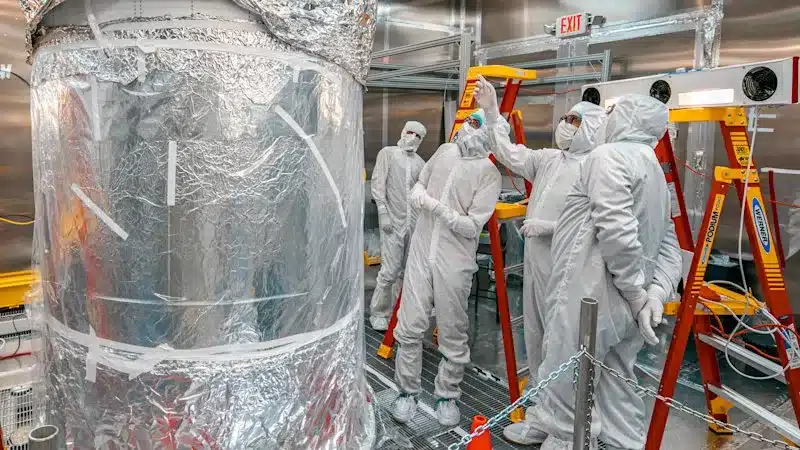
The universe’s most profound enigma, dark matter, which constitutes approximately 85 percent of all mass, may have just shown a glimmer of itself in an unexpected place: the depths of an abandoned gold mine. Physicists are buzzing with cautious optimism following the detection of a faint light signal within a highly sensitive experiment designed to hunt for this elusive substance. While the data is preliminary and requires further analysis, this anomaly could represent the first direct evidence of dark matter.
The Pervasive Puzzle of Dark Matter
Dark matter remains one of science’s greatest unsolved mysteries. Despite its overwhelming presence, it cannot be seen or directly measured, and its fundamental composition is unknown. Yet, the observed structure of galaxies, the large-scale organization of the cosmos, and even the conditions necessary for our existence are only comprehensible if the universe is permeated by an invisible, unknown form of matter that provides a crucial gravitational scaffolding.
Early Clues: Zwicky and Rubin
The concept of dark matter originated in the 1930s with astronomer Fritz Zwicky. While studying the Coma galaxy cluster, Zwicky observed that galaxies were moving at speeds so high they should have dispersed. He calculated that the cluster must possess significantly more mass—around 400 times what was visible—to generate the gravitational pull needed to hold it together. He posited the existence of unseen matter, a notion initially met with skepticism.
Decades later, in the 1970s, astronomer Vera Rubin provided further compelling evidence. Her research on spiral galaxies revealed that stars on their outer edges orbited at nearly the same speed as those closer to the center. This contradicted expectations, as stars farther out should move slower according to the visible matter’s gravity. Rubin concluded that an unseen mass, dark matter, must be exerting gravitational influence, famously stating, “What you see in a spiral galaxy is not what you get.” Modern astronomical observations, such as gravitational lensing, also show light bending around massive, invisible regions, further supporting the presence of dark matter.
The LUX-ZEPLIN Experiment: A Deep Underground Search
Detecting dark matter requires moving beyond telescopic observations and venturing into highly controlled environments deep within the Earth. The LUX-ZEPLIN (LZ) experiment, a collaborative effort involving about 250 scientists and engineers, is at the forefront of this search. Dr. Theresa Fruth from the University of Sydney played a key role in its design and construction.
Inside the Detector
The LZ detector is essentially a large vessel filled with ultra-pure liquid xenon, cooled to approximately -100 degrees Celsius. Xenon, a noble gas, is chosen for its density in liquid form and its lack of long-lived radioactive isotopes, ensuring a remarkably quiet and clean environment. This purity is critical to distinguish a potential dark matter signal from background radiation.
The liquid xenon is housed in tanks made of medical-grade titanium and Teflon, further shielded by over 250,000 liters of water. This entire apparatus is situated 1.5 kilometers underground in an abandoned gold mine in South Dakota. This extreme depth shields the detector from cosmic rays and other background radiation that constantly bombard the Earth’s surface, creating an exceptionally stable and isolated setting.
The Search for WIMPs
The LZ experiment is specifically designed to detect Weakly Interacting Massive Particles (WIMPs), a leading theoretical candidate for dark matter. WIMPs are hypothesized to be subatomic particles, significantly heavier than protons, that interact very weakly with ordinary matter, passing through it almost unnoticed, much like ghosts. The theory suggests that if a WIMP were to collide with the nucleus of a xenon atom within the LZ detector, it would produce a minuscule flash of light.
A sophisticated array of 500 photomultiplier tubes is employed to detect these faint light signals. Scientists meticulously analyze the data, scrutinizing each flash to rule out explanations involving known background radiation sources, such as radioactivity from the detector materials themselves or other stray particles.
A Glimmer of Hope
Recently, the LZ team reported observing a light flash that, thus far, cannot be attributed to any known background signal. This unexplained event has generated considerable excitement, tempered by scientific caution. “We don’t really know what to do with that, because we’re so used to not seeing anything,” Dr. Fruth commented. “The moment you see something and you don’t quite know yet what it is, it’s very exciting, but also a little bit scary.”
Statistical Significance and Next Steps
The observed signal currently stands at a statistical significance of 2.6 sigma. In particle physics, a discovery typically requires a 5-sigma level of confidence, meaning there is less than a one-in-a-million chance the signal is a statistical fluctuation. The 2.6-sigma level indicates a roughly 0.5 percent probability that the flash could be explained by known background phenomena rather than a WIMP.
To address this, the LZ scientists are making their data publicly available for the broader scientific community to analyze and scrutinize. This collaborative approach is crucial for validating the finding and exploring potential explanations. The LZ team will continue collecting data, hoping that further events will emerge to either strengthen the statistical significance of the current signal or provide new insights.
Broader Implications and Future Research
The potential detection of dark matter, even at this early stage, could mark a pivotal moment in scientific history. Understanding dark matter’s nature would revolutionize cosmology and particle physics, offering profound insights into the fundamental workings of the universe.
Dr. Fruth is also involved with another dark matter detector located in a gold mine in Stawell, Victoria, Australia, which utilizes ultrapure crystals instead of liquid xenon. This parallel research highlights the global, multi-faceted effort to unravel the dark matter mystery. The implications of unlocking dark matter’s secrets extend beyond its own identity, potentially opening doors to understanding other fundamental aspects of reality that remain beyond our current grasp.