Storm alert systems in the Canadian Prairies are facing scrutiny after some Manitoba residents received tornado warnings for events occurring hundreds of kilometers away in Saskatchewan. The incident has raised concerns about the precision of these alerts and the potential for “warning fatigue” among the public.
Confusing Tornado Warning Issued
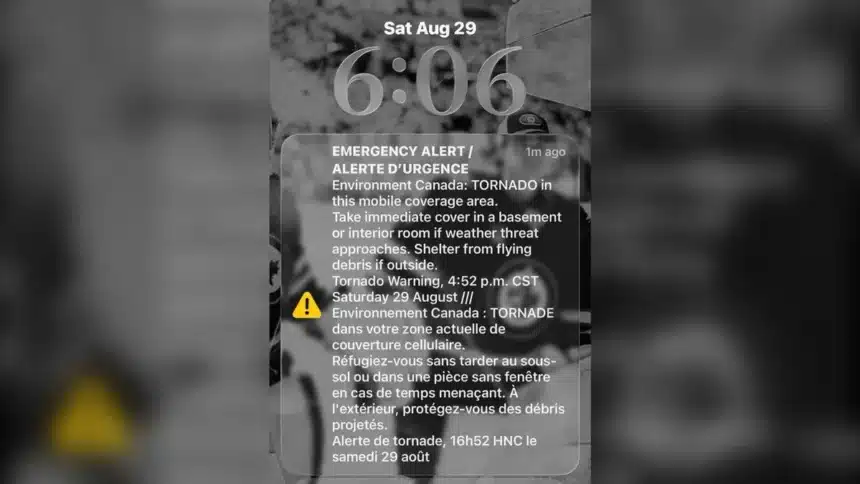
On August 29th, Victoria Espey, a resident of Onanole, Manitoba, was at her family cabin when her phone issued a severe weather alert. The notification, received shortly after 6 p.m., indicated a tornado within her “mobile coverage area,” specifically near Riding Mountain National Park. However, Espey noted that the weather at her location was pleasant, prompting confusion about the alert’s validity.
“It said that a tornado had touched down in the cell service area, and I was the only one who got it,” Espey recounted. “I thought ‘that was weird’, because it was pretty nice outside.”
Expert Analysis of the Alert
Seeking clarity, Espey contacted Justin Oertel, owner of The Weather Centre of Manitoba, a service that provides online weather updates. Oertel investigated the alert and determined it was issued for an area south of Melville, Saskatchewan. This location is approximately 250 kilometers away from Espey’s cabin, raising significant questions about the alert’s geographic targeting.
“A warning should mean there’s imminent or occurring severe weather, like where you are standing right now,” Oertel explained. “Otherwise, the warning is going to fall on those deaf ears, and it’s not going to get to the people that really need it.”
Targeted Alerts and Communication Challenges
Environment and Climate Change Canada (ECCC) stated that its meteorologists are employing new, more targeted warning systems designed to alert individuals within very specific geographic zones experiencing severe thunderstorms or tornadoes. These alerts are then transmitted to Pelmorex, a company that manages a system enabling government agencies to issue such localized warnings, according to director Kurt Eby.
Eby elaborated on the technical challenges, particularly in rural areas. “Sometimes you’ll have in rural areas where communications towers serve a much broader distribution, because there’s not as many. In a city, you have two antennas in basically every city block. Out in the country, you can see them, they’re much more spread out,” he said. This wider reach of cellular signals in less populated regions can contribute to alerts being sent to individuals far from the actual weather event.
The Risk of Warning Fatigue
Craig Boehm, a storm chaser from Saskatchewan, highlighted the potential negative consequences of such inaccuracies. He suggested that frequent, non-threatening alerts can lead to “warning fatigue,” where people become desensitized to genuine emergencies.
“For everyone else, for a regular day person, they would be getting all these warnings, seeing a storm cloud coming and going and saying, ‘Is this a tornado?’” Boehm stated. “When in reality, in that line of storms, that warning was 30, 40, 50, 60 kilometres south or north of them and really no chance of hitting them.” This can erode public trust and reduce the effectiveness of critical safety notifications when they are most needed.
Commitment to Improvement
As the current storm season begins to wind down, Environment Canada has indicated its commitment to refining its alert services. The agency plans to implement further improvements over the coming year to ensure that Canadians receive the most accurate and timely weather information possible, especially during severe weather events.
The incident involving Victoria Espey serves as a reminder of the ongoing efforts required to balance broad public safety with the need for precise, localized warnings. The goal is to ensure that when a severe weather alert is issued, it is relevant and actionable for the recipients, thereby maximizing its protective value.