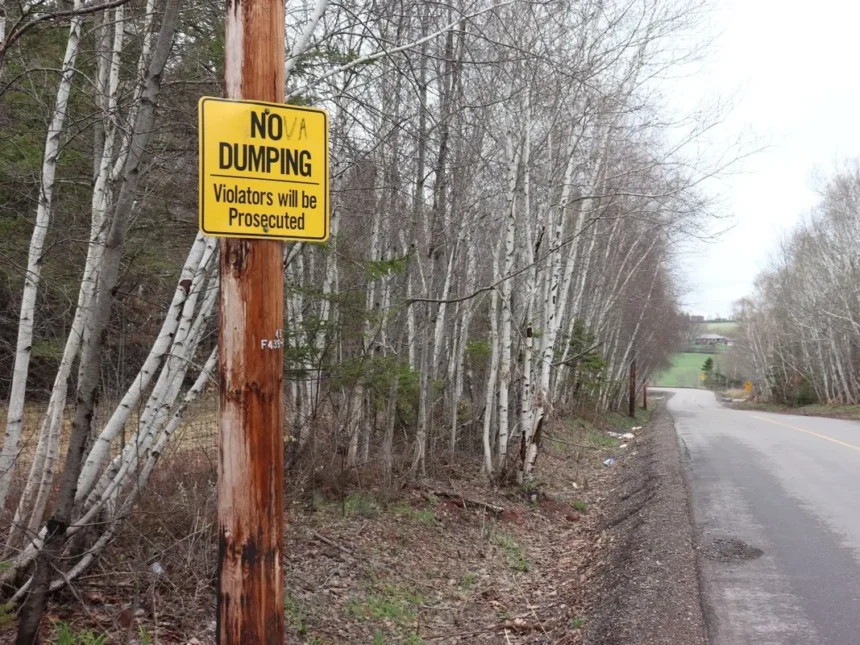
Illegal garbage dumping is an escalating problem across Canada, prompting calls for more robust enforcement and significantly higher penalties. While individuals and community groups often take the initiative to clean up the mess, official responses have historically been limited, particularly at the provincial level. However, Alberta is signaling a potential shift, with Premier Danielle Smith indicating that the province is considering a crackdown on perpetrators of illegal dumping, including increased fines and jail time.
Alberta’s Proposed Crackdown on Illegal Dumping
During a recent press conference, Premier Smith responded to questions about the province’s strategy for combating illegal dumping. She acknowledged the need for action, stating, “We need to do something in the fall.” The government is currently exploring measures that could include a provincewide fine of up to $10,000 and a potential two-year jail sentence for offenders. These proposed penalties represent a substantial increase from the current maximum fines under Alberta’s environmental protection law, which stand at $250 for individuals and $1,000 for corporations.
Smith also mentioned that public consultations are underway to gauge opinions on the proposed penalties, indicating a willingness to adjust them if deemed too severe. She recalled the “do-not-litter” campaigns of the 1970s and expressed a personal commitment to picking up litter when encountered. The possibility of launching a new public awareness campaign to deter littering was also raised.
The Need for Stronger Deterrents
Despite the encouraging remarks from Alberta’s leadership, some argue that the proposed $10,000 fine may still fall short of effectively deterring illegal dumping, especially when compared to jurisdictions with similar or even higher maximum penalties. Evidence from various regions suggests that current fines are often insufficient to offset the costs and risks associated with illegal disposal.
For instance, in Rocky View County, which surrounds Calgary, a municipal bylaw imposes fines of up to $10,000 for dumping. Yet, even with this ceiling, a recent incident saw individuals in a work truck dumping wood chip waste onto private property. When questioned about the outcome, a county spokesperson declined to comment on specific cases, highlighting another challenge: the lack of transparency and public accountability for offenders.
The Anonymity Problem
A critical issue in addressing illegal dumping is the anonymity often afforded to perpetrators. The author suggests that provincial laws should mandate the public disclosure of allegations against individuals and companies involved in illegal dumping. This transparency would empower consumers and businesses to make informed decisions, for example, when hiring disposal or landscaping services, by knowing if a company has a history of illicit waste disposal.
Environmental and Economic Impacts of Dumping
The consequences of illegal dumping extend far beyond mere aesthetics. It poses significant threats to wildlife, can contaminate waterways and groundwater, and imposes substantial cleanup costs on landowners and municipalities. The normalization of such practices is seen as a step backward for environmental stewardship and respect for private property and natural spaces.
The economic toll is considerable. In Rocky View County alone, illegal dumping costs an estimated $500,000 annually, with projections indicating this figure could double to $1,000,000 by 2030. This trend is mirrored nationwide:
- Montreal: Reported illegal dumping incidents nearly doubled between 2016 and 2023, rising from 16,306 to 28,441.
- Vancouver: With a maximum fine of $10,000, the city recorded approximately 22,000 dumping reports in 2024, a number similar to 2018 levels, indicating a lack of significant improvement.
- Mississauga: Despite having a higher maximum fine of $100,000, the city saw reports of illegal dumping roughly double between 2015-2017 (around 500 reports) and last year (580 reports).
- Markham: Dumping incidents in the Rouge National Urban Park reached record highs in 2024.
Strengthening Enforcement and Penalties
The ease with which dumpers can avoid detection, particularly in rural and remote areas, contributes to the problem. Landowners and local residents cannot constantly monitor vast tracts of land or extensive road networks. Dumpers exploit this by avoiding disposal fees, making illegal dumping a potentially cost-saving, albeit illegal, business practice.
To effectively combat this, fines must be substantial enough to significantly impact offenders’ finances, rendering illegal dumping an unviable business model. The penalties should be burdensome for individuals and reflect a strong societal condemnation of environmental disregard. The author suggests that fines for corporate offenders should reach hundreds of thousands or even millions of dollars, comparable to penalties imposed on industries like oil for environmental breaches. For individuals, fines in the tens of thousands are proposed, aligning with penalties for other environmental law violations.
Revisiting Alberta’s Environmental Protection Act
Alberta’s Environmental Protection and Enhancement Act currently categorizes offenses into three tiers. The highest tier allows for maximum fines of $1,000,000 for corporations and $100,000 for individuals. The second tier caps fines at $500,000 for corporations and $50,000 for individuals. However, the third tier, which specifically covers garbage dumping, has much lower maximums: $1,000 for corporations and $250 for individuals.
There is a clear opportunity for Alberta to amend this legislation, reclassifying illegal dumping as a more serious offense. By adjusting the fine structure and potentially increasing penalties within the existing tiers or creating a new, more severe category for dumping, Alberta could establish a robust framework that serves as a model for other provinces seeking to tackle this pervasive issue.
Conclusion
The growing problem of illegal dumping necessitates a firm and decisive response. While community efforts are commendable, systemic change requires stronger government action. Alberta’s proposed increase in fines and potential jail time, coupled with public consultations, represents a significant step. However, ensuring that penalties are truly deterrent, that offenders are held publicly accountable, and that the environmental and economic costs are adequately addressed will be crucial for effectively curbing illegal dumping across the province and the nation.