[ad_1]
Key Takeaways
- A financial community’s success depends on the dimensions and quantity of its lively consumer base.
- The previous lead of Fb’s Libra undertaking, David Marcus, is the previous President of PayPal. PayPal’s founding mission, and subsequent T-shirt motto, was to create “A New World Forex.”
- Marcus constructed Fb’s stablecoin undertaking after concluding that Bitcoin lacked the qualities to be a profitable medium of change.
- With a view to seem decentralized, Libra fashioned the Libra Affiliation, however included many very inter-connected companies and folks, as famous elsewhere in The Chain sequence.
- Authorities regulators, fearing Fb’s immense lively consumer base, shortly referred to as the Libra group to testify earlier than Congress, and ultimately pressed the undertaking to fold earlier than launching.
- Libra had beforehand said of their S-1 filings that regulatory stress and uncertainty may lead the undertaking to by no means launch. Different proof suggests all the purpose of Libra was to good the public-private partnership for the long run implementation of the U.S. authorities’s most well-liked digital foreign money undertaking.
- Jared Kushner despatched an e-mail to Steve Mnuchin in Could 2019 relating to a Sam Altman publish on stablecoins titled “US Digital Forex.”
- Mnuchin’s Treasury then held a March 2020 assembly after inviting many figures talked about in The Chain sequence, together with Wences Casares and Peter Thiel.
- Libra introduced partnerships with Fireblocks, Silvergate Financial institution, and Paxos to be able to expedite their stablecoin undertaking, however none materialized.
- After being shutdown by regulators, Libra bought off its property to Silvergate Financial institution in January 2022.
- Silvergate facilitated Bitcoin-collateralized loans with MicroStrategy and Marathon Digital, and had been partially owned by Block.One, BlackRock, State Avenue and Citadel Securites.
- Silvergate Financial institution, whose SEN product serviced a considerable quantity of corporations talked about in The Chain sequence, was then liquidated by regulators in March 2023.
- Silicon Valley Financial institution (SVB), which failed two days after Silvergate, banked a major quantity of the businesses and enterprise capital within the cryptocurrency business.
- The day earlier than the SVB collapse, Peter Thiel’s Founders Fund pulled out funds, and suggested purchasers to do the identical, triggering deposit flight.
- 10 prospects alone had $13 billion in deposits at SVB, and $42 billion left the financial institution in 6 hours. In different phrases, SVB collapsed because of an acute liquidity disaster that was spawned by only a few folks.
- The Trump administration’s deregulation of the banking business in 2018 loosened capital and reporting necessities, resulting in lots of the points seen within the banking disaster in 2023.
- Circle’s USDC stablecoin, which had $3.3 billion of reserves at SVB, would “depeg” to 86 cents through the disaster.
- Six months after the banking disaster, and two weeks after the U.S. Home Monetary Companies committee superior their first stablecoin invoice, Paxos and PayPal launched PYUSD.
- The Gillibrand-Lummis Stablecoin Invoice was straight influenced by the Terra-LUNA collapse, which resembles extra of a managed demolition than an natural collapse. Consequently, the invoice bans algorithmic options in pursuit of preserving the twin banking system. Each Senator Gillibrand and Senator Lummis have important donor ties to lots of the corporations talked about in The Chain sequence.
- Giant lobbying teams, corresponding to Coin Heart and the Digital Chamber of Commerce, had been fashioned to assist information laws because it pertains to stablecoins and digital property. Each of those lobbying teams have advisory ties to stablecoin issuers and plenty of corporations and folks talked about to date in The Chain sequence.
- A number of events talked about on this piece, from the Libra group to lobbyists, have echoed the sentiment that USD stablecoins might help retain the U.S. greenback because the world’s reserve foreign money.
- Lots of the firms fashioned after the dissolving of Libra keep on the work of constructing a brand new monetary system based mostly on stablecoins and public blockchains.
- In keeping with nationwide safety state members, Bitcoin and stablecoins can present a “boon for surveillance” along with serving to develop the financial system.
- The Bitcoin-Greenback system, as described in The Chain sequence, is the actualization of PayPal’s founding intention to create a “new world foreign money”, and it was fastidiously constructed to seem as an natural phenomenon when it isn’t.
The preliminary trio of items in The Chain sequence have targeted on the three important pillars for creating a brand new digital financial system. The primary, The Chain of Custody, examined the development of novel custodial infrastructure to allow the safe holding of billions of {dollars} value of digital property after the proliferation of Bitcoin as a brand new monetary class. The second, The Chain of Issuance, investigated the primordial roots of digital funds fortifying knowledge brokers and knowledge bankers inside the international surveillance community. It additionally famous how stablecoin issuers are the trendy day analogue to the affect that the foremost infrastructural titans of the Industrial Age had on the formation of The Federal Reserve within the first half of the 20th century. The third, The Chain of Consensus, targeted on the foreign money speculators and intelligence-connected builders behind the financial coverage and consensus infrastructure of privately-issued cash and the blockchain revolution through the infancy of the Deflationary Age caused by Bitcoin and the next, dollarized iterations of its underlying database expertise.
In abstract, a brand new monetary system can’t be constructed with out the flexibility to custody property, subject new property, and uphold the settlement and financial coverage of mentioned property by way of a governing consensus. But, even with the profitable formation of this vital trifecta, the development of a financial community is just fruitless with out the acquisition of the final remaining pillar: a community of lively customers. This idea is effectively understood by each the personal sector firms which were talked about all through this sequence, along with the general public sector that at present acts because the enabling atmosphere for the foundations and laws of nation-state financial techniques upheld by central banks internationally. None of those public issuers of cash, nevertheless, have the worldwide impression of the U.S. Federal Reserve and the U.S. Treasury system, which offers immense privileges that come downstream from their issuance of the notes and reserves backing the world reserve foreign money, the U.S. greenback. With 66 international locations worldwide itemizing the greenback as an official foreign money, the huge variety of customers using these devices makes the greenback system the biggest monetary community on the planet.
Even inside this monopoly, there’s a fractured set of settlement networks, corresponding to PayPal, and personal banks, corresponding to J.P. Morgan, issuing mentioned {dollars} in customers’ checking accounts. This balkanization presents a novel alternative for additional consolidation and, with that consolidation, the flexibility to accumulate much more customers. For instance, PayPal acquired thousands and thousands of worldwide customers by way of their purchases of Venmo and Xoom, whereas J.P. Morgan assumed the deposits of the failed First Republic Financial institution after the onset of the regional banking disaster in 2023.
Cash itself is however a expertise that allows agreeable and predictable outcomes between two bartering events. This axiom requires cash that concurrently acts as a unit of account, a retailer of worth, and a medium of change. Whereas all of those properties may be met by a large number of at present circulating currencies – and even commodities – their usefulness for settlement throughout each time and house is decided practically completely by the variety of customers inside their respective networks. The greenback system is essentially the most liquid financial community on the planet, and has held this place for practically a century. Traditionally, the world’s reserve foreign money has held its dominant standing for roughly this similar period of time. With U.S. debt ranges now rising at uncontrollable and exponential charges, the formation of proposed options to the greenback’s monopoly are popping up throughout the globe. The world financial system is a finite pie consisting of finite customers, and with the greenback community showing actually weak for the primary time in a long time, opponents are posturing for a bit. Nevertheless, with the worldwide broadband web dissolving among the management that nation states have over their very own residents’ financial decisions, the world is definitely dollarizing quicker than ever.
Because the web age enters its third decade, the stakes for creating the web of cash have by no means been larger. For now, the proliferation of dollarized blockchains seemingly goals to fortify the greenback’s maintain over international finance, not dissolve it. Whatever the greenback’s domination of denomination, the upstart issuers of those tokenized property have hemorrhaged away sufficient customers that it now threatens lots of the privileges the legacy system as soon as loved, primarily the accessible earnings discovered by promoting their knowledge and leveraging their deposits.
The understanding that social networks are communication platforms, and that cash itself is only a ledger upholding the communicative expression between customers, led the social media big Fb to experiment with including monetary devices to their vastly well-liked Messenger app. Whereas Bitcoin and options had been round for practically a decade earlier than Fb’s Libra was proposed, this was “the shot heard ’around the world” for central bankers and regulators to sit up and take a novel funds system proposed by the world’s largest social community critically.
But, as Fb quickly came upon, when you come on the king, you greatest not miss. Or at the very least this was the story that was advised to the world: The U.S. regulatory system mentioned “No” and that was that. Nevertheless, this concluding piece to The Chain sequence, The Chain of Command, postulates that Libra was by no means supposed to truly go to market as designed, however slightly was meant to set the stage for clear regulation by way of laws that will develop into the enabling atmosphere for a decades-long try at creating a brand new world foreign money by the exact same events lined to date on this sequence.
Libra, Diem and Fb’s Stablecoin
Sitting on a Caribbean seaside through the winter of 2017, David Marcus was struck with the concept of making a worldwide digital foreign money to run on Fb’s Messenger. Marcus, who had bought his cell fee supplier Zong to PayPal for $240 million in 2011, and who had been launched to Bitcoin in 2009, was actually no spring rooster to the quickly evolving FinTech and digital funds house. Inside 9 month of Zong’s acquisition by PayPal, Marcus was named PayPal’s president in April 2012. Then, in June 2014, Marcus was recruited by Fb’s Mark Zuckerberg to run their Messenger app. By the point the concept would develop into Libra started to germinate throughout his 2017 trip within the Dominican Republic, the social community’s messenger app boasted over 1.3 billion lively customers.
Previous to his expertise with PayPal and Fb, Marcus had based GTN Telecom, famous as being the “first to interrupt Switzerland’s telecommunications monopoly” in 1996. GTN Telecom was backed by the UK’s 3i, a enterprise capital agency based in 1945 by the Financial institution of England and “a syndicate of British banks,” and was later bought in 2000 to WorldCom’s World Entry simply two years earlier than WorldCom would file for Chapter 11 chapter after extreme accounting fraud. Marcus went on to discovered Echovox, a “cell monetization firm targeted on monetizing internet and conventional media audiences” by way of “transaction-enabled cell providers,” shortly after the October 2000 sale of GTN. Zong was later spun off from Echovox. Bertrand Perez and Kurt Hemecker, two executives at Zong, would develop into a part of the founding group at Libra alongside Marcus.
“In late 2009 once I first stumbled upon Bitcoin and browse the white paper, I attempted to play with it, nevertheless it was so cumbersome even for a geek like me. I simply couldn’t get it. So I sort of put it apart, brushed it apart, after which got here again to it in 2012 when a superb good friend of mine who’s sometimes called a Affected person Zero in Silicon Valley for Bitcoin, [Xapo’s] Wences Casares, principally began telling me extra about it and telling me ‘you must truly spend time and perceive this factor.’ And so I did. After which I simply couldn’t cease interested by it. I simply couldn’t cease interested by this concept that you might truly be your individual self-sovereign for digital worth and you might transfer it round with none middleman in between…
Then in 2013 at PayPal, that’s after Zong bought acquired by PayPal and I used to be operating it, I do not forget that Argentina requested us to truly cease the move of cash going in a foreign country from PayPal accounts positioned in Argentina. And I bear in mind us having to conform as a result of we had been regulated entity, and seeing the value of Bitcoin rise the identical day. And it was actually clear that loads of Argentines on the time had been truly shifting their funds into Bitcoin in order that they might have management over their hard-earned cash.”
David Marcus, The Block, June 27, 2023
In keeping with reporting from Monetary Instances, Marcus, a detailed confidant of Zuckerberg, apparently “texted Zuckerberg to stipulate his ruminations” and after efficiently convincing Fb’s CEO, he was given a “blessing to discover the concept additional.” Marcus shortly outlined his concept in an inner memo, highlighting that “Fb’s greater than two-billion-strong consumer base” empowered with crypto “might provide a handy and low-cost option to transfer cash world wide,” along with offering “a treasure trove of information about what folks spend their cash on.”
For the social community, the “doable multi-billion-dollar business alternatives had been clear,” together with “consumer transaction knowledge,” “extra engagement,” “extra e-commerce,” and “a slice of charges from transactions.” In keeping with an unnamed regulatory official, this “was at all times their benefit.” Libra would “create large alternative and some huge cash for them. But when Fb was going to be the rationale it was very profitable, they had been additionally going to be the rationale it will fail.”
Throughout the months proper after Libra’s announcement, Marcus up to date his ideas on Bitcoin, stating “For me, now, it’s clearer that Bitcoin serves a objective of being digital gold, not a superb medium of change.” It was this axiom that led Marcus to specific that “this was the fitting time for us to begin interested by how we might tackle the very issues that blockchain and cryptocurrency had been meant to do” and that “we had actual options to convey to the fore.” Marcus later defined his motivations for bringing publicly-issued cash by way of tokenized {dollars} to the Libra experiment in an August 2023 dialog with Bankless:
“I don’t suppose that I’m within the camp of people that wish to absolutely separate cash from State. I really feel like my very own private goal is to truly make the underlying rails actually environment friendly, actually open, actually interoperable, and allow extra folks to have entry to them. I feel that the world the place truly good governments can not management their very own financial coverage, and many others., this world the place it doesn’t exist, could be chaos.”
It’s maybe this affinity for State-controlled financial coverage that led Marcus to announce Libra to the world inside the confines of The Previous San Francisco Mint in June 2019. Nevertheless, the undertaking itself was began each in earnest and in secrecy by Fb in early 2018, when Morgan Beller, a former companion of Andreessen Horowitz, joined Marcus in plotting to convey each funds and a novel foreign money development to Fb’s Messenger product. In keeping with reporting from the Monetary Instances, the pair first labored “in a small, empty room” with “partitions adorned with whiteboards” inside “Fb’s principal campus in Menlo Park.” Shortly after, the duo “moved to a bigger, extra secluded constructing” positioned “on the outskirts of the corporate’s headquarters” that restricted entry to “solely workers with specific passes” consisting of “the crypto specialists, engineers and economists.” The undertaking was codenamed Libra, and Beller was quoted as saying that the group was “paranoid about leaks” and operated “like a secret Swat operation.”

Along with Beller, Marcus was shortly joined by Christian Catalini, a analysis scientist at MIT who had based the MIT Cryptoeconomics Lab. Whereas there, Catalini designed the MIT Digital Forex Analysis Research, which “gave entry to Bitcoin to all MIT undergraduate college students.” In 2013, Catalini turned a member of the Expertise Advisory Committee of The Commodity Futures Buying and selling Fee (CFTC) alongside his advisory board appointments to Coinbase, Algorand, Chainlink and Hivemind Capital. Catalini turned important to the event of Libra, and is famous as being a co-creator of Libra and Chief Economist of the Diem Affiliation after Libra rebranded to Diem, along with his title of Head Economist at Meta FinTech.
Catalini, alongside Jai Massari – a companion within the Monetary Establishments Group of Davis Polk & Wardwell LLP and an outdoor counsel to Diem – wrote a bit titled “Stablecoins and the Way forward for Cash” which proposes that “by a smart regulatory strategy, true stablecoins can fulfill their promise with out introducing new dangers.” Their idea on the following evolution of cash, which was demonstrated all through the multitude of iterations of Libra, is excerpted under:
“Trendy cash is a mixture of private and non-private cash. Public cash contains central banks-issued money and digital claims in opposition to central banks. Non-public cash contains deposit claims in opposition to business banks. Whereas the general public sector protects the steadiness of cash, as much as 95% of cash in developed economies is personal. Stablecoins are a type of personal cash. This isn’t a brand new idea — the concept of separating financial and credit score features traces again 80 years. By reducing the price of digital verification, blockchain expertise can broaden the function of each the private and non-private sector within the provision of cash. Whereas the general public sector might try to attach with shoppers and companies straight, the personal sector is prone to be extra environment friendly in assembly the general public’s wants and growing selection.
Succeeding on this transformation would require the fitting stability between the private and non-private sectors. International locations that overemphasize the general public strategy will doubtless find yourself falling brief in velocity to market, competitors, and innovation…The general public sector may battle with serving residents and companies successfully. Given the extremely excessive bar by way of resilience and safety, it would doubtless take years for a CBDC to be developed and adopted…That is the place CBDCs and stablecoins are robust enhances, not substitutes. The general public sector might deal with issuing digital cash and delivering on sound cash, whereas the personal sector might construct rails and purposes. Competitors with legacy networks would additional guarantee the next diploma of resilience and innovation…
The query for central banks and regulators then turns into which mixture of the three approaches [“true” stablecoins, deposit coins, and CBDCs] also can enhance competitors, decrease price, and improve entry to the monetary system…A a lot stronger mixture could be the general public sector specializing in regulation of stablecoins first, after which on CBDC issuance on a number of rails later to enhance potential shortcomings…Public sector steering and normal setting may be extremely helpful in selling the fitting options in these areas…Within the case of cash, the private and non-private sectors can play to their relative strengths, solidify their public-private partnership, and enhance societal outcomes within the course of.”
Catalini, Massari, and Marcus would all go on to type LightSpark – an institutional funds firm targeted on Bitcoin and the Lightning Community – after the dissolution of the Libra undertaking. The pivot again in the direction of Bitcoin and particularly the Lightning Community is maybe greatest exemplified by the regulatory realities inside the US. As Marcus said to The Block: “I simply wish to state that I really feel prefer it’s a disgrace that we’re on this present state of uncertainty from a regulatory standpoint as a rustic… I feel you recognize the rationale Bitcoin is so particular is as a result of, initially, it’s the solely asset on the market that has been clearly outlined as not a safety by the SEC within the U.S.” In reality, the Libra group truly met with Lightning Labs on the onset of the undertaking whereas nonetheless within the technique of figuring out the most effective plan of action to construct Fb’s digital foreign money. In keeping with Marcus throughout a dialogue with Bankless, “In early 2018,” the Libra group “went to see Lightning Labs group in SF and we checked out Lightning as one of many methods to truly do that.” On this interview, he additional articulated his place on Lightning, bringing stablecoins to Bitcoin, and even algorithmic stablecoins:
“I’m truly all for stablecoins on prime of Lightning when that turns into a factor and there are a variety of labor streams which might be on the market to make that occur. I feel my downside is definitely when you’re depending on one stablecoin, or one asset, to be the native core settlement asset of a fee community, then you’ve got an issue as a result of the algorithmic stablecoins don’t work in my view. I actually consider that it’ll by no means work and so stablecoins must have a reserve and somebody controls that reserve and if somebody controls that reserve, then it’s the only level of failure of your total fee community when you’re solely depending on it.”
Regardless of the group’s curiosity in Bitcoin, Marcus said that “sadly the tech simply wasn’t prepared for prime time and definitely not for scaling to the kind of scale that Meta had with its Messaging apps.” This realization led Marcus and his group to “truly go construct new tech and that’s what we did.”
After the Libra undertaking was introduced to the world in 2019, there have been a couple of organizational methods employed to be able to mitigate the looks of centralization, together with the institution of the Libra Council, the Libra Affiliation, and the board of administrators. All three of those groupings had been fashioned through the inaugural assembly held in October 2019 in Geneva, Switzerland. The primary batch of organizations that signed on as members included: “Anchorage, Andreessen Horowitz, Bison Trails Co., Breakthrough Initiatives, L.P., Novi Monetary [initially known as Calibra, the company responsible for building the wallet software for Libra], Coinbase, Inc., Artistic Destruction Lab, Farfetch UK Restricted, Iliad, Kiva Microfunds, Lyft, Inc., Mercy Corps, PayU, Ribbit Capital, Spotify AB, Thrive Capital, Uber Applied sciences, Inc., Union Sq. Ventures, Vodafone, Ladies’s World Banking, [and] Xapo Holdings Restricted.”
Lots of the firms listed right here have appeared inside The Chain sequence, together with the one OCC-chartered crypto financial institution Anchorage Digital, Marc Andreessen’s Andreeseen Horowitz, Coinbase, the PayPal- and Omidyar -affiliated Kiva, Meyer Malka’s Ribbit Capital, Fred Wilson’s Union Sq. Ventures, and Wences Casares’ Xapo. Others that haven’t been beforehand mentioned on this sequence additionally boast ties to this similar community. As an illustration, Thrive Capital, the enterprise capital agency of Joshua Kushner (Jared Kushner’s brother), raised $40 million in 2011 from traders together with Peter Thiel, the Wellcome Belief, and Princeton College, whereas it later took an estimated $120 million from Goldman Sachs in 2021 by way of their Petershill Companions affiliate. The agency is suggested by Twitter founder Jack Dorsey and holds a “good proportion” of the net fee juggernaut, Stripe, which in 2023 raised practically $6.5 billion from Andreessen Horowitz, Thiel’s Founders Fund and Goldman Sachs. In October 2024, Stripe would spend $1.1 billion to accumulate stablecoin issuer Bridge, main Stripe CEO Patrick Collison to refer to stablecoins as “room-temperature superconductors for monetary providers.”
One other instance is Breakthrough Initiatives, which was fashioned by DST International founder and Xapo investor Yuri Milner. Milner is maybe greatest identified for creating The Breakthrough Prize with Mark Zuckerberg and Anne Wojcicki, the ex-wife of Google’s Sergey Brin and present CEO of 23andMe. The Artistic Destruction Lab is a non-profit that has partnered with XPRIZE, a basis began by Singularity College’s Peter Diamandis with a board that includes Google’s Larry Web page, Elon Musk, movie director James Cameron, and Google’s Ray Kurzweil, who sponsored the Singularity Summit in 2006 alongside Thiel and the Machine Intelligence Analysis Institute, the latter was suggested by Thiel and blockchain pioneer Jed McCaleb. McCaleb is greatest identified for founding the primary important Bitcoin change, Mt.Gox, along with Ripple Labs and Stellar, the latter of which raised funds from “Stripe and PayPal executives” and options the PayPal Mafia’s Keith Rabois, Thiel-protégé Sam Altman, Stripe CEO Patrick Collison, and the Idealab– and Thiel–affiliated Naval Ravikant as advisors.
Along with the Libra Affiliation, a technical steering committee was fashioned in December 2019. 5 members had been elected together with Anchorage Digital co-founder Diogo Mónica, Calibra core product lead George Cabrera III, Bison Trails founder Joe Lallouz, Union Sq. Ventures companion Nick Grossman, and Mercy Corps rising expertise director Ric Shreves. The Libra Council additionally appointed a board of administrators, which included Matthew Davie of Kiva Microfunds; Patrick Ellis of PayU; Katie Haun of Andreessen Horowitz; David Marcus of Novi Monetary; and Wences Casares of Xapo Holdings Restricted. The Libra board, as soon as established, voted on and appointed the preliminary Libra Affiliation employees, together with Bertrand Perez as Chief Working Officer and Interim Managing Director; Dante Disparte as Head of Coverage and Communications; and Kurt Hemecker as Head of Enterprise Improvement. Along with different Libra group members not talked about within the early press releases, Laura Morgan Walsh, a 13-year veteran of PayPal, was named Head of Operations.
Katie Haun, along with her function at Andreessen Horowitz, is the Founder and CEO of Haun Ventures, alongside Libra steering committee member Diogo Mónica. Haun, a lifetime member of the Council of Overseas Relations (CFR), and a Coinbase board member from 2017 till 2024, started her profession with a decade lengthy stint as a federal prosecutor serving the SEC, the FBI and the Treasury, answerable for creating the U.S. authorities’s first cryptocurrency process drive that helped lead investigations into the Mt.Gox hack and the Silk Highway prosecution. Haun went to Stanford Regulation Faculty, and studied with Sam Bankman-Fried’s dad and mom, assembly the now notorious and disgraced head of FTX when he was solely a toddler. Casares, featured in The Chain of Custody, is a long-time good friend of Marcus, and joined the PayPal board in 2016, along with being on the board of Kiva and the government chairman and founder of the cryptocurrency lobbying group, Coin Heart.
Along with the preliminary 21 firms that signed on to the Libra Affiliation, fee stalwarts Visa, PayPal, Mastercard, Stripe and Mercado Pago all expressed curiosity within the undertaking, earlier than promptly dropping out, alongside PayPal-acquirer eBay, after stress from U.S. regulators. Senator Brian Schatz (D-HI) and Senator Sherrod Brown (D-OH) despatched letters to Visa CEO Alfred Kelly, Jr., Stripe CEO Patrick Collinson, and Mastercard CEO Ajaypal Banga “over the corporations’ participation within the growing community.” “It’s chilling to suppose what might occur if Fb combines encrypted messaging with embedded nameless international funds by way of Libra.” Schatz and Brown additionally recommended that collaborating corporations “corresponding to Visa, Stripe, and Mastercard” might even see “heightened regulatory scrutiny general” because of Libra Affiliation membership after they wrote: “In case you take this on, you may anticipate a excessive degree of scrutiny from regulators not solely on Libra-related fee actions, however on all fee actions.”
This sentiment was first initiated by Maxine Waters, the Californian congresswoman who sat because the Chair of the Home Monetary Companies Committee through the Libra hearings, in a letter dated July 2, 2019:
“We write to request that Fb and its companions instantly comply with a moratorium on any motion ahead on Libra—its proposed cryptocurrency and Calibra—its proposed digital pockets. It seems that these merchandise might lend themselves to a wholly new international monetary system that’s based mostly out of Switzerland and supposed to rival U.S. financial coverage and the greenback. This raises critical privateness, buying and selling, nationwide safety, and financial coverage issues for not solely Fb’s over 2 billion customers, but additionally for traders, shoppers, and the broader international financial system.
On June 18, 2019, Fb introduced its plans to develop a brand new cryptocurrency, referred to as Libra, and a digital pockets to retailer this cryptocurrency, referred to as Calibra…Whereas Fb has revealed a “white paper” on these tasks, the scant data offered in regards to the intent, roles, potential use, and safety of the Libra and Calibra exposes the huge scale of the dangers and the shortage of clear regulatory protections. If services and products like these are left improperly regulated and with out ample oversight, they might pose systemic dangers that endanger U.S. and international monetary stability. These vulnerabilities may very well be exploited and obscured by dangerous actors, as different cryptocurrencies, exchanges, and wallets have been previously. Certainly, regulators across the globe have already expressed related issues, illustrating the necessity for strong oversight…
These dangers are much more obvious in gentle of Fb’s troubled previous, the place it didn’t at all times preserve its customers’ data protected. For instance, Cambridge Analytica, a political consulting agency employed by the 2016 Trump marketing campaign, had entry to greater than 50 million Fb customers’ personal knowledge which it used to affect voting conduct. Consequently, Fb expects to pay fines as much as $5 billion to the Federal Commerce Fee (FTC), and stays beneath a consent order from FTC for deceiving shoppers and failing to maintain client knowledge personal…
As a result of Fb is already within the palms of a over quarter of the world’s inhabitants, it’s crucial that Fb and its companions instantly stop implementation plans till regulators and Congress have a chance to look at these points and take motion. Throughout this moratorium, we intend to carry public hearings on the dangers and advantages of cryptocurrency-based actions and discover legislative options. Failure to stop implementation earlier than we are able to achieve this, dangers a brand new Swiss-based monetary system that’s too massive to fail.”
Consultant Waters furthered this apprehension in a letter penned the following month, August 2019, by which she said that her “issues stay with permitting a big tech firm to create a privately managed, different international foreign money.” David Gerard, the writer of Libra Shrugged: How Fb Tried to Take Over the Cash, made be aware that “The assaults had been completely bipartisan as a result of either side agree: you don’t mess with the cash…That is what occurs when the goals of bitcoin bros meet actuality.” In settlement with Gerard’s remark, each Waters and the Trump-nominated Federal Reserve Chair Jerome Powell expressed points relating to Libra throughout Powell’s testimony earlier than the Home Committee on Monetary Companies in July 2019. Waters reiterated her issues on the onset of the listening to, articulating that she “consider[s] that what Fb is planning raises critical privateness, buying and selling, nationwide safety and financial coverage issues for shoppers, traders, the US financial system, and the worldwide financial system,” and additional famous that “Fb’s foray into this subject ought to sign to all of us that our present system of regulation lacks ample coordination safeguards and a focus to crypto.” Waters even referred to as upon Powell to “be a pacesetter on this subject,” and that the Fed chair “shouldn’t take a wait-and-see strategy in terms of analyzing a monetary system involving 2.4 billion folks.” Powell appeared to lend a hand that Fb’s massive lively consumer base introduced issues for regulators not but seen in different cryptocurrency experiments:
“Because of the to the potential for fairly broad adoption, Fb has a pair billion plus customers, so you’ve got, I feel, for the primary time, the potential for a really broad adoption. And if there have been issues there related to cash laundering, terrorist financing – any of the issues that we’re all targeted on, together with the corporate, they might instantly come up to systemically essential ranges simply due to the mere dimension of the Fb community.”
Jerome Powell, July 10, 2019, U.S. Home of Representatives
Then-Treasury Secretary Steve Mnuchin, who initially beneficial Powell to President Trump for the Fed Chair place, took a barely extra optimistic strategy in commenting on Fb’s foreign money plans, stating that “I’m wonderful if Fb needs to create a digital foreign money, however they must be absolutely compliant,” and “under no circumstances can this be used for terrorist financing.” Whereas on the subject of issuing digital foreign money, Mnuchin revealed that “Powell and I’ve mentioned this – we each agree that within the close to future, within the subsequent 5 years, we see no want for the Fed to subject a digital foreign money.” Along with discussions inside the Trump administration, Powell had additionally confirmed that his group had “met with Fb representatives within the months forward of the Libra announcement,” in “a part of the tech firm’s international tour of conferences with monetary authorities.”

In keeping with reporting from Wired, many regulators “left these conferences unhappy,” and that “regulators within the UK, Japan, and Singapore have referred to as for larger scrutiny of Libra in current weeks.” On the time, the Financial institution of England expressed that “Fb has made rounds with regulators world wide to debate its plans [Libra], together with us. There are advantages…but additionally dangers we’re watching, and echo the assertion [Bank of England] Governor Carney issued.” Then-BoE governor Mark Carney mentioned he was “open-minded about Fb’s Libra token,” however “warned mass adoption would drive it” to “be topic to the best requirements of regulation.” Mu Changchun, the deputy director of the Folks’s Financial institution of China’s fee division advised Bloomberg it “received’t be sustainable with out the assist and supervision of central banks.” France even arrange a process drive inside the Group of Seven (G7) nations to debate Libra, main France’s finance minister Bruno Le Maire to state “It’s out of query” that Libra be allowed to “develop into a sovereign foreign money,” and that “it may possibly’t and it should not occur.”
Along with these conferences by international monetary regulators, President Trump himself held a dinner with Zuckerberg and Fb board member Peter Thiel on the White Home in October 2019 after the Fb CEO testified to Congress relating to Libra. It was the second time Zuckerberg had met with Trump that Fall after a September 2019 assembly within the Oval Workplace. Just a few months earlier than, Trump’s son-in-law and particular adviser, Jared Kushner, had emailed Mnuchin in Could 2019 relating to a weblog publish by Peter Thiel protégé Sam Altman titled “US Digital Forex,” by which Altman expressed a novel technique for the nation to aim to undertake slightly than try and cease cryptocurrency:
“I’m fairly certain cryptocurrency is right here to remain in some type (at the very least as a retailer of worth, which is the one use case we now have seen work at scale to this point). There was presumably a time when governments might have completely stopped it, nevertheless it seems like that’s within the rearview mirror.
Nevertheless, I feel it’s very doable that the dominant cryptocurrency hasn’t been created but (Google was years late to the search engine occasion, and Fb got here lengthy after most individuals assumed the social community wars had been received). And from the attitude of a nation, there are actual issues with present techniques, particularly round pseudo-anonymity, potential to operate as an precise foreign money, and taxability.
Though I don’t suppose the US authorities can cease cryptocurrency, I do suppose it might create the winner–let’s name it “USDC” for US Digital Forex–and repair some challenges that governments at present face with cryptocurrency. I feel the primary superpower authorities to do one thing like this may have an enviable place in the way forward for the world, and a few energy over a worldwide foreign money. The US authorities might determine to deal with USDC as a second authorized foreign money, which might be massively highly effective.”
Kushner requested Mnuchin his ideas on a U.S. Digital Forex, and even recommended placing collectively a spotlight group to debate: “Steven – Would you be open to me bringing a small group of individuals to have a brainstorm about this matter?” Kushner wrote. “My sense is it might make sense… and in addition be one thing that would finally change the best way we pay out entitlements as effectively saving us a ton in waste fraud and in addition in transaction prices.” This e-mail was revealed in “The Mnuchin Information,” which had been obtained by CoinDesk by way of a FOIA request in the beginning of 2022. Inside these recordsdata was the revelation that the Treasury had held a handful of conferences with regulators and private-sector fee firms concerned in blockchain. Considered one of these conferences was a March 2, 2020 “crypto summit” that featured outstanding figures from The Chain sequence, together with; Meyer Malka of Ribbit Capital, Joey Garcia of Isolas (in addition to positions at Xapo and RSK), Jack Dorsey of Twitter, Jerry Brito of Coin Heart, Brian Armstrong of Coinbase, Peter Briger of Fortress (in addition to stints at Goldman Sachs, the Council of Overseas Relations, and PayPal’s Digital Advisory Board), Michael Gronager of the CIA-funded Chainalysis, Wences Casares of Xapo, and Jeffrey Yass of Susquehanna. Thiel was invited to this assembly, however was unable to attend. Along with these personal sector stalwarts, “high-ranking authorities officers from the Treasury, FinCEN, the FBI and different businesses” had been additionally current.
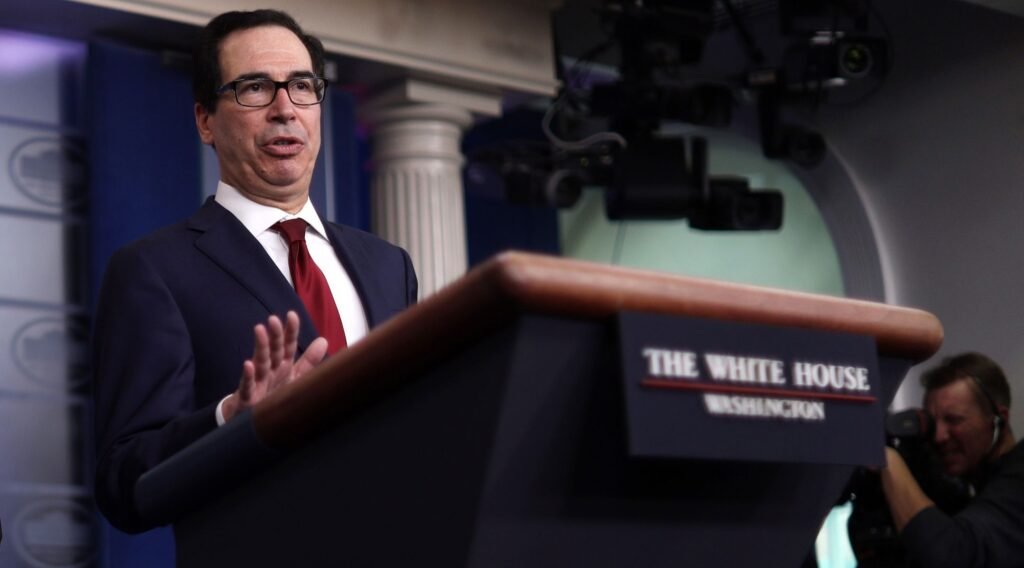
Coinbase’s Chief Monetary Officer, Alesia Haas “has a private friendship with Secretary Mnuchin,” in keeping with an e-mail despatched to the Treasury division. In keeping with commentary from CoinDesk, Haas was beforehand CFO at OneWest, the financial institution Mnuchin ran through the 2008 monetary disaster, that additionally employed former Coinbase government Brian Brooks, who was made Appearing Comptroller of the Forex in Could 2020 by way of Mnuchin’s designation. Whereas solely on the OCC for a 12 months, Brooks launched “regulatory initiatives that offered banks with the inexperienced gentle to supply cryptocurrency custody providers and stablecoin fee techniques,” earlier than leaving to re-join the personal sector, together with a three-month stint as CEO of Binance.US. The identical month of Brooks appointment, Could 2020, Haas was current throughout a Treasury convention name with Coinbase CEO Armstrong. Brooks allowed Anchorage Digital, a Libra Affiliation member suggested by PayPal co-founder Max Levchin, to safe a nationwide belief constitution and develop into the nation’s first and solely accredited “digital asset financial institution,” simply days earlier than he stepped down from his function in January 2021.
Republican Senator Mike Rounds of South Dakota penned a positive letter to Anchorage in October 2019, changing into the primary elected official to “endorse” the Libra undertaking, stating: “Applied sciences like Libra … have the potential to assist unbanked and underbanked shoppers proper right here at dwelling… It might be unlucky to shun a brand new resolution that would join extra of essentially the most weak People to our monetary providers system… Given the size of time it would take for the Fed to complete FedNow, the Libra Affiliation shouldn’t wait to see if current conversations a couple of Fed-run digital foreign money come to fruition.” Whereas Senator Rounds endorsed Fb’s undertaking, few members of the regulatory arms of the U.S. appeared to share these sentiments.
Fb, going through social and political prosecution for his or her involvement in what’s now referred to as the Cambridge Analytica knowledge scandal, was coping with a disaster of confidence from their customers and regulators because the Libra undertaking started. Notably, Cambridge Analytica concerned not only one however two firms intently related to Peter Thiel: Fb and CIA contractor Palantir. As well as, two outstanding figures within the Cambridge Analytica knowledge scandal, which was key to the profitable marketing campaign of President Trump, had been Steve Bannon and Brittany Nicole Kaiser, with Bannon being referred to as Tether-cofounder Brock Pierce’s “proper hand man,” and Kaiser having been the marketing campaign supervisor for Pierce’s failed 2020 presidential marketing campaign. Pierce would additionally “pop up” in marketing campaign finance stories as a “Trump marketing campaign megadonor,” who as soon as spent $100,000 for “dinner and entry” to Trump and Mnuchin. Zuckerberg himself acknowledged the impression of the scandal on Fb’s crypto prospects when he advised lawmakers in 2019, “I perceive we’re not the perfect messenger proper now . . . I’m certain folks want it was anybody however Fb placing this concept ahead.”
This self-acknowledged affliction on Fb’s picture led the corporate to make selection alternatives whereas constructing out the second iteration of Libra’s group. In Could 2020, Fb appointed Stuart Levey – the previous Beneath Secretary for Terrorism and Monetary Intelligence on the Treasury Division beneath President Bush and President Obama, senior employees on the Division of Justice, Chief Authorized Officer of HSBC, and a senior fellow on the Council of Overseas Relations – because the CEO of Libra. After the shuttering of Libra/Diem, Levey joined CIA-front Oracle as an Govt Vice President and Chief Authorized Officer. Libra would equally rent Steve Bunnell – former Chief of the Legal Division on the U.S. Legal professional’s workplace, normal counsel for the Division of Homeland Safety, and Fellow of the Trilateral Fee – to develop into its Chief Authorized Officer. “The folks had been actually extraordinary, among the absolute best,” said Ari Redbord, who was the Senior Adviser to the Treasury Deputy Secretary and the Beneath-Secretary for Terrorism and Monetary Intelligence. “They principally put collectively the group that regulators would wish to hear from when they’re trying [at] the way you’re going to construct out a compliance programme.”
In an try and sway regulators, Libra additionally introduced on former HSBC government James Emmet as a managing director; Sterling Daines as Libra’s Chief Compliance Officer who beforehand labored at Credit score Suisse, Goldman Sachs, and Deloitte along with consulting for the DOJ and the Monetary Crimes Enforcement Community (FinCEN); Saumya Bhavsar as Normal Counsel after expertise at Credit score Suisse, UBS, Euroclear, and the OCC, in addition to the European Fee and British Parliament; and former aide to the Chairman of the U.S. Senate Banking Committee Susan Zook from Mason Avenue Consulting to foyer on behalf of Libra.
Along with Mason Avenue, Libra spent over $7.5 million in 2019 alone on third-party lobbying corporations together with Sternhell Group, the Cypress Group, and the regulation agency Davis Polk & Wardwell, the latter of which had beforehand employed Fed Chair Jerome Powell and NY Senator Kirsten Gillibrand – one of many authors of the Stablecoin invoice. Davis Polk & Wardwell are maybe greatest identified for representing the Sackler family-owned Purdue Pharma, notorious for his or her function within the U.S. opioid disaster, and for representing main Wall Avenue banks and corporations through the 2008 disaster whereas additionally advising the federal government on the design of the bail-outs, a few of which had been deemed quasi-illegal even by its personal attorneys. Fb additionally employed the lobbying agency FS Vector, which was led by companion John Collins, the previous Head of Coverage at Coinbase, who had beforehand served as senior employees for the U.S. Senate Committee on Homeland Safety and Governmental Affairs which in 2013 held “the primary congressional inquiry and listening to into crypto and blockchain.”
By September 2020, Brock Pierce’s Blockchain Capital, featured in The Chain of Issuance, formally joined the Libra Affiliation, main Libra’s Head of Coverage Dante Disparte to remark that the agency “would advise on the creation of its international fee system” and “make its community of specialists and business figures accessible for the Affiliation’s use.” Bradford Stephens, a co-founder of Blockchain Capital, additionally joined the Diem Affiliation board. By December 2020, Fb had introduced the rebranding of Libra to Diem, in no small half because of makes an attempt to distance the undertaking from the social community. “The unique title is tied to an earlier iteration of the undertaking that obtained a troublesome reception, let’s say, from regulators and different stakeholders,” CEO Stuart Levey famous on the time.
The preliminary white paper and undertaking define for Libra described an artificial stablecoin that will be pegged to a basket of fiat currencies and authorities bonds or Treasuries, known as the Libra Reserve. In keeping with reporting from CoinDesk in October 2019, Marcus described some alterations to those intentions, claiming that “the brand new path isn’t essentially Libra’s desired choice.” Nevertheless, the undertaking should stay “agile.” Marcus additional said that Libra “might undoubtedly strategy this with having a large number of stablecoins that characterize nationwide currencies in a tokenized digital type,” and that that is “one of many choices that ought to be thought-about.” The pivot from a basket to a straight tokenized fiat foreign money was maybe influenced by remarks from future SEC Chair and former CFTC Chair Gary Gensler, who argued in July 2019 that “as at present proposed, the Libra Reserve, in essence, is a pooled funding automobile that ought to at a minimal, be regulated by the [SEC], with the Libra Affiliation registering as an funding advisor.” Marcus reportedly advised Reuters that Fb nonetheless supposed to launch Libra in June 2020 regardless of the regulatory pushback: “We’ll see. That’s nonetheless the purpose.. We’ve at all times mentioned that we wouldn’t go ahead except we now have addressed all professional issues and get correct regulatory approval. So it’s not completely as much as us.”
In April 2020, Libra introduced the “providing [of] single-currency stablecoins along with the multi-currency coin,” in its mission to develop into “a complement” versus “a alternative for home currencies” whereas expressing a “hope to work with regulators, central banks, and monetary establishments” to “broaden the variety of single-currency stablecoins accessible on the Libra community over time.” The duvet letter additional defined the change from solely a Libra Reserve mannequin:
“Whereas our imaginative and prescient has at all times been for the Libra community to enhance fiat currencies, not compete with them, a key concern that was shared was the potential for the multi-currency Libra Coin (≋LBR) to intervene with financial sovereignty and financial coverage if the community reaches important scale and a big quantity of home funds are made in ≋LBR. We’re subsequently augmenting the Libra community by together with single-currency stablecoins along with ≋LBR.”
Along with the stablecoin modulation, the up to date white paper eliminated “any point out of ever introducing permissionless participation within the Libra community” with “all counterparties working nodes within the Libra community” remaining “identified to all others.” “Regulators raised considerate questions in regards to the perimeter of management for the Libra community – specifically, the necessity to guard in opposition to unknown individuals taking management of the system and eradicating key compliance provisions,” the quilt letter states in direct opposition to the unique intentions for Libra “to develop into permissionless.”
By November 2020, only a month earlier than the Diem rebrand, Libra once more adjusted their plans to launch a “single dollar-pegged stablecoin subsequent 12 months” in keeping with reporting from the Monetary Instances. Libra will “merely launch as a single coin” that’s “backed 1:1 by the U.S. greenback,” assuming it receives “approval from the Swiss monetary regulator FINMA.” The social community nonetheless claims that “the opposite currencies inside the basket and the composite should be rolled out at a later time,” whereas “the dollar-pegged coin might launch as quickly as January [2021].” In February 2021, Diem introduced a partnership with custodian Fireblocks and First Digital Belongings Group to offer “the digital plumbing to permit monetary service suppliers corresponding to banks, exchanges, fee service suppliers (PSPs) and eWallets to plug into Diem on day one.”
In keeping with earlier reporting from Limitless Hangout, Fireblocks has important ties to the Israeli army and intelligence state, along with the U.S. regulatory regime by way of its advisory appointments of former SEC Chair Jay Clayton and Coinbase co-founder Fred Ehrsam:
“In 2022, Israel’s Ministry of Finance and the Tel Aviv Inventory Change established the primary digital authorities bond with Fireblocks (a digital property safety platform). The initiative was referred to as Venture Eden and it targeted on three options: “the tokenization of fiat, the tokenization of presidency bonds, and directions to immediate the change of property.” Fireblock’s CEO and co-founder, Michael Shaulov, was a group chief in an elite army outfit, Unit 8200 (collaborating in essentially the most demanding and mission-critical IDF tasks).
In 2022, Fireblocks was the highest valued digital (tokenized) asset infrastructure supplier, supporting over 800 main establishments. That very same 12 months, BNY Mellon, the world’s largest custodian financial institution, tapped Fireblocks to develop a monetary infrastructure for managing their digital property and, since then, Fireblocks has secured the switch of $2 trillion in digital property.”
Fireblocks has been funded by BNY Mellon, Silicon Valley Financial institution, Malka’s Ribbit Capital, Mike Novogratz’s Galaxy Digital, and DRW Enterprise Capital, amongst others. Fireblock’s workers embrace many former Unit 8200 and IDF members, to not point out CLO Jason Allegrante who labored on the Federal Reserve Financial institution of New York, Davis Polk & Wardwell and the San Juan Mercantile Financial institution & Belief, which was based by Nick Varelakis, a former government of the Tether-affiliated Noble Financial institution based by Brock Pierce. In October 2024, Fireblocks introduced a $1 million grant program to “increase PYUSD [PayPal’s stablecoin] developer adoption.”
This partnership finally yielded little profit for Fb, nevertheless. In Could 2021, the social community once more pivoted to companion with Silvergate Financial institution to subject their U.S. dollar-pegged stablecoin and handle its reserves. “We’re dedicated to a fee system that’s protected for shoppers and companies, makes funds quicker and cheaper, and takes benefit of blockchain expertise to convey the advantages of the monetary system to extra folks world wide,” said Diem CEO’s Levey. “We look ahead to working with Silvergate to appreciate this shared imaginative and prescient.” Silvergate CEO Alan Lane added his personal commentary, stating “we consider in the way forward for U.S. greenback backed stablecoins and their potential to rework current fee techniques. We’re impressed by Diem’s expertise and dedication to constructing a regulatory compliant fee system.” The press launch accompanying the announcement would additionally be aware that Diem could be shifting its operations out of Switzerland and again to the US.
Diem’s Levey and his government group knowledgeable the Fed and the Treasury that they had been planning on launching their stablecoin with Silvergate on the finish of June 2021. In a heated telephone dialog, the Fed’s normal counsel Mark Van Der Weide advised Levey that “the federal government was uncomfortable condoning any undertaking till it had put a ‘complete regulatory framework’ for stablecoins in place,” whereas expressing “nervousness a couple of coin with the potential to ‘massively scale’ as Diem may.” Levey would reply publicly, whereas demanding “honest and equal therapy.” “Stopping a restricted, legally permissible pilot whereas different stablecoins develop unchecked is neither honest nor equitable.” In response to the “No” from the U.S. regulatory regime, Dante Disparte, then-Govt Vice President at Diem Affiliation, give up in frustration solely to affix Circle, the issuer of USDC, in April 2021.
In August 2021, Marcus appeared on Bloomberg Expertise to debate the current developments of Diem:
“Within the early days, the concept the massive concept of Libra was actually one which had a stablecoin that included numerous current currencies as a substitute of simply being aligned with a greenback, which is what’s being ready now. Additionally it was to be regulated in Switzerland, and since then the group at Diem introduced this again to the U.S. to be regulated within the U.S. given it was a greenback stablecoin that was labored on. And so now it’s principally within the technique of getting approvals to maneuver ahead, and getting the right licensing construction to truly transfer ahead.”
Diem co-founder Catalini subsequently made feedback to CoinDesk to additional articulate their plans for the Silvergate collaboration, together with a dedication to section their token out as soon as a CBDC was issued:
“What we’re actually suggesting is extra of a public-private partnership. We see this nearly like a brief train, the place issuers like Silvergate in collaboration with Diem will probably be issuing a diem greenback, however the second there’s a CBDC … We’re the one issuer of a stablecoin, to my data, that dedicated publicly to phasing out our personal token and changing it with a CBDC token.”
Earlier than Diem might launch their stablecoin with Silvergate, in October 2021, Fb introduced one more partnership with Paxos, a belief firm and stablecoin issuer with quite a few connections to PayPal, as profiled in The Chain of Issuance. The pilot program was set to “go reside within the U.S. and Guatemala” which might enable “customers to begin buying and selling the Paxos Greenback (USDP)” whereas “crypto change Coinbase will present custody providers for this system.” In keeping with a Coinbase weblog publish on the time of announcement, Novi customers who participated within the pilot might “purchase Pax Greenback (USDP) by their Novi account,” permitting Novi customers to “be capable to switch USDP between one another instantaneously,” which “Novi will maintain on deposit with Coinbase Custody.” As Paxos’ Head of Technique Walter Hessert said in Paxos’ weblog publish, “This information represents a tide shift in digital property, because it’s the primary time that stablecoins are available in a client pockets outdoors of the crypto ecosystem.”
The exact same day, October 19, 2021, a bunch of U.S. Senators – Brian Schatz (D-HI), Sherrod Brown (D-OH), Richard Blumenthal (D-CT), Elizabeth Warren (D-MA) and Tina Smith (D-MI) – penned an open-letter to Fb demanding the fast discontinuation of the Novi pilot. In keeping with reporting from CoinDesk, the lawmakers felt that “Fb can’t be trusted to guard consumer knowledge or handle a funds community,” within the letter revealed “simply hours after Fb introduced it was launching a pilot program for its Novi pockets subsidiary.” Excerpts from the well timed letter embrace the next:
“On a number of events, Fb has dedicated to not launch a digital foreign money absent federal monetary regulators’ approval. In ready remarks earlier than the Home Monetary Companies Committee in October 2019, you mentioned that Fb would ‘not be part of launching the Libra funds system wherever on the planet except all U.S. regulators approve it.’ Extra just lately, David Marcus, the chief overseeing Fb’s digital foreign money efforts, mentioned, ‘[w]e are undoubtedly not going to launch with out the right regulatory framework.’
Regardless of these assurances, Fb is as soon as once more pursuing digital foreign money plans on an aggressive timeline and has already launched a pilot for a funds infrastructure community, although these plans are incompatible with the precise monetary regulatory panorama – not just for Diem particularly, but additionally for stablecoins typically. The businesses that oversee the U.S. monetary system are finding out the dangers that stablecoins pose to monetary stability. Accordingly, they’re contemplating tips on how to tackle these inherent dangers and make clear regulation and supervision of those merchandise. As Federal Reserve Chair Powell mentioned of stablecoins at a July 2021 Senate Banking and Housing Committee listening to, ‘They’re like cash funds, they’re like financial institution deposits they usually’re rising extremely quick however with out applicable regulation.’ Appearing Comptroller of the Forex Hsu just lately likened stablecoins to the wholesale funding markets whose collapse precipitated the 2008 monetary disaster: ‘When it comes to ‘identified knowns,’ a run on a big stablecoin may very well be extremely destabilizing.’ Mr. Marcus has cited Fb’s success in securing ‘licenses or approvals for Novi in practically each state,’ and concluded that ‘Novi is able to come to market.’ To be clear, your potential to safe state-issued cash transmitter licenses isn’t equal to acquiring the blessing of ‘all U.S. regulators,’ as you mentioned in your testimony two years in the past.
Along with the dangers merchandise like Diem pose to monetary stability, you haven’t provided a passable clarification for the way Diem will stop illicit monetary flows and different prison exercise. The intergovernmental Monetary Motion Activity Drive warned in a report back to the G-20 finance ministers that stablecoins’ ‘propensity for mass-adoption makes them extra weak for use by criminals and terrorists to launder their proceeds of crime and finance their terrorist actions.’ The President’s Working Group on Monetary Markets mentioned in December 2020 that stablecoins ‘are prone to entice illicit actors and, with out applicable mitigation measures, enable evasion of key public coverage targets.’
Sadly, Fb’s choice to pursue a digital foreign money and funds community is only one extra instance of the corporate ‘shifting quick and breaking issues’ (and in too many circumstances, deceptive Congress so as to take action). Again and again, Fb has made acutely aware enterprise choices to proceed with actions which have harmed its customers and the broader society. Fb can’t be trusted to handle a fee system or digital foreign money when its current potential to handle dangers and preserve shoppers protected has confirmed wholly inadequate.”
The letter concluded, “We urge you to right away discontinue your Novi pilot and to commit that you’ll not convey Diem to market.”
The Dismantling of Libra
Regardless of the pivots, regardless of the brand new companions, and regardless of pandering to regulators throughout the globe, Diem by no means truly made it to market. Surprisingly, Fb and its Libra/Diem brokers had been fairly open of their acknowledgments that this was a probable last final result, one foreseen by some even from the beginning of the undertaking. In a dialog with CNBC in November 2019, Marcus was requested by Andrew Ross Sorkin, “What did you suppose was gonna occur then by way of the expectation for the way [Libra] would roll out and play out within the public?” Marcus’ reply was transient and to the purpose: “Nicely, nearly because it truly occurred.” In step with this sentiment, Fb itself acknowledged that regulatory points could also be an insurmountable barrier to its Libra undertaking of their quarterly report back to the SEC in June 2019:
“Libra is predicated on comparatively new and unproven expertise, and the legal guidelines and laws surrounding digital foreign money are unsure and evolving. Libra has drawn important scrutiny from governments and regulators in a number of jurisdictions and we anticipate that scrutiny to proceed. As a main sponsor of the initiative, we’re collaborating in responses to inquiries from governments and regulators, and adversarial authorities or regulatory actions or adverse publicity ensuing from such participation might adversely have an effect on our status and hurt our enterprise.
As this initiative evolves, we could also be topic to a wide range of legal guidelines and laws in the US and worldwide jurisdictions, together with these governing funds, monetary providers, and anti-money laundering. In lots of jurisdictions, the applying or interpretation of those legal guidelines and laws isn’t clear, significantly with respect to evolving legal guidelines and laws which might be utilized to blockchain and digital foreign money. These legal guidelines and laws, in addition to any related inquiries or investigations, might delay or impede the launch of the Libra foreign money in addition to the event of our services and products, improve our working prices, require important administration time and a focus, or in any other case hurt our enterprise.
As well as, market acceptance of such foreign money is topic to important uncertainty. As such, there may be no assurance that Libra or our related services and products will probably be made accessible in a well timed method, or in any respect.”
In a dialog with Harry Stebbings of 20VC, Marcus defined how the failure to persuade regulators on the deserves of Diem led him to name it quits:
Marcus: “Once I take into consideration the Fb journey with Libra – I nonetheless name it Libra as a result of it’s a greater title than Diem – once I principally determined it it was not value preventing for it anymore, I felt actually good, like actually, actually good, that we had tried the whole lot in our energy after which some to persuade regulators and world powers, principally, that this was one thing of advantage and that the world wanted, nevertheless it simply wasn’t going to occur.”
Stebbings: “What was the core purpose it wasn’t going to occur?”
Marcus: “I feel it was simply actually onerous for regulators and others to just accept that Fb could be on the heart of a protocol for cash for the web. And really that any personal firm could be on the heart of that and that’s why we devolved a lot energy into this consortium that we didn’t management, that we’re only a member of, however that wasn’t sufficient. And I feel that the political – it was very political to be clear – and I feel the political stress on regulators to not allow an organization with the attain of Fb to truly be on the helm of such a undertaking was simply insurmountable.”
In an August 2023 dialog with Bankless, Marcus furthered these sentiments whereas articulating that “Sadly, nobody truly believed the ability dynamics behind it,” and that the “model affiliation with Fb on the time was simply not palatable from a political standpoint.” Marcus even went as far as to substantiate that “the undertaking was killed or shut down by the federal government.”
The truth that the federal government could be so hostile to Fb’s digital foreign money efforts is fascinating in gentle of the truth that Fb was one of many autos used to denationalise controversial U.S. army surveillance tasks after 9/11. Shortly after Peter Thiel and associates created Palantir with CIA funding to denationalise, and thus rescue, DARPA’s then-embattled Complete Info Consciousness program, Thiel turned Fb’s first important investor on the behest of Sean Parker, whose first contact with the CIA came about at age 16. What Fb turned after the involvement of Thiel and Parker bore such an uncanny resemblance to a different shuttered DARPA undertaking of the identical period, referred to as LifeLog, that LifeLog’s architect has even famous the direct parallels. Considered one of these parallels, although left unmentioned by former DARPA undertaking managers, is the truth that Fb launched the exact same day that LifeLog was shut down. Fb’s long-standing ties to the army/intelligence communities, which go far past its origins to revelations about its collaboration with spy businesses as a part of the Snowden leaks and its function in affect operations – a few of which have concerned the Thiel-founded Palantir – makes one marvel if the animosity of the federal government towards Fb’s digital foreign money ambitions was merely a smokescreen and that the true intent was in perfecting the public-private partnership of capital creation for the digital age, particularly its surveillance potential.
Regardless of the anticipated failure to launch, Marcus acknowledged that Libra “served as a blueprint for lots of tasks that got here after.” As Lisa Ellis of Moffet Nathanson defined to FT, Diem “pressured regulators and governments to begin to educate themselves on the expertise and stimulated enterprise capital funding in different initiatives as a result of there was such a frenzy of focus.”
These sentiments had been seemingly confirmed in each the tasks later headed by former Libra employees, to not point out the enterprise capital invested in mentioned companies. Whereas Marcus’ LightSpark will probably be mentioned later, Sui and Aptos, two “descendants” of Libra raised $300 million and $350 million respectively, each leveraging Libra’s Transfer programming language. Aptos was funded by Andreessen Horowitz, Multicoin Capital, 3 Arrows Capital, Tiger International, FTX Ventures and Coinbase Ventures. Sui, the blockchain constructed by Mysten Labs which added native USDC availability in October 2024, was based in September 2021 by 4 former members of Libra. Mysten Labs, which co-authored a troubling paper with O.N.E. Amazon’s co-founders – together with the architect of BlackRock’s ETFs, Peter Knez, as described in earlier reporting from Limitless Hangout – is deeply tied to Fb and its Libra/Diem undertaking. Evan Cheng, Mysten’s co-founder and CEO, was beforehand the top of Analysis and Improvement at Novi Monetary, whereas Sam Blackshear, one other co-founder and the CTO of Mysten Labs, was beforehand the Chief Engineer at Novi, having contributed considerably to the creation of the Transfer programming language utilized by Libra/Diem whereas at Meta. The founding group at Mysten additionally contains Adeniyi Abiodun and George Danezis, key contributors to Diem’s stablecoin and the aforementioned Transfer programming language.
In January 2022, the Diem Affiliation formally folded by asserting the sale of its mental property associated to the Diem Fee Community to their former companion, Silvergate Capital Company for $182 million. Within the press launch, Diem’s CEO Levey eulogized Fb’s effort, claiming that regardless of “a senior regulator inform[ing] us that Diem was the best-designed stablecoin undertaking the US Authorities had seen,” and “regardless of giving us optimistic substantive suggestions on the design of the community,” it “nonetheless turned clear from our dialogue with federal regulators that the undertaking couldn’t transfer forward.” Levey commented on the persevering with intentions of Libra even after the sale, stating that “we stay assured within the potential for a stablecoin working on a blockchain designed like Diem’s to ship the advantages that motivated the Diem Affiliation from the start.”
Sadly for Levey, and people behind the efforts of the social community’s crypto undertaking, Silvergate itself could be shutdown in March 2023, by the exact same regulators that had first shuttered Libra.
The Regional Banking Disaster
Silvergate Financial institution was based as a financial savings and mortgage affiliation in 1988 by Dennis Frank and Derek Eisele. In 1996, Frank, an ex-Goldman Sachs banker, reorganized the S&L right into a regional financial institution servicing the Southern California space after recruiting traders he had met from his stint at Goldman. Frank satisfied the board of Silvergate to stop its mortage operations in 2005, a couple of years earlier than the subprime debacle. Thus, when the Nice Monetary Disaster struck in 2008, Silvergate remained solvent and able to lend. On the onset of the disaster, Frank requested Alan Lane to affix the financial institution as CEO, having frolicked at Independence One Financial institution, Enterprise Financial institution of California, and Southwest Group Bancorp. In keeping with reporting from CNBC, Lane shared that Frank advised him “I’m a Wall Avenue man and I would like a banker as a companion, would you be a part of me?”

Whereas the financial institution’s books had been balanced, the usual subject of banking remained: tips on how to garner buyer deposits to be able to fund loans. In the beginning of the 2010s, Silvergate would flip in the direction of the oft-unbanked cryptocurrency business to fill their coffers. In 2013, Lane bought his first Bitcoin, partially out of curiosity in a brand new business, and partially out of concern of how this upstart foreign money might disrupt the banking sector at massive. “I believed ‘uh oh, what am I gonna do?’” Lane expressed upon discovering the blockchain. “I put two and two collectively and I believed, effectively it would disrupt banking long-term however within the short-term these firms want banks. They’re not doing something fallacious. They’re not doing something unlawful or immoral. In the event that they had been we wouldn’t be banking them.”
In 2013, Lane introduced within the executives from a handful of “younger crypto exchanges” to be able to assess their areas of friction, and the way Silvergate might assist the blossoming blockchain business. A 12 months prior, Silvergate had obtained Federal Reserve standing, and within the Summer season of 2014, Lane had invited the California State Banking Division board and the Federal Reserve Financial institution of San Francisco to share what he had discovered from the exchanges, and extra particularly current the deserves of Bitcoin. “That open communication with the regulators early on has confirmed to be actually foundational,” Lane would share. “We’re very collaborative with the regulators, we ask them if they’ve strategies, and what we are able to do higher.”
Silvergate shortly added the Winklevoss twin’s Gemini change, Paxos, Kraken, and others to their checklist of crypto-clients, serving to the financial institution supply a lot wanted deposits, whereas additionally offering an olive department to a smattering of largely unbanked blockchain stalwarts. As FTX’s Sam Bankman-Fried put it himself in a now-deleted testimonial on Silvergate’s web site, “Life as a crypto agency may be divided up into earlier than Silvergate and after Silvergate. It’s onerous to overstate how a lot it revolutionized banking for blockchain firms.” In January 2014, Silvergate introduced on on their first crypto buyer, SecondMarket, a agency began by Barry Silbert of the not-yet-founded Digital Forex Group.
SecondMarket was constructed to facilitate the sale of personal securities, corresponding to shares of firms not but publicly listed. Its traders included FirstMark, Chamath Palihapitiya’s Social Capital, Temasek Holdings, Silicon Valley Financial institution, and Li Ka-shing amongst others, the latter being the controversial father of Block.one investor, Richard Li, as famous in The Chain of Consensus. SecondMarket was additionally suggested by Steven Bochner – a former Chairman of the board of administrators at Nasdaq, a former member of the board on the SEC, and a member of the board on the Federal Reserve Financial institution of San Francisco – along with being suggested by Alan Denenberg, a companion at Davis Polk & Wardwell.
SecondMarket later rebranded as Genesis Buying and selling in April 2015 with Genesis Buying and selling naming their new CEO, Brendan O’Connor, after Silbert resigned in July 2014 to be able to type the Digital Forex Group. O’Connor advised CoinDesk that Genesis Buying and selling was “the biggest over-the-counter market maker” in cryptocurrency, in addition to being the “first broker-dealer within the U.S. regulated by the Monetary Trade Regulatory Authority (FINRA) and the Securities and Change Fee (SEC) to actively commerce bitcoin.”
Almost a decade later, each Genesis Buying and selling and Silvergate would discover themselves caught in the midst of the Terra-LUNA and FTX managed demolitions. Terra’s Do Kwon accused Genesis Buying and selling, by way of their subsidiary Genesis Asia Pacific, of collaborating with Sam Bankman-Fried’s FTX and Alameda Analysis to be able to assault the peg of the algorithmic stablecoin TerraUSD, referred to as UST. Kwon, in a sequence of tweets dated December 7, 2022, recommended that “the time has come for Genesis Buying and selling to disclose in the event that they offered the $1B USD shortly earlier than the crash to SBF or Alameda.” The $1 billion greenback buy was certainly brokered by Genesis Buying and selling’s Asia Pacific, along with one other $500 million sourced from Three Arrows Capital, with the deal being formally introduced as closed on Could 5, 2022. Genesis Buying and selling’s personal Twitter account defined that “the Genesis facet of the deal represents the primary of its magnitude, with Genesis Asia Pacific Pte. Ltd. taking over 1 billion UST in change for $1 billion value of BTC.” By Could 12, Terra’s LUNA had misplaced 99.7% of its worth, and the $1 billion of UST secure now held by Genesis was successfully nugatory.
Kwon additionally questioned SBF himself, particularly in search of solutions as to why his buying and selling desk Alameda had borrowed over $1 billion value of Bitcoin from Voyager through the de-pegging, alluding to risk that the borrowing was associated to a big brief place on the Terra ecosystem. Kwon would additionally “reveal” that Alameda was answerable for the “massive foreign money contraction that UST went by in Feb 2021” because of Alameda promoting 500 million in UST “in minutes” to “drain the Curve liquidity swimming pools through the Magic Web Cash (MIM) disaster.” FTX would formally lose round $100 million on the failure of LUNA. Nevertheless, reporting from the New York Instances would again Kwon’s assertion that SBF’s corporations had been behind the huge promote orders of TerraUSD. As lined inThe Chain of Consensus, the fallouts of Terra-LUNA’s collapse had been essential in creating the context that later led to FTX’s insolvency. It’s of be aware that the Bitcoin that had as soon as backed Terra-LUNA’s stablecoin was algorithmically liquidated by way of Binance, which was a very long time banking shopper of Silvergate, having reportedly moved some $50 billion for the change by Silvergate accounts since 2019. The CEO of FTX’s Digital Markets, Ryan Salame, asserted by way of a Tweet that “Silvergate suggested all our banking exercise.” Within the aftermath of their chapter submitting, FTX revealed that Genesis International Capital “turned out to be the biggest unsecured creditor of FTX” to the tune of $226.3 million owed.
The SEC went on to sue Silvergate for his or her participation within the FTX scandal, with the July 2024 swimsuit claiming “SCC, Lane, and [former Chief Risk Officer Kathleen] Fraher misrepresented the operational and authorized dangers going through the Financial institution by falsely stating in SEC filings and different public statements that the Financial institution had an efficient BSA/AML compliance program tailor-made to the heightened dangers posed by its crypto asset prospects.” In keeping with reporting from Blockworks, the Silvergate employees “had been capable of hint $9 billion value of transfers from FTX-related entities,” but the attorneys on the SEC wrote: “Most troubling to the BSA employees was the development of funds that flowed from FTX’s custodial accounts — which held FTX buyer funds — to a sequence of non-custodial FTX-related entities’ accounts, adopted by transfers of those funds to different third events — both by the SEN or to accounts exterior to the Financial institution.” In keeping with reporting from NYMag, SEC filings confirmed that “funds supposed for FTX had been deposited into the Silvergate account of an Alameda subsidiary” to be able to “disguise the truth that they had been going to Alameda.” This subsidiary, North Dimension, claimed to be “a web based electronics retailer” in keeping with “a now-defunct web site that seems to have been faux since nothing may very well be bought on it.”
SEN, or the Silvergate Change Community, had develop into a vital piece of infrastructure for inter-exchange settlement along with offering a lot wanted settlement providers for stablecoin suppliers. As Alan Lane defined on Bloomberg’s OddLots podcast in 2022:
“We’re the regulated on-ramp from the U.S. greenback and different fiat currencies into the bitcoin and digital asset market. After which likewise, we’re the off-ramp from that the digital asset market again into fiat currencies… So let’s discuss in regards to the stablecoins. The stablecoin issuers who use our platform are all the regulated, U.S. dollar-backed stablecoin issuers… We don’t financial institution the algorithmic stablecoin choices, nor these different stablecoins which might be possibly collateralized by different digital property. These don’t want a U.S. greenback financial institution as a result of they’re not backed by USD. Importantly, we additionally don’t financial institution Tether and consider it or not, we had the chance to work with Tether very early on however as a result of they weren’t inside the US. And, you recognize, once more we’re very critical about regulation, and so we checked out it and we thought you recognize that is an fascinating concept… However they’re offshore. We will’t actually get our palms round their regulatory standing in the US and so we weren’t capable of financial institution them again then. This was again in 2017, nor can we financial institution them immediately. In order that’s what we don’t do.
What we do is for USDC, for the Pax Greenback which is issued by Paxos, for the Gemini Greenback issued by Gemini and for TrueUSD. They use the SEN and our API for the minting and burning of their tokens. These tokens are issued when a greenback hits their Silvergate checking account and it’s all programmatic. So if anyone needs to buy USDC from Circle, what they might do is they might ship {dollars} into Circle’s checking account at Silvergate. And when these {dollars} hit the checking account then, at that second, there’s an API name from Silvergate to Circle that claims ‘we simply obtained x quantity of {dollars} from this buyer.’ And at that time, Circle is aware of we now have the {dollars} in our possession. So that they flip round they usually mint the USDC token and ship it to the pockets tackle of that establishment that’s trying to buy the USDC. After which the identical factor occurs in reverse. If somebody needs to redeem their USDC and return to U.S. {dollars}, they ship the USDC to the pockets at Circle. Circle, at that time, as soon as they’ve possession of the USDC, they then ship an instruction to us by way of API and we then, in flip, will ship the {dollars} again to that prior USDC token holder.”
In keeping with a SEC submitting with knowledge as current as October 2018, Silvergate serviced 35 digital foreign money exchanges, together with “the 5 largest U.S. domiciled digital foreign money exchanges,” holding simply over $792 million of deposits. The submitting confused the significance of SEN, whereas additionally highlighting the substantial progress of Silvergate’s “digital foreign money initiative.” In 2014, with solely 8 prospects, the financial institution held $6 million in crypto-related deposits, whereas by 2018, the financial institution had 483 crypto purchasers, with $1.6 billion in deposits on the financial institution’s books.
It was additionally in 2018 that Silbert’s Digital Forex Group invested in Silvergate Capital Company itself, promoting 9.5 million shares for $114 million in funds to “additional assist the financial institution’s fintech deposit initiatives.” By November 2020, Bitcoin custodian and stablecoin financial institution Xapo – featured in The Chain of Custody – would lose their Director of Institutional Investments, the 13-year Morgan Stanley vet Jonathan Melton, after he introduced he was to affix Silvergate because the Director of Digital Asset Lending, partly to assist broaden the financial institution’s SEN Leverage product. In June 2021, the previous CLO at Coinbase, Michael Lempres, joined Silvergate as Chairman, taking on for Dennis Frank. Previous to Coinbase, Lempres was an government at Andreessen Horowitz and a senior legal professional at Silicon Valley Financial institution. At SVB, Lempres was instrumental in working with regulators to broaden their booming cryptocurrency purchasers, and even began working at SVB’s buyer, Bitnet Applied sciences, in 2015. BitNet was fashioned by former Visa workers after Visa bought fee infrastructure agency Cybersource in 2010, and was funded by Blockchain Capital, Digital Forex Group, and Stephens Funding Administration. In 2016, Lempres was moreover elected the mayor of Atherton, a small city in Silicon Valley that boasts Google’s Eric Schmidt and Fb’s Sheryl Sandberg as residents. In the identical announcement, Silvergate would add Aanchal Gupta, a former threat and safety supervisor at Microsoft, Fb, and Yahoo!, to its board. In 2019, Antonio Martino joined Silvergate as CFO, having been a senior supervisor at Financial institution of Montreal previous to 17 years at Citigroup.
In July 2021, Silvergate introduced that they had garnered $4.3 billion in new deposits from “new and current digital foreign money prospects” in Q2 of 2021 alone. The lion’s share got here from crypto exchanges, which “deposited $2.4 billion in money through the quarter,” whereas institutional investor deposits “grew by $1.8 billion.” Silvergate famous that 120 new digital foreign money prospects had been added within the quarter, bringing their complete to 1,224, whereas the financial institution’s SEN had “processed 137,947 transactions and transferred $239.6 billion over the community” through the quarter. Within the announcement, Lane commented on the expansion of deposits, whereas speculating that future progress may come from a enterprise corresponding to Fb’s Diem:
“Within the second quarter, common deposits from digital foreign money prospects grew by $3.5 billion to $9.9 billion. Pushed by the document quantity we skilled on this, we’re prudently deploying these deposits into curiosity incomes property, together with the acquisition of $4.5 billion of each brief and lengthy period securities through the quarter…We’re taking a look at our capital wants and anticipated progress to be capital environment friendly and having runway to assist that progress. We’re additionally taking a look at off stability sheet mechanisms to tackle that progress that may come from a stablecoin undertaking like Diem.”
Of significance regarding the financial institution’s eventual failing, Silvergate’s Tier 1 leverage ratio, which “measures fairness capital in opposition to risk-weighted property,” stood “effectively above the regulatory threshold of 5% at 7.9% this quarter” however down from “the 9.68% degree it was at within the first quarter of this 12 months [2021].” As famous above, Diem was shut down and its property bought to Silvergate on the finish of January 2022. On March 29, 2022, Silvergate issued a $205 million Bitcoin-collateralized mortgage with MacroStrategy, a subsidiary of Michael Saylor’s MicroStrategy, within the Washington, DC-based software program firm’s now-successful try and develop into one of many largest Bitcoin holders on the planet. Curiously, one of many different largest Bitcoin holders on the planet, Block.one/Bullish International, had taken a $225 million mortgage itself from Silvergate simply the day earlier than, on March 28, in keeping with an SEC submitting. Silvergate was shortly changing into an indispensable pillar within the cryptocurrency business, however earlier than 2022 might shut, all the business, Silvergate included, would discover itself scrambling to make depositors entire.
On November 7, 2022, Tyler Pearson, the son-in-law of CEO Lane, was demoted from his place of Chief Danger Officer, along with different government degree shakeups. 4 days later, on November 11, FTX filed for Chapter 11 chapter. Lower than two weeks later, on November 23, Block.one CEO Brendan Blumer bought a 9.27% stake in Silvergate, promptly upping the funding to 9.9% the following month, making EOS’s developer Block.one the biggest single investor in Silvergate. In keeping with reporting from Protos, Citadel Securities and Cathie Wooden’s ARK Make investments additionally bought thousands and thousands of {dollars} value of shares of Silvergate, whereas thousands and thousands value of “advances from the Federal House Mortgage Financial institution (FHLB) had been taken out by Silvergate.”
On December 5, Silvergate filed a letter with the SEC the place Lane claimed “we carried out intensive due diligence on FTX and Alameda Analysis,” and “we now have a resilient stability sheet and ample liquidity.” Nevertheless, a month later, on January 5, 2023, Silvergate revealed that, because of its shopper FTX collapsing, a large financial institution run had taken place, with $8.1 billion, over 68% of its deposits, leaving the financial institution in This autumn 2022. This shortly “led to an acute liquidity crunch, which pressured Silvergate to unload illiquid securities for a lack of over $700 million and to borrow $4.3 billion in short-term advances from Federal House Mortgage Banks.” Possible in response to the stability sheet revelation, the value of Silvergate inventory “declined by $11.54 per share, or 22.6%, from a closing value of $50.96 per share on November 7, 2022, to a closing value of $39.42 per share on November 8, 2022,” on “unusually excessive buying and selling quantity,” as famous by Cohen Milstein’s case examine. Silvergate additionally introduced they fired about 40% of their workforce, with 200 workers receiving pink slips.
Regardless of the tanking inventory value, and accusations of fund mismanagement, Silvergate as a substitute noticed a string of optimistic bulletins from conventional funding stalwarts because the winter of 2023 carried on. On January 31, 2023, Larry Fink’s BlackRock– a serious shareholder in FTX – reported a 7% stake in Silvergate, after a submitting with the SEC revealed that the agency elevated their place from the beforehand reported 5.9%. Two days later, on February 2, State Avenue reported a 9.32% stake in Silvergate, whereas on February 14, Citadel Securities additionally revealed a 5.5% stake within the California-based financial institution.
Whereas the normal asset managers had been seemingly shopping for up the deeply-discounted shares, March 2023 would fare far worse for Silvergate’s digital foreign money purchasers. On March 2, Coinbase, Michael Novogratz’s Galaxy Digital, Paxos, Circle, CBOE’s Digital Markets, Crypto.Com, Gemini, LedgerX and Bitstamp all suspended banking partnerships with Silvergate. The following day, March 3, Silvergate introduced that SEN could be shut down “efficient instantly,” after making a “risk-based choice.” This was doubtless due partly to a chapter choose ordering the financial institution to launch practically $10 million to their former shopper, BlockFi, a problem which was ordered the identical day.
Signature Financial institution, which failed two days after Silicon Valley Financial institution, had its personal inter-crypto change community, referred to as Signet. Signature had relationships with many cryptocurrency firms, a lot of which had begun in 2018, together with Circle, Coinbase, Kraken and even FTX. The financial institution was to the New York Group Bancorp subsidiary, Flagstar Financial institution, one week after the FDIC assumed management of Signature. Trump’s Treasury Secretary, Steve Mnuchin, would later lead an funding package deal to rescue NYCB with $1 billion in March 2024, main the corporations to rename the now-merged banks into Flagstar Monetary in October 2024. Joseph Otting, a “longtime banking government and shut ally of Mr. Mnuchin,” the former President of OneWest Financial institution and the Chief Operator at Trump’s OCC earlier than Brian Brooks, would develop into its CEO.
On March 7, Block.one, by then referred to as Bullish International, liquidated its Silvergate place after expressing issues in regards to the financial institution’s lack of ability to file its 10-Ok and the financial institution’s announcement of the shut down of SEN, revealing it had “no publicity to Silvergate.” The following day, March 8, Silvergate shut down operations after a voluntary liquidation to federal regulators. Actually, a voluntary liquidation is an uncommon taking place within the banking business, and thus there was a lot hypothesis as to why Silvergate would do such, together with a well-researched piece from Pirate Wires suggesting that the Biden administration’s regulators used “a casual mandate” which restricted “crypto deposits at 15 %” to convey the financial institution down.
Whereas the precise purpose why the financial institution shuttered will doubtless by no means see the sunshine of day, there have been actually corporations that benefited from the voluntary liquidation. On March 23, MicroStrategy introduced they had been capable of repay their mortgage early as a result of financial institution’s closure “with out prepayment charges” and at a “21% low cost,” paying solely $161 million of the $200 million owed. On March 8, the day the financial institution was closed, Marathon Digital, which had opened a $200 million line of credit score from Silvergate, introduced that they had halted its credit score services, serving to take away practically $50 million in debt and save round $5 million in annual borrowing prices.
A month earlier than the financial institution liquidated, on February 14, Yahoo! reported that George Soros’ Soros Fund Administration, along with its sizable investments in Marathon and MicroStrategy, had positioned “100,000 shares value of put choices” by way of a brief place on the soon-to-be-shutdown Silvergate. Brief sellers through the regional banking disaster remodeled $3.5 billion in mark-to-market earnings in March 2023 alone, with Silicon Valley Financial institution and Signature Financial institution – the second- and third-largest financial institution failures respectively in U.S. historical past – having been within the prime 20 most-shorted regional financial institution shares, in keeping with reporting from Yahoo!.
The Silicon Valley Chapter
Silicon Valley Financial institution was based in October 1983 by Stanford professor Bob Medearis and Wells Fargo government Invoice Biggerstaff, after the 2 former Financial institution of America managers determined to discovered a financial institution to fund an childish Silicon Valley. The concept for the financial institution first emerged throughout a recreation of poker in Pajaro Dunes, California that featured Starr Colby, who was the top of Lockheed’s “pilot-less drone program” on the time. Medearis claimed the deregulation from the Reagan administration created the atmosphere for such a monetary establishment, and the shortage of enterprise capital within the area created ample alternative to finance the scholars and entrepreneurs, kickstarting the pc revolution in earnest.
In keeping with reporting by Vox, by 2021 SVB claimed to financial institution “practically half of all U.S. venture-backed startups,” to not point out being a banking companion for “loads of the enterprise capital corporations” that fund these startups. By the point of its failure in March 2023, SVB held greater than $200 billion in property for California’s tech business, making it the biggest financial institution to fail for the reason that Nice Recession. However earlier than it failed, the financial institution had develop into an indispensable pillar within the FinTech business of the valley. Dallas Enterprise Journal‘s Mark Calvey reported that executives at SVB had advised him that “the financial institution’s deal with working intently with VCs and their portfolio firms was truly a option to scale back threat.” In keeping with Calvey, if “top-tier enterprise corporations,” corresponding to Sequoia or Kleiner Perkins, had been “pouring thousands and thousands right into a promising startup,” SVB felt “extra comfy in extending enterprise debt.” The as soon as Treasurer of Silicon Valley Financial institution, David Jaques, went on to affix PayPal extraordinarily early within the firm’s historical past, serving to the agency correctly adjust to banking laws.
Sadly, it was a few of these enterprise capital stalwarts that will later assist set off the run that will convey the financial institution down on March 10, 2023. Two days earlier than, on March 8, SVB Monetary Group, the guardian firm of the financial institution, introduced it will undertake a $2.25 billion share sale after offloading $21 billion value of securities at a $2 billion loss. Deposits on the financial institution had soared after unprecedented pandemic-era stimulus coincided with successfully zero-percent rates of interest, main the financial institution to put money into longer period bonds within the search of yield. Whereas the acquisition of U.S. authorities debt is commonly thought-about risk-free, banks that get caught holding lengthy period bonds throughout an rate of interest hike – such because the quickest charge hike in U.S. banking historical past in 2022-2023 after the extremely inflationary interval throughout authorities lockdowns – usually must promote at a loss earlier than the bonds can mature to cowl fleeing deposits.
Astute enterprise funds that had their cash in SVB – usually in egregious extra of the FDIC’s insurance coverage restrict of $250,000 – corresponding to Peter Thiel’s Founders Fund and Fred Wilson’s Union Sq. Ventures suggested their purchasers to drag their deposits out of the financial institution earlier than the losses tallied larger. On March 9, the highest executives at Founder’s Fund determined to maneuver the agency’s capital to an assortment of bigger banks, with their CFO Neil Ruthven stating, “Thursday morning [March 9] it was clear we had been in the midst of a financial institution run, and we reacted in step with our fiduciary duties.” Different corporations, corresponding to Sequioa Capital, Coutue, and the a number of unnamed founders that shared feedback privately to Axios, additionally moved their funds out of SVB that day as effectively. The Info reported that Union Sq. Ventures directed firms of their portfolio to “solely preserve minimal funds in money accounts.” In keeping with reporting from John Titus for BestEvidence, 10 prospects alone had $13 billion in deposits at SVB, whereas $42 billion would go away the financial institution in simply 6 hours. By the top of the day, the financial institution’s shares would drop over 60%, taking out practically $9.4 billion within the inventory’s market cap.
The priming for such a financial institution run, nevertheless, was removed from inbuilt a day. Whereas the match on this regional banking bonfire was these aforementioned, influential VC corporations advising companions to shortly pull funds, the tinder was these “killer whale accounts” depositing billions past typical FDIC insurance coverage and the kindling was the financial institution investing in lengthy period bonds throughout a low rate of interest atmosphere. In the end, the gas wooden itself was the Trump administration’s deregulation of the banking business in 2018.
In an effort to defang the Democrat-led Dodd-Frank regulation through the Obama administration, the Republican-controlled Congress handed laws in Could 2018 that weakened sure restrictions on banks, particularly upping the “too-big-to-fail” threshold from $50 billion in complete property to $250 billion because it pertains to particular reporting and capital necessities. On account of this transformation, all three of the banks that failed in 2023 not needed to “bear stress assessments,” or “submit so-called dwelling wills,” each of that are “security valves designed to plan for monetary catastrophe.”
The invoice, signed by President Trump and referred to as the Financial Progress, Regulatory Reduction and Client Safety Act, lifted this provision to $100 billion for 18 months, and ultimately raised it to $250 billion in an effort to make it simpler for smaller banks to lend extra and save prices on reporting and stress testing. Banks with lower than 1 / 4 trillion in property would not must bear annual stress assessments carried out by the Federal Reserve, nor would they must conduct their very own semiannual assessments. As well as, banks with beneath $10 billion in complete property would not must honor the Volcker Rule, named after former Fed Chair Paul Volcker, which banned banks from proprietary buying and selling and made it unlawful for banks to “place bets with cash from deposits.” Lastly, the capital necessities for banks not deemed “systemically essential monetary establishments” had been loosened, liberating up capital for elevated lending.
Senator Elizabeth Warren of Massachusetts, a proud heel of cryptocurrency, would particularly level to those reforms as being a vital element to the financial institution’s failure, stating: “President Trump and congressional Republicans’ choice to roll again Dodd-Frank’s ‘too massive to fail’ guidelines for banks like SVB – decreasing each oversight and capital necessities – contributed to a expensive collapse.” Of be aware, as reported by The Lever, SVB had spent “greater than half one million {dollars} on lobbying” to “hike the regulatory threshold to $250 billion” in 2015. Regardless of the financial institution itself having pushed for the precise regulation that helped arrange its failure, many outstanding monetary figures got here out in protection of the client deposits, together with Invoice Ackman, Larry Summers, PayPal’s David Sacks, and Sam Altman.
Even Treasury Secretary Janet Yellen said “We’re involved about depositors and we’re targeted on attempting to satisfy their wants.” In keeping with reporting from The Washington Put up on the time of the financial institution’s failure, “Federal authorities are critically contemplating safeguarding all uninsured deposits at Silicon Valley Financial institution, weighing a rare intervention to stop what they concern could be a panic within the U.S. monetary system.” The Put up additional famous that “Though the FDIC insures financial institution deposits as much as $250,000, a provision in federal banking regulation might give them the authority to guard the uninsured deposits as effectively in the event that they conclude that failing to take action would pose a systemic threat to the broader monetary system. In that occasion, uninsured deposits may very well be backstopped by an insurance coverage fund, paid into recurrently by U.S. banks.”
Former Treasury Secretary and former Xapo advisory board member Larry Summers referred to as for fast motion to guard deposits, stating “What is completely crucial is that, nevertheless this will get resolved, depositors be paid again, and paid again in full…this isn’t the time for ethical hazard lecture.” The previous COO of PayPal, David Sacks, tweeted “The place is Powell? The place is Yellen? Cease the disaster NOW. Announce that every one depositors will probably be protected. Place SVB with a High 4 financial institution. Do that earlier than Monday open or there will probably be contagion and the disaster will unfold.” OpenAI’s CEO Sam Altman equally tweeted that “TL;DR: at this level, to make certain of avoiding disaster, the FDIC must briefly assure all deposits. different options may work, however that is the most effective one.” On March 12, two days after the financial institution failed, the Treasury, the Fed and the FDIC introduced “steps to make sure deposits will probably be paid in full,” stating:
“After receiving a suggestion from the boards of the FDIC and the Federal Reserve, and consulting with the President, Secretary [Janet] Yellen accredited actions enabling the FDIC to finish its decision of Silicon Valley Financial institution, Santa Clara, California, in a fashion that absolutely protects all depositors… Depositors could have entry to all of their cash beginning Monday, March 13. No losses related to the decision of Silicon Valley Financial institution will probably be borne by the taxpayer.”
Endeavor board member Matt Harris – a Bain Capital Enterprise companion and NY Fed Fintech Advisory Group member mentioned in The Chain of Custody – commented on the hypocrisy of the second, tweeting “Wanting ahead to the tweets from the VCs who sparked this financial institution run congratulating themselves on their prescience.” In keeping with their web site, Silicon Valley Financial institution was an official financial institution companion of Endeavor.
Whereas the U.S. regulators confirmed up on the proper time to assist guarantee depositors had been made entire, just a few weeks earlier than SVB went beneath, the financial institution’s CEO, Greg Becker, had already begun offloading shares of the soon-to-be-collapsed financial institution. In keeping with reporting from Newsweek, Becker had bought “greater than $3.5 million in shares,” with a February 27 submitting with the SEC demonstrating that exactly “$3,578,652.31 in frequent inventory” was liquidated “two weeks earlier than SVB was shut down by federal regulators.” These 12,451 shares bought would account “for 10 %” of “his roughly 98,000 shares,” whereas one other SEC submitting would present that the financial institution’s Chief Monetary Officer, Daniel Beck, had additionally bought “$575,180 in shares” on “the identical February day.” SVB additionally reportedly paid out bonuses to U.S. workers mere hours forward of the take over by regulators.
It wasn’t simply executives on the banks, or Soros’ brief positions, that benefited from the regional banking disaster. In keeping with a examine from McKinsey, deposits flowed “out of midsize U.S. banks after the regional banking disaster,” whereas “the biggest and smallest banks added deposits.” Considered one of these “smallest banks” was a brand new entity referred to as Mercury, which was based in 2017 and has raised over $163 million from traders corresponding to Andreessen Horowitz, Coatue, Naval Ravikant, Ron Conway’s SV Angel, and CRV in addition to “angel traders, athletes, entertainers and prospects.” Mercury noticed greater than $2 billion in deposits within the first handful of days after SVB’s collapse, with round 8,700 new prospects in March 2023 alone. “It was by far our greatest month we’ve had at Mercury, an enormous influx,” Mercury CEO and co-founder Immad Akhund advised TechCrunch. “We tried to prioritize folks coming from SVB and even constructed some instruments so they might connect with SVB accounts… We had been already rising and we noticed an roughly 20% bounce due to what occurred with SVB.” By July, Mercury had seen over 26,000 new prospects since March’s regional financial institution disaster.
Whereas the fast uncertainty of the financial institution failure certainly ruffled some feathers of the assorted depositors at SVB, the U.S. regulatory system promised to make them entire, and thus purchasers corresponding to Sequoia Capital, the Tencent-backed Kanzhun, the Bezos, Milner and Mubadala Funding Firm-backed Altos Labs, amongst others, would all escape unscathed. SVB’s largest creditor aided by the federal government rescue was be the issuer of the stablecoin USDC, Circle Web Monetary, which had had $3.3 billion deposited on the financial institution. In keeping with a press launch from Circle, this amounted to about 8% of the USDC complete reserve, with a remaining 77% of its reserve being collateralized short-dated U.S. Treasury payments held by BNY Mellon and managed by BlackRock.
Within the failure of SVB, USDC would “depeg” from the USD, falling as low as 86 cents. Howard Lutnick, the CEO of Cantor Fitzgerald which custodies Tether’s Treasury holdings, took a dig at Circle throughout his speech on the Bitcoin2024 convention by which he said: “Give it some thought: Circle had USD $3.3 billion of your reserves uninsured within the Silicon Valley Financial institution when it went bust.” Tether’s Paolo Ardoino additionally commented on the state of affairs, saying “You may do not forget that I used to be very public about my issues about MICA and the requirement of 60% in non-insured money deposits, like what occurred to Circle with Silicon Valley Financial institution in 2023. They misplaced $3 billion after which survived as a result of the FDIC stepped in.”
Regardless of allegations of beginning the bank-run himself, PayPal co-founder Peter Thiel claimed to lose $50 million personally with the failure of SVB. Thiel’s Founders Fund had been investing in Bitcoin since 2014 and realized practically $2 billion in earnings from their 8-year cryptocurrency funding in March 2022, when Bitcoin was practically $50,000 a coin. Founders Fund would start investing once more within the digital asset business shortly after the banking disaster, placing $100 million every in Bitcoin and Ethereum.
Six months after the disaster, in August 2023, PayPal introduced their very own stablecoin, PYUSD, with all eyes turning in the direction of Congress for the legislative readability by way of their oncoming regulation that will decide the winners and losers of the “Nice Stablecoin Warfare.” The Home Monetary Companies Committee’s Republican chair, Consultant Patrick McHenry, commented that the PYUSD announcement was a sign that stablecoins “maintain promise as a pillar of our twenty first century funds system.”
Two weeks earlier than Paxos and PayPal launched PYUSD, the U.S. Home Monetary Companies committee superior the primary iteration of their stablecoin invoice. McHenry confused the significance of the invoice, stating: “We’re at present at a crossroads to maintain America on the forefront of digital asset innovation. Congress is making important, bipartisan progress on laws to make sure the U.S. leads the monetary system of the long run.”
The Consolidation: The Gillibrand-Lummis Stablecoin Invoice
Since 2022, the efforts to cross laws dealing the crypto business have been largely spearheaded by Kirsten Gillibrand (D-NY) and Cynthia Lummis (R-WY). The 2 feminine senators, who each obtain a major quantity of funding from the crypto business, tried however did not get their first try at a crypto oversight invoice handed in 2022 as did their second try in 2023. The Gillibrand-Lummis payments have usually favored giving the CFTC extra oversight over the business than the SEC (resulting in criticism from the SEC’s Gary Gensler) whereas the latest iteration would ban algorithmic stablecoins and make sure that stablecoin laws are used to keep up “the U.S. greenback’s dominance.”
In the end, the invoice – amongst different issues – is seen as encouraging banks to start issuing dollar-pegged stablecoins, having them compete straight or type alliances with current stablecoin issuers like Circle, Paxos and Tether. Over the previous few years, the place concern over a Central Financial institution Digital Forex (CBDC) has develop into outstanding within the U.S. and elsewhere, prime crypto executives – like Coinbase’s Brian Armstrong – in addition to CIA veterans have said fairly plainly that dollar-pegged stablecoins had been to develop into the U.S.’ de facto CBDC to be able to give the U.S. a “first-mover benefit” in digital foreign money issuance, as greenback stablecoins are “already right here” whereas a CBDC would take years to develop. As well as, the coverage of the Federal Reserve since final 12 months has made it clear that they favor “personal stablecoin issuance slightly than official CBDC issuance.” With stablecoins being simply as programmable and surveillable as CBDCs, and a few stablecoin issuers like Tether already allied with U.S. intelligence and safety businesses, the present stablecoin invoice is poised to pave the best way for the U.S.’ de facto CBDC and to make sure that Wall Avenue and well-established titans of digital finance like PayPal have the benefit.
Given the above, Kirsten Gillibrand’s involvement within the invoice is smart. After beginning her profession as a regulation clerk in Albany, NY, Gillibrand labored on the international, white-shoe regulation agency Davis, Polk & Wardwell, whose alumni embrace present Fed chairman Jerome Powell, from 1991 to 2000. The agency, since its earliest years, has been intently related to J.P. Morgan (now a serious donor to Gillibrand’s campaigns) and Wall Avenue typically. One telling instance of the function of the agency in Wall Avenue’s political machinations occurred through the 2008 monetary disaster, when the agency represented the general public sector, i.e. the Treasury Division and Federal Reserve Financial institution of New York, in addition to the Wall Avenue banks deemed to have performed a task in creating the disaster, together with Citigroup. Subsequently, the agency helped develop the federal government response to the disaster together with by serving to draft the comparatively toothless Dodd-Frank Act which, over a decade after its passage, has finished subsequent to nothing to rein within the “too massive to fail” banks or stop the federal government’s “privatize the positive factors, socialize the losses” coverage with respect to financial institution failures. Davis, Polk & Wardwell continues to give closely to Gillibrand’s political battle chest as does one other regulation agency the place she used to work, Boies, Schiller & Flexner.
Whereas Wall Avenue banks like J.P. Morgan and Wall Avenue regulation corporations like Sullivan & Cromwell donate closely to Gillibrand, she has extra just lately taken on essential gamers within the crypto business as donors. The most important of those is Coinbase, whereas different donors embrace Uniswap Labs. One other essential donor is Fred Wilson’s Union Sq. Ventures, which has backed Coinbase in addition to MondoDB. Andreessen Horowitz is one other important donor to Gillibrand, which has made many investments within the crypto house, together with being the majority of the funds behind Multicoin Capital, which can be backed by Union Sq. Ventures. Multicoin Capital itself donates important sums to Gillibrand and can be a serious donor to Cynthia Lummis. As will probably be mentioned shortly, Mulitcoin Capital has important ties to the stablecoin business, significantly the stablecoin issuers most favored by the Gillibrand-Lummis invoice.
Whereas Gillibrand might have began off as a company lawyer, politics was at all times inside her sights. Certainly, Kirsten Gillibrand’s political profession is essentially due to her very politically-connected household. Gillibrand’s father, Douglas Rutnick, a profession lobbyist who has represented Morgan Stanley, Lockheed Martin and even the NXIVM intercourse cult, was a long-time “shut affiliate” and good friend of former New York Senator Alfonse D’Amato. Rutnick has been described as a “beneficiary” of the corrupt Democratic Social gathering-run “machine” in New York’s capital Albany, with native papers noting that Rutnick “each served as Albany County public defender and ran a personal regulation agency representing purchasers with enterprise earlier than town” that was later accused of partaking in “questionable offers.” Gillibrand’s grandmother, Polly Noonan, was additionally intimately related to the “Albany machine” as she was the long-time mistress of former Albany mayor Erastus Corning, a Democrat, and served as vice chair of New York’s Democratic occasion within the Nineteen Eighties. That appointment was allegedly a favor granted by former New York governor Mario Cuomo, as Noonan had raised important marketing campaign funds for his gubernatorial bid previous to her appointment.
Gillibrand later claimed that it was her father’s ties to D’Amato that scored her a university internship at D’Amato’s workplace in Albany, NY when he was a serving Senator and marked her earliest foray into politics. Although she subsequently said that she didn’t personally meet D’Amato till years later over “one beautiful dinner collectively,” D’Amato – a scion of New York’s Republican occasion – was a central determine when it was introduced that Gillibrand would inherit Hillary Clinton’s Senate seat after Clinton joined the Obama administration as Secretary of State in 2009.
D’Amato later claimed to have had nothing to do with Gillibrand’s appointment and Gillibrand later claimed that D’Amato did nothing to affect her politics, as a substitute claiming that Andrew Cuomo and Hillary Clinton (each extraordinarily corrupt) had helped safe her political future. She particularly identifies Clinton as a mentor. Nevertheless, for anybody acquainted with New York politics, the place the back-door deal and close-knit energy networks reign supreme, the fact is probably going fairly completely different from what they publicly professed.
D’Amato is noteworthy for a couple of causes. First, he was slavish to prison banks all through his profession, a lot of which funded his political campaigns. As an illustration, he was a serious supporter of the repeal of Glass-Steagall, which allowed for the mergers that produced lots of the “too massive to fail” banks and later helped produce the 2008 monetary disaster. D’Amato, whereas head of the Senate Banking Committee, had tried to hurry up the passage of laws that will repeal it. D’Amato had beforehand been purchased out by Drexel Burnham Lambert, altering his stance on junk bond laws that would have mitigated monetary crises of the late Nineteen Eighties, together with that which led to Drexel’s chapter in 1990. Gillibrand is backed by lots of the similar pursuits as J.P. Morgan – run by former Vacationers Group government Jamie Dimon – and Apollo International Administration – created by Drexel Burnham Lambert executives led by Drexel’s former head of M&A Leon Black – are among the many present prime donors to Gillibrand.
D’Amato can be essential for his ties to organized crime networks which have develop into deeply embedded in U.S. politics and the American intelligence neighborhood, as mentioned within the ebook One Nation Beneath Blackmail. For instance, D’Amato was intently tied to each Roy Cohn and Cohn’s long-time regulation companion and right-hand man Tom Bolan, who was a detailed aide and advisor to D’Amato. Cohn was additionally reported to have been a serious affect on D’Amato’s (unsuccessful) efforts to scale back sentences for a convicted mafia member in addition to to push to re-evaluate homicide prices in opposition to Gambino mafia boss Paul Castellano, a shopper of Cohn and Bolan’s regulation agency. As famous in One Nation Beneath Blackmail, Cohn – additionally well known as Donald Trump’s mentor – was intimately related to New York energy networks in addition to organized crime factions that labored with intelligence to blackmail outstanding figures in authorities by internet hosting “events” the place targets had been inspired to have intercourse with minors.
Members of this faction have ties to the so-called “Mega Group” of billionaires, which is alleged to incorporate figures like Ronald Lauder, inheritor to the Estee Lauder fortune, whose failed political profession was backed by D’Amato. As well as, D’Amato’s later political campaigns intimately concerned the Republican strategist Arthur Finkelstein, who can be credited with securing Benjamin Netanyahu’s profitable win as Israel’s Prime Minister in 1999. Finkelstein’s function within the Netanyahu marketing campaign had been brokered by Ronald Lauder, who had additionally donated closely to Netanyahu that election cycle.
Doug Rutnick, Gillibrand’s father and D’Amato’s shut good friend, as famous earlier, was additionally a lobbyist for the NXIVM intercourse cult, which was intently related to the Bronfman household. The Bronfmans have a long-standing affiliation with group crime and Charles Bronfman co-created the aforementioned “Mega Group” with Leslie Wexner, the primary patron of Jeffrey Epstein, in 1991. Each the Bronfmans and Wexner enormously affect and are main donors to the Israel foyer group AIPAC, Gillibrand’s prime donor from 2019-2024.
In keeping with stories, Rutnick was paid $25,000 a month by NXIVM in 2004. Although the group’s intercourse cult facet was nonetheless unknown on the time, it had been derided as a “cult” earlier than he was employed. Nevertheless, Gillibrand’s associations with NXIVM, sadly for her, seem to go far past simply her father, together with her stepmother having additionally been wooed by the group. The NXIVM government who courted her stepmother, Nancy Salzman, can be alleged to have sat with Gillibrand at a Hillary Clinton fundraiser in 2006. A key determine in NXIVM, Clare Bronfman, was a serious donor to Clinton and additionally contributed $2,400 to Gillibrand’s 2010 marketing campaign to keep up Clinton’s previous Senate seat.
The founding father of NXIVM, Keith Raniere, is the son of James Raniere, a New York-based advertiser who dealt with his company’s account for Seagrams and knew Edgar Bronfman Sr. professionally through the Seventies. Keith Raniere, an avid fan of Ayn Rand, reportedly thought-about the inhabitants to be divided into two courses – parasites and producers – which helped form the cult’s views and even the 12 commandments of the group. The 11th NXIVM commandment, in keeping with reporting from The Observer, required all members to “pledge to ethically management as a lot of the cash, wealth and assets of the world as doable” because of being “important for the survival of humankind for this stuff to be managed by profitable, moral folks.” Regardless of most New Age organizations’ rejection of materialism, NXIVM understood the significance of cash within the trendy age. As Sara Bronfman defined in 2009, the 12 months Bitcoin was launched, “to be able to survive in a Western capitalist nation, one wants to have the ability to change the merchandise of their efforts for cash that’s going to permit them to reside.”
Lummis, like Gillibrand, can be funded by Multicoin Capital. In Lummis’ case, Multicoin Capital was her 4th largest donor final marketing campaign cycle and the most important giver to her marketing campaign from the crypto business. Multicoin Capital is primarily backed by Andreessen Horowitz in addition to different figures linked to Peter Thiel or Thiel protégés, corresponding to David Sacks of the so-called “PayPal Mafia.” Multicoin traders corresponding to Chris Dixon and Elad Gil have ties to firms created by Thiel protégé Palmer Luckey, Oculus VR (acquired by Fb) and the protection contractor Anduril. Gil can be an investor in Coinbase along with Multicoin. Mulitcoin, together with a number of of its backers (Chris Dixon, Andreessen Horowitz and Union Sq. Ventures), invested a major sum alongside Peter Thiel within the Brock Pierce-founded agency behind EOS, Block.one.
Multicoin’s portfolio contains Paxos (which can be backed by Thiel’s Mithril Capital) and Worldcoin (based by Thiel protégé Sam Altman) in addition to Algorand, Ethereum and the now defunct crypto change FTX. Multicoin was considerably affected by FTX’s collapse in late 2022, because it had round 10% of the property for considered one of its three funds at FTX and in addition had important publicity to FTX’s over leveraged token FTT. Limitless Hangout beforehand reported on FTX’s shut ties to the stablecoin Tether in addition to FTX’s personal ambitions to again a distinct dollar-pegged stablecoin by way of its affiliation with the extremely suspect Moonstone Financial institution. Sam Bankman-Fried, previous to FTX’s implosion, had spoken of a “stablecoin battle” the place completely different gamers within the crypto business had been preventing for dominance over whose stablecoin would dominate in a post-regulatory atmosphere. Bankman-Fried notably had performed an outsized function in efforts that preceded these of Gillibrand and Lummis to manage digital property in the US.
Multicoin itself can be very concerned about and has invested in stablecoins. They’ve a very fascinating relationship with Circle, which points the USDC stablecoin. Circle Ventures is an investor in Multicoin, whereas Sei – which is backed by Multicoin – is an investor in Circle. In keeping with Lummis, Circle is poised to profit considerably greater than its opponents from the stablecoin laws she just lately launched with Kirsten Gillibrand.
Multicoin additionally led the Collection A funding spherical for the Mountain Protocol, which produces USDM, a yield-bearing stablecoin backed completely by short-term U.S. treasuries. Multicoin helps USDM partly as a result of “USDM has the strongest regulatory moat immediately” in comparison with different greenback stablecoins and is “considerably forward” in terms of imminent stablecoin laws. They write that they “are optimistic that USDM will develop into the market chief and scale to billions of individuals.” Coinbase Ventures additionally made a serious funding within the Mountain Protocol, which is partnered not solely with Coinbase itself but additionally the CIA-funded Chainalysis and the Israeli intelligence-linked Fireblocks. Inside 4 months from its launch, USDM had develop into the biggest Treasury-backed greenback stablecoin on the planet.
Notably, yield-bearing stablecoins are absent from the Gillibrand-Lummis invoice, although such stablecoins can include important threat and sometimes misstate the yield as positive factors slightly than merely maintaining with financial dilution. The dearth of curiosity in addressing one of these stablecoin could also be associated to the truth that gamers a lot bigger than Multicoin Capital, corresponding to BlackRock, are launching their very own yield-bearing stablecoins. BlackRock’s yield-bearing BUIDL token. Circle, which has a serious alliance with BlackRock, provides conversion from BUIDL to its USDC stablecoin and USDM additionally solely at present converts into USDC. As well as, Paxos, a Multicoin Capital and Thiel-backed stablecoin issuer partnered with PayPal, has additionally entered the taking part in subject with their Elevate Greenback (USDL) stablecoin.
In February 2024, each Treasury Secretary Yellen and Fed Chair Powell made remarks to Congress that the U.S. wants a legislative framework for stablecoins, stressing the significance they play in international greenback hegemony. Each Gillibrand and Lummis view their legislative efforts as largely geared toward guaranteeing greenback dominance. Lummis’ different crypto proposals, corresponding to a current introduction of bitcoin strategic reserve invoice, are additionally geared toward “supercharging” the greenback. Lummis introduced the strategic reserve proposal at Bitcoin 2024 in Nashville, commenting that “Establishing a strategic Bitcoin reserve would firmly safe the greenback’s place because the world’s reserve foreign money into the twenty first century and guarantee we stay the world chief in monetary innovation.”
“Passing a regulatory framework for stablecoins is completely vital to sustaining the U.S. greenback’s dominance, selling accountable innovation, defending shoppers and cracking down on cash laundering and illicit finance,” in accordance to Gillibrand. She additionally said that:
“The bipartisan Lummis-Gillibrand Fee Stablecoin Act preserves the twin banking system and offers each federal and state businesses roles in chartering and enforcement. It protects shoppers by mandating one-to-one reserves, prohibiting algorithmic stablecoins, and requiring stablecoin issuers to adjust to U.S. anti-money laundering and sanctions guidelines. To draft the strongest invoice doable, our places of work labored intently with the related federal and state businesses and I’m assured this laws can earn the mandatory assist within the Senate and the Home.”
In April, Lummis and Gillibrand launched the Fee Stablecoin Act of 2024. Gillibrand referred to it as a “landmark bipartisan laws that creates a transparent regulatory framework for fee stablecoins that can shield shoppers, allow innovation, and promote U.S. greenback dominance whereas preserving the twin banking system.” The invoice itself would additionally enable stablecoins to be “issued by non-depository belief firms (nonbanks) when the nominal worth of all its tokens is beneath $10 billion.” The textual content itself states that stablecoin issuers with a market cap above $10 billion could be required to be “a depository establishment approved as a nationwide fee stablecoin issuer.”
In keeping with reporting from Forbes, firms corresponding to Circle or Paxos would “have two choices to have the ability to proceed to subject stablecoins” if this invoice was to develop into regulation by “both a state nonbank pathway” or as “a depository establishment on the federal or state degree that turns into a nationwide fee stablecoin supplier.” Importantly, the invoice expressly prohibits “another type of stablecoin issuance” past being backed by 1:1 reserves of greenback denominated property, together with algorithmic fee stablecoins such because the failed TerraUSD, as mentioned in The Chain of Consensus. The invoice additionally accommodates an “extraterritorial clause” which implies that, if codified into regulation, even firms working outdoors the U.S., corresponding to Tether, could be required to abide by the laws merely because of coping with U.S. greenback tokens.
“With a view to meet the rising demand for our ever-evolving monetary business, we have to craft laws that strikes the cautious stability of creating a transparent and workable framework for stablecoins whereas defending shoppers,” defined Lummis. “Collectively, Senator Gillibrand and I labored to protect our twin banking system and set up guardrails that shield shoppers and stop illicit finance whereas guaranteeing we don’t derail innovation. Passing this bipartisan resolution is vital to sustaining the U.S. greenback’s dominance and making sure the U.S. stays the world chief in monetary innovation.”
The content material of the invoice was suggested by way of “a number of rounds of technical help” from representatives of the Board of Governors of the Federal Reserve System, Division of the Treasury, the Nationwide Financial Council, the New York Division of Monetary Companies, Wyoming Division of Banking and the Federal Deposit Insurance coverage Company. Whereas growing the landmark invoice, each Lummis and Gillibrand “labored intently” with “key business lobbies and commerce associations,” publishing six pages of statements from entities together with the Digital Chamber of Commerce, the Affiliation for Digital Asset Markets, the Blockchain Affiliation, Fireblocks, Multicoin Capital, the Crypto Council for Innovation, Kraken, Coinbase, and even FTX’s SBF, amongst others.
Included on this assortment of statements was a quote from J. Christopher Giancarlo – the previous Chairman of the CFTC, present board member of Paxos and The Digital Chamber of Commerce, and co-founder of the Digital Greenback Basis – which said:
“The Accountable Monetary Innovation Act is what our nation wants at this second – a considerate, complete strategy to regulation that acknowledges the potential of digital property to drive American competitiveness on the worldwide stage. The invoice offers a commonsense path for digital asset exchanges to register with the CFTC and balances client safety and innovation. I look ahead to working with Sen. Lummis and Sen. Gillibrand to make sure we now have authorized readability for digital property quickly.”
Preserving The Twin Banking System: The Non-public-Public Partnership
The preface to the 2008 version of Who Controls The Web? by Jack Goldsmith and Tim Wu notes the pivot inside the “internet neutrality” motion. They be aware that, through the Nineteen Nineties, the core perception was that authorities censorship of the web was unimaginable, whereas the 2000s had been spent lobbying the federal government to uphold and shield free speech on the internet from threats emanating from web service suppliers and adversarial international governments. The parallels to the cryptocurrency business are astounding, full with the formation of completely new lobbying teams that perpetuate the notion that the adoption of the expertise as soon as framed as “kryptonite” to the nation state should now get hold of “readability” from legislators and regulators.
Two of the biggest lobbying teams within the business, Coin Heart and The Digital Chamber of Commerce, have quite a few connections to the events lined to date in The Chain sequence. Coin Heart was beforehand suggested by Xapo’s Wences Casares, along with each DCG’s Silbert and Paxos founder Charles Cascarilla being early funders. The unique iteration of Coin Heart’s advisory board featured Union Sq. Ventures’ Fred Wilson, Marc Andreeseen, World Financial Discussion board and Council of Overseas Relations member John Villasenor, and Jason Thomas, the creator and director of the FBI’s Web Crime Grievance Heart (IC3) and Affiliate Director of the Heart for Intelligence and Nationwide Safety Evaluation (CINSA). As well as, Lightning Lab’s Elizabeth Stark is listed as Coin Heart Fellow. Notable early Bitcoiners Balaji Srinivasan and Jeff Garzik had been additionally listed on the founding Board of Administrators, with Srinivasan additionally being credited as a co-founder of Coin Heart.
The Digital Chamber of Commerce was based by CEO Perianne Boring, a former tv anchor and “legislative analyst within the U.S. Home of Representatives.” The present Board of Advisors boasts heavy U.S. regulatory stalwarts; together with former SEC Chair Paul Atkins; former CFTC Chair J. Christopher Giancarlo; the godson of David Rockefeller and former Richard Nixon speech author, George Gilder; former J.P Morgan government and creator of the credit score default swap, Blythe Masters; the DCG’s Rumi Morales; former Trump White Home Chief of Workers Mick Mulvaney; and DRW and DRW Cumberland founder Don Wilson, amongst others.
Giancarlo, lovingly referred to by some as “CryptoDad,” has served on quite a few boards associated to the blockchain business, together with BlockFi, Paxos, and PolyMarket, amongst others. He beforehand had been appointed by President Obama to the CFTC in 2013, and was ultimately made its chair by President Trump in 2017. Giancarlo additionally was appointed a Director of the Board Danger Committee for Nomura Holdings, along with his stint on the board on the American Monetary Change (AFX). The AFX was based by Dr. Richard Sandor to be able to create new lending charge benchmarks in lieu of LIBOR (London Inter-Financial institution Supplied Fee), known as AMERIBOR.
Richard Sandor is credited with inventing monetary derivatives within the Seventies and, through the Nineteen Eighties, he was an government on the scandal-ridden financial institution identified for its function within the junk bond scandal and S&L disaster, Drexel Burnham Lambert. Shortly after Drexel’s implosion because of its monetary criminality, Sandor was tapped by the Bush administration to develop a market-based “resolution” for the acid rain disaster, leading to sulfur emissions buying and selling that was pioneered by teams like Howard Lutnick’s Cantor Fitzgerald. Shortly after the success of the sulfur emissions buying and selling scheme, Sandor was sought out by Maurice Robust, a Rockefeller crony who served as founding director of the UN Environmental Programme and who was later fled to China to keep away from prosecution for the egregious mishandling of UN funds in what’s remembered because the oil-for-food scandal. Robust tasked Sandor with growing one other market-based “resolution” to carbon dioxide emissions to be able to assist implement Agenda 21, the pre-cursor to immediately’s “sustainable” growth objectives or SDGs. Sandor, with enter from Robust, spent the following few years growing what’s now referred to as the cap and commerce system and has since develop into an advocate for creating related markets for entry to wash water and air.
Upon his announcement of becoming a member of Sandor’s AFX, Giancarlo said: “Dr. Richard Sandor is among the true visionary builders of latest monetary merchandise. He has finished it once more with AMERIBOR and AMERIBOR Futures, recognizing that LIBOR won’t get replaced with a singular benchmark, however with a number of. AMERIBOR is aptly designed to serve the actual want of America’s regional and neighborhood banks for an unsecured lending charge that’s clear, hedge-able and IOSCO suitable.”
PolyMarket, a prediction market that has come beneath scrutiny just lately for facilitating alleged whale manipulation of their 2024 Trump/Harris election guess, introduced the addition of Giancarlo as Chair of its board in Could 2022 shortly after settling with the CFTC for $1.4 million. In Could 2024, PolyMarket’s Collection B founding spherical was led by Thiel’s Founders Fund, along with Ethereum founder and 2014 Thiel Fellow, Vitalik Buterin, amongst others. Upon the increase, PolyMarket additionally introduced on former President of Cantor Fitzgerald’s Cantor Change, Richard Jaycobs, because the Head of Market Growth, with reporting from Yahoo! claiming he’ll work “intently” with Giancarlo.
Three months after Giancarlo was appointed to the CFTC, in November 2013, the CFTC charged Donald R. Wilson and his firm DRW Investments with value manipulation of rate of interest swaps futures contracts, which “allegedly affected the costs of over 1,000 futures contracts,” in keeping with the criticism. Nevertheless, in December 2018, the CFTC misplaced their case in opposition to Wilson, having their compliant dismissed by Manhattan Circuit Decide, Richard Sullivan. Upon the ruling, in keeping with reporting from Reuters, Giancarlo said that “the regulator was contemplating its subsequent steps,” however would “proceed pursuing market manipulation circumstances, together with at trial.” Decide Sullivan, a former counsel for Marsh & McLennan, was nominated by President Trump to the U.S. Court docket of Appeals for the Second Circuit in Could 2018, and was confirmed by the Senate in October 2018, simply two months earlier than the ruling. On February 27, 2019, the CFTC introduced they might not enchantment the dismissal from Sullivan. “[A]fter cautious consideration of the problems, in addition to discussions with company employees and Commissioners, Chairman Giancarlo has determined that the company won’t enchantment the district courtroom’s choice in CFTC v. Wilson et al.,” in keeping with CFTC Director of Public Affairs, Erica Elliott Richardson.
Precisely one week later, on March 6, the Chamber of Digital Commerce introduced the addition of Wilson to its advisory board, along with seven new firms becoming a member of their government committee, together with Block.one, DRW’s Cumberland, MakerDao and TrustToken, the issuer of the stablecoin TrueUSD. Upon his appointment, Wilson said that “as a member of the Chamber of Digital Commerce, we [DRW’s Cumberland] look ahead to partaking the coverage neighborhood across the significance and potential of those applied sciences and serving to this rising market mature.” Six months later, in September 2019, Giancarlo was additionally appointed to the Board of Advisors for the Chamber of Digital Commerce.
Giancarlo had beforehand been the U.S. authorized counsel to Fenics Software program, a web based U.S. Treasury market fashioned by Cantor Fitzgerald subsidiary BGC after promoting their eSpeed product to Nasdaq. BGC is led by CEO and Chairman of the Board, Howard Lutnick, who now co-chairs the Trump transition group. In July 2022, BGC facilitated “the primary ever intermediated block commerce of CME Group Bitcoin choices contracts in Asia” between Wilson’s Cumberland DRW and Goldman Sachs. Upon the settlement, Paul Kremsky, the International Head of Enterprise Improvement for Cumberland, said that “Since Cumberland DRW first established an OTC cryptocurrency desk in 2014, the purpose has at all times been to assist usher establishments into the digital property house.” Kremsky additionally added that “BGC will probably be a key companion in opening the rising asset class to a broader group of banks, funds, and traders, and Cumberland is extraordinarily excited to work with them as a liquidity supplier.”
Cumberland’s partnership with Tether (USDT) custodian Cantor Fitzgerald ought to be unsurprising, provided that Cumberland is the second largest Tether buyer, solely behind FTX’s Alameda Analysis arm. Cumberland was thought-about an “extremely essential market maker on Binance” in keeping with reporting from Protos, with roughly 79% of all USDT issued to Cumberland being despatched on to the world’s largest crypto change. Cumberland had additionally labored with Silbert’s Genesis lender, as was famous in a Tweet from Cumberland’s social media account. Cumberland can be “a really lively participant” with different stablecoin suppliers, together with Circle’s USDC and Binance’s BUSD (issued by Paxos), along with sending USDT to Coinbase, FTX, BitFinex and Huobi, amongst others.
Cumberland additionally participated within the 2021 President’s Working Group of their discussions on stablecoins, offering 5 suggestions to the administration, together with giving “oversight authority to established banking regulators.” Cumberland additionally made clear the surveillance potential of digital {dollars} on blockchains, stating “stablecoins allow funds to be transferred 24/7, in real-time, globally, and with traceability,” whereas explaining that “current banking options are unable to supply the identical capabilities.” Each Coin Heart and the Digital Chamber of Commerce provided related feedback relating to the long run regulation of stablecoins. Curiously, the Google Analytics ID for the Digital Chamber of Commerce’s web site is reportedly linked to 2 of Tether co-founder Brock Pierce’s former firms, together with Noble Financial institution and Blockchain Capital.
In August 2023, Coin Heart referred to The Readability for Stablecoins Act as considered one of “three good crypto payments” which “incorporates our steering that stablecoins comprised purely of software program not be topic to lined by regulation.” Coin Heart would later push again on the Stablecoins Act provision for a two 12 months moratorium on algorithmic stablecoins, citing “First and Fourth Modification issues” inside the clause that states it’s “illegal for any individual to interact within the enterprise of issuing, creating, or originating an algorithmic fee stablecoin.” Nevertheless, they might later backpedal and name this strategy “not unreasonable” because of it being “not an outright everlasting ban, however a two-year moratorium.” “It solely prohibits future exercise and doesn’t have an effect on current tasks,” the group defined, and “it doesn’t prohibit speech, solely the issuance of tokens that the ‘originator has represented will probably be transformed, redeemed, or repurchased for a hard and fast quantity of financial worth’.”
In October 2024, the Digital Chamber of Commerce (DCC) commented on the “Senate model” of the Readability for Fee Stablecoins Act, remarking that “the absence of a transparent regulatory framework has held again its full potential.” Cody Carbone, the President of the DCC added that “Stablecoin regulation is not simply an choice – it’s a necessity that’s been overdue for too lengthy.” Beforehand, in April 2023, the group had made normal feedback to the Home Committee on Monetary Companies, articulating that “We consider clear, constant authorized requirements for stablecoins are vital to the success of the digital asset and Web3 industries globally, preservation of U.S. primacy in growth and innovation, and for U.S. nationwide safety by upholding and lengthening the greenback’s world reserve foreign money standing.”
The Digital Chamber has since expanded on this idea of greenback hegemony by way of stablecoins in a piece titled “Stablecoins will protect the U.S. greenback because the worlds reserve foreign money”:
“A federally regulated stablecoin regime that requires backing by money and money equivalents like U.S. treasury notes doesn’t infringe on authorities’s issuing authority, it extends the usage of the greenback. As digital property pegged to a secure worth, such because the U.S. greenback, stablecoins provide a novel mixture of stability and accessibility, permitting for seamless cross-border transactions whereas minimizing the dangers related to volatility. This might help keep international confidence within the U.S. greenback and guarantee its continued dominance in worldwide commerce and finance.
Moreover, the widespread adoption of stablecoins can foster monetary inclusion, bringing the advantages of digital foreign money to unbanked and underbanked populations world wide. By selling the usage of stablecoins, the U.S. can leverage the benefits of digital currencies to increase the attain and affect of the greenback within the quickly evolving international monetary panorama.”
This concept of stablecoins serving to retain U.S. greenback hegemony was echoed by President Trump in his keynote at Bitcoin 2024. As articulated in earlier reporting on Limitless Hangout, Trump’s speech included intentions to “create a framework to allow the protected, accountable growth of stablecoins […] permitting us to increase the dominance of the U.S. greenback to new frontiers all world wide.” Trump even went as far as to say that “those that say that Bitcoin is a risk to the greenback have the story precisely backwards” and that “Bitcoin isn’t threatening the greenback.” Of be aware is Trump’s remark that “there’ll by no means be a CBDC whereas I’m President of the US,” regardless of his intention to make use of dollar-denominated stablecoins to unfold the U.S.’s dominance throughout the globe.
This idea can be present in a Could 2024 publish by Morgan Beller, the beforehand talked about co-founder of the Libra undertaking, titled “Stablecoins Are Protection Tech.” Beller’s missive states within the first paragraph that “Considered one of my private motivations behind Libra was nationwide protection.” The piece additionally said the next:
“Stablecoins are protection tech…The essential concept is that the way forward for cash will probably be extra digital than it’s bodily. And stablecoins – on this case, cryptocurrency pegged to a secure foreign money just like the USD – are the most effective software we now have for digitizing the greenback. If we don’t digitize the greenback, we threat dropping its place on the heart of the monetary world. If that occurs, we are going to lose a vital pillar of US stability and management that most individuals are taking as a right proper now…
In case you are a stablecoin founder and also you haven’t been considering of your self as a protection tech firm, suppose once more. And in case you are a regulator who has been sleeping on stablecoins and the function they are going to play within the hegemony of the greenback, get up… If we wish to create secure infrastructure – for finance and even democracy (bear with me) – then we have to transfer shortly…
Being the world’s reserve foreign money isn’t a proper. It’s a privilege. It comes with some monetary perks, like by no means having to undergo an change course of for commerce, or the truth that we borrow cash at decrease rates of interest (and, in a distinct gentle, it makes it simpler for us to impose sanctions on different international locations).
However the true energy is safety. If the greenback had been to break down it will have large repercussions all through the world financial system. A lot of the world’s financial system is held collectively by the truth that the US is secure. Which suggests we’re much less prone to expertise focused assaults, monetary warfare, hostile takeover…or worse…
From our American POV, the USD not as a lot a weapon as it’s a protect…It has at all times confounded me that there are nonetheless US regulators that don’t see protected and safe stablecoin tasks as our (benign) trojan horses for continued dominance of the US greenback. If you wish to proliferate your foreign money by many secure property, throughout many safe exchanges, what higher choice do you’ve got than a stablecoin? It’s additionally free advertising and marketing for USD – a direct option to give entry to these {dollars} to thousands and thousands extra folks world wide who need them by a decentralized community…
A various stablecoin ecosystem is strictly what we wish to see. Not only for shoppers, however for nationwide safety. Many tasks pegged to the USD, means the greenback is means more durable to overhaul…
Now we have a community of stablecoin founders all through the US who can step in to resolve this downside for us, if we offer them with the assets and assist they want. The crypto-obsessed on the market wish to deal with particular person coin market caps, however come on guys: it is a group sport.
Technically and organizationally, stablecoins will enable the greenback to digitally proliferate…That is what I hope all stablecoin founders will come to appreciate, when you don’t understand it already. Your work is a matter of nationwide protection, and even a matter of democracy.”
This sentiment appears extensively shared, with many key figures in each the private and non-private sectors seeing the way forward for the greenback in privately-issued greenback stablecoins in lieu of a U.S. issued central financial institution digital foreign money in order that it perpetuates the “twin banking system,” permitting the federal government to service its funds and debt by way of the promoting of Treasuries to personal banks and firms, corresponding to stablecoin issuers. It ought to be of little shock that lots of the firms poised to seize this trillion greenback business by way of king-making regulation, together with lots of the corporations lined to date in The Chain sequence, have quite a few connections to the primary main participant in on-line settlement, PayPal.
Regulatory Approval: The King’s New Market
Considered one of Libra’s different co-founders, Christian Catalini, just lately co-authored a bit for Harvard Enterprise Overview in August 2024 titled “The Race to Dominate Stablecoins.” The article opens with “Stablecoins, a novel type of interoperable and programmable cash, have the potential to rewire the worldwide monetary system.” Catalini, alongside together with his co-author Jane Wu, expresses the thesis that stablecoins are poised to displace legacy fee networks, with the “promise to alter the stability of energy in these industries,” and thus “the businesses that management the stablecoin market will wield substantial affect over the way forward for cash.” The piece furthers that the idea of “The Stablecoin Warfare” has come to a head, and the winner(s) of this battle will develop into dominating figures within the new international monetary system, making parallels to different expertise platform wars corresponding to HD-DVD vs. Blu-Ray, VHS vs. Betamax, and even Macintosh vs. PC. Unsurprisingly, the piece, excerpted under, paints an final result favorable to PayPal’s PYUSD issued by Paxos vs. the incumbents, Tether and Circle:
“The conclusion of a platform battle is at all times the identical: A dominant design emerges, everybody switches over, and the battle is finished…However whereas the blockchains battle may be over, the one for stablecoin dominance is simply starting…
Stopping the consortium behind Libra solely purchased incumbents time, and issues are heating up once more… Regulation provides incumbents an opportunity to leverage their distribution and lobbying to gradual issues right down to a halt whereas constructing a counteroffensive. That is what killed Libra, and others might face the identical destiny quickly.
Stablecoins current a second probability at reforming the monetary system. However whether or not they are going to be in a position to take action depends upon the stablecoin wars — and whether or not regulators tip the scales in favor or in opposition to innovation…Regardless of the unpredictable degree of regulatory interference within the stablecoin wars, a very powerful query is whether or not we are going to finish with one or two international gamers main, or with a swarm of commoditized issuers.
For each Tether and Circle, we consider the technique is easy: Adapt to tighter compliance and client safety requirements with out dropping the flexibility to monetize the stablecoin ecosystem. It is a delicate balancing act, as stricter regulation will inevitably restrict how issuers create and seize worth…
Paxos is betting on a world with many stablecoins. By positioning itself as a stablecoin infrastructure supplier, Paxos helps others subject branded stablecoins. This has been so efficient that when PayPal determined to enter crypto, it partnered with Paxos. Whereas PayPal’s PYUSD solely has $350 million in circulation, market cap is the fallacious metric when you care about funds slightly than crypto buying and selling and decentralized finance (DeFi). For stablecoins that wish to compete with the cardboard firms, complete funds quantity (TPV) will probably be a greater metric, and that’s the place PayPal might quickly overtake USDC due to its current service provider enterprise…
So whereas Tether and Circle have dominated the crypto period, graduating from this area of interest, unregulated market to billions of shoppers and companies is a basically completely different recreation.”
Catalini left Meta after the Libra undertaking was shuttered, solely to shortly be a part of former PayPal President David Marcus at LightSpark. LightSpark later partnered with Xapo, Ripio, and Coinbase to be able to assist facilitate their Lightning Community builds, together with launching their Common Cash Deal with normal with Xapo and Ripio. Each of which boast ties to the Endeavor Argentina community, with Endeavor itself largely funded by Pierre Omidyar, the earlier proprietor of PayPal who stays its largest shareholder. LightSpark’s roster is chock filled with former PayPal workers, together with Marcus, VP of Product Nicolas Cabrera, CMO Christina Smedley, Working Accomplice Tomer Barel, along with former Libra group members, together with Catalini, Head of Engineering Vincent Durmont, CTO Kevin Hurley, CDO Geoff Teehan, and VP of Finance, Mary Kauffman. LightSpark was funded by investments from Mickey Malta’s Ribbit Capital, Paradigm, a16z crypto, Kushner’s Thrive Capital, Beller’s NFX, and Coatue, amongst others.
In October 2024, LightSpark introduced their very own Bitcon Layer 2 platform Spark, which permits native issuance of stablecoins, whereas additionally permitting the switch of stablecoins issued by different means, together with Lighting Lab’s Taproot Belongings. LightSpark additionally introduced an improve to their UMA product, UMA Lengthen, which integrates Bitcoin’s Lightning Community straight with conventional banking techniques for 44 fiat currencies in over 100 international locations. VP of Product Nicolas Cabrera said that “that is the primary time connecting the Lightning Community to conventional banking routes and financial institution techniques.” Marcus himself said that “On the finish of the day, when you construct a extra environment friendly community that allows international cash actions to maneuver quicker, cheaper, in actual time 24/7 with no blackout dates, then that’s the place cash goes to move and the monetary system and the ecosystem gamers are simply going to wish to adapt to that.” On account of Diem’s earlier partnership with Paxos, the issuer of PYUSD, and Marcus’ relationship with PayPal, it appears doubtless that LightSpark might ultimately add assist for PayPal’s stablecoin.
Paxos’ Head of Technique, Walter Hessert, expressed optimistic sentiments on PYUSD’s adoption in a dialog with Bitcoin Journal in October 2023, stating “PYUSD actually has a chance to be one of many largest, if not the biggest stablecoin available in the market over the approaching years.” Hessert additionally said that “we’re going to be in a market that’s trillions of {dollars} of stablecoins, that are privately issued and extremely regulated,” whereas “PayPal has set the usual for regulatory oversight.” In a slight to those incumbent issuers, Hessert asserted that “the USDT or USDC fashions of regulation,” or “lighter types of oversight” are usually not “going to be ample anymore, and “that PayPal has a very, actually nice alternative to take an enormous share of this subsequent wave of progress.”
This regulation, which Hessert claims will dictate the way forward for stablecoins, is about to come back to a head through the imminent 2024 Presidential election. Trump’s choose for Vice President, J.D. Vance, who has quite a few connections to Peter Thiel and the prolonged PayPal mafia, was previously a principal at Thiel’s Mithril Capital, a serious investor in Paxos. Main Trump’s Transition Crew is Howard Lutnick, the CEO of Cantor Fitzgerald which custodies Tether’s Treasuries, who has just lately come beneath scrutiny for “improperly mixing his enterprise together with his duties standing up a possible administration.” In keeping with reporting from Politico, Lutnick took conferences on Capitol Hill beneath the guise of transition group issues, then “allegedly us[ed] the chance to speak about issues impacting his funding agency, Cantor Fitzgerald,” which included “high-stakes regulatory issues involving its cryptocurrency enterprise.” Regarding the battle of curiosity, Richard Painter, a White Home ethics lawyer who served in President George W. Bush’s administration, articulated “to have a man who’s within the crypto business selecting monetary regulators, I feel, is an invite for bother.”
As well as, one other member of the Trump transition group, former Presidential candidate Vivek Ramaswamy, who dropped out to marketing campaign on behalf of Trump and whose prime aide joined the Trump marketing campaign in November 2023, based Try Asset Administration in 2022, and was promptly funded by Lutnick and Palantir’s Joe Lonsdale, after receiving seed funding from Peter Thiel.
In September 2024, Trump introduced plans to launch his personal cryptocurrency, referred to as World Liberty Monetary, which pegged Wealthy Teo – the co-founder of Paxos, as famous in The Chain of Issuance – to function their stablecoin lead. World Liberty Monetary’s mission, in keeping with a Tweet, is to “make crypto and America nice once more by driving the mass adoption of stablecoins and decentralized finance.” One other tweet from World Liberty Monetary reads, “By spreading U.S.-pegged stablecoins world wide, we make sure that the U.S. greenback’s dominance continues, securing America’s monetary management and affect on the worldwide stage.”
In August 2024, Anchorage Digital introduced a partnership with PayPal by which they might provide stablecoin rewards for holders of PYUSD. Anchorage Digital, as famous beforehand in The Chain sequence, was the primary and solely digital asset financial institution to obtain a Federal Constitution constitution from the OCC in January 2021, which was given to Anchorage within the last days of the Trump administration. The pinnacle of the OCC on the time, Brian Brooks, a former co-worker at OneWest Financial institution with Secretary Mnuchin and the previous Chief Authorized Officer of Coinbase, left the general public sector to affix Binance’s U.S. change for 3 months earlier than becoming a member of Bitcoin miner Bitfury . Anchorage has been funded by Visa, BlackRock, Ron Conway’s SV Angel, PayPal Ventures, Blockchain Capital, Alameda Analysis, Goldman Sachs, Andreessen Horowitz, Khosla Ventures, Naval Ravikant and Leon Black’s Apollo. In October 2024, Anchorage investor PayPal Ventures introduced the long run use of PYUSD as a funding mechanism for all future investments. Anchorage’s board options Blockchain Capital co-founder, P. Bart Stephens, along with a16z’s Chris Dixon, and Paradigm’s Kate Biber. It is usually at present suggested by former U.S. Fed Governor Kevin Warsh, former Soros Fund supervisor Stanley Druckenmiller, and PayPal co-founder Max Levchin.
Whereas the preliminary promise of Bitcoin and cryptocurrency was to reduce authorities management over the issuance of cash, the killer use case of blockchain expertise to date has been the tokenization of {dollars} backed by U.S. Treasuries. This premise, albeit with the added public and immutable ledger, is shockingly just like the present “twin banking system” referenced by Gillibrand and Lummis. Capital creation stays the final word public-private partnership, by which the Treasury creates bonds, the Fed units the speed of yield over set durations, and personal banks use these securities to again {dollars} in checking accounts.
In a stablecoin financial system – at the very least one by which non-Treasury-backed, algorithmic options are neutered by public sector regulation penned in response to personal sector crimes – the premise is exactly the identical. The principle variations, sadly, are as a result of nature of public blockchains, by which each and all transactions are revealed transparently in a novel database construction permitting complete statement of monetary knowledge, together with account balances, fee dimension and denominations, and even the account addresses of senders and receivers. That is seemingly a major drawback from legacy fee rails, which solely offers monetary data to the choose banking establishments concerned in settling the fee. Authorities regulation usually restricts one of these knowledge from being bought or made accessible to the general public en masse, outdoors of the case of hacks stemming from irresponsible knowledge protections.
The monetary data to be gleaned from a public blockchain financial system has created a state of affairs by which not do data brokers or intelligence businesses want warrants or regulatory approval to trace and hint these digital funds. As Max Levchin put it, “There is no such thing as a such factor as expertise that’s strictly for good.” This sentiment was articulated by the previous Appearing Director of the CIA, Michael Morell, who referred to as the expertise behind Bitcoin a “boon for surveillance.” Morell wrote a bit titled “An Evaluation of Bitcoin’s Use in Illicit Finance” by which he furthered that “blockchain expertise is a strong however underutilized forensic software for governments to establish illicit exercise and convey criminals to justice,” and that “Put merely, blockchain evaluation is a extremely efficient crime preventing and intelligence gathering software.”
The piece units the premise that governments shouldn’t struggle this expertise, however slightly embrace it as means to fight illicit finance. Inside the report, a present CFTC official said that it “is simpler for regulation enforcement to hint illicit exercise utilizing Bitcoin than it’s to hint cross-border criminality utilizing conventional banking transactions, and much simpler than money transactions.” One other unnamed skilled advised the authors that “the possibility of catching illicit actors” is “magnitudes larger” utilizing “blockchain than within the conventional banking sector,” whereas one other “went as far as to say” that “if all criminals used blockchain, we might wipe out illicit monetary exercise.” One other skilled drove this level dwelling, with the report stating that “the most important risk involving cryptocurrencies isn’t illicit finance however slightly that governments don’t but absolutely perceive the ability of blockchain as a software for regulation enforcement and intelligence businesses.”
This sentiment was echoed by Tether founder Brock Pierce in a dialog at Idealab, the California expertise incubator identified for being PayPal’s first institutional investor, as lined in The Chain of Issuance:
“Bitcoin isn’t actually nameless. Think about if I had a greenback invoice and handed it to you after which that invoice was signed that this transaction was carried out and that invoice bought handed round. Each transaction that happens with a Bitcoin is completely recorded, possibly not with my id straight related to it, however in the identical means that you simply thought you’ll publish issues on the web 5 or 10 years in the past, and that may not ever be tracked again to you, sooner or later just about each Bitcoin transaction goes to be related again to a person. So anonymity is definitely not its actual use case.”
Peter Thiel himself has additionally perpetuated this concept, stating that “folks within the FBI inform me that they’d a lot slightly have criminals use Bitcoin than 100 greenback payments.” Thiel’s CIA-linked Palantir even introduced in 2021 that they had been contemplating including Bitcoin to its stability sheet, and that it at present accepts Bitcoin as fee for its services and products. Whereas banks like J.P. Morgan and Citi are extensively thought-about to be the forefathers of knowledge banking, PayPal’s Max Levchin insinuates that it was in reality PayPal that pioneered this data-driven behavioral evaluation which, when paired with its anti-fraud algorithim “Igor” – the precursor to Thiel’s Palantir– created a formidable private-sector intelligence dealer:
“At PayPal, which I co-founded a few years in the past and was a CTO for the primary 4 years – proper after we bought acquired by eBay, I left – we form of pioneered that idea, I’d say, by capturing human behavioral knowledge within the transactional processing, that we’ve seen thousands and thousands of these per day, to achieve such deep understanding of what folks would do this we had been capable of predict their intentions typically earlier than they knew their very own intentions”
In keeping with Thiel, PayPal was the first firm to file within the U.S. for a public providing after the occasions of 9/11. The downstream results of that day would have massive implications for the world at massive, and the reactionary laws the U.S. put in place would each restrict capabilities of latest ventures, whereas king-making incumbents corresponding to PayPal. As Thiel himself said, “I truly have no idea if an organization like PayPal might have been began even two, three years later.” He would additional articulate this idea in an interview with The Rubin Report:
“Within the aftermath of 9/11, we bought the Patriot Act in the united statesand that hooked up, you recognize, rather more regulatory scrutiny to monetary transactions, to funds, that know-your-customer guidelines turned a lot, a lot trickier. And so I do suppose that there’s a bizarre means by which there was a gap to begin a enterprise like PayPal in 1999, 2000, [but] even three years later, I feel it won’t have been doable.”
Whereas Thiel claims to be a libertarian – regardless of being a authorities contractor and an FBI informant, amongst different hypocrisies – his first actual success as a enterprise, to not point out his first main windfall of money, was cemented in its near-monopoly in no small half because of authorities regulation after a serious harmful occasion. Sadly, the parallels to the managed demolition of FTX and Terra-LUNA to the mass casualty occasion of 9/11, at the very least with reference to inspiring king-making authorities regulation, are quite a few. For starters, there have been mass earnings made by these geared up with insider data informing their brief positions, and additional, the proliferation of government-endorsed technological solutions to prison exercise has led to constitutional conflicts with huge impacts on the privateness of the nation’s residents, to not point out the world inhabitants at massive, all beneath the guise of defending folks.

Thiel overtly expressed the necessity for redistributing the compromises between safety and freedom in his essay “The Straussian Second,” by which he wrote that “the brute info of September 11 demand a reexamination of the foundations of recent politics,” additional stating:
“The twenty-first century began with a bang on September 11, 2001. In these surprising hours, all the political and army framework of the nineteenth and twentieth centuries, and certainly of the trendy age, with its emphasis on deterrent armies, rational nation-states, public debates, and worldwide diplomacy, was referred to as into query.
For a way might mere speaking and even nice drive deter a handful of loopy, decided, and suicidal individuals who seemingly operated outdoors of all of the norms of the liberal West? And what wanted now to be finished, provided that expertise had superior to some extent the place a tiny variety of folks might inflict unprecedented ranges of harm and loss of life?
The notice of the West’s vulnerability referred to as for a brand new compromise, and this new compromise inexorably demanded extra safety on the expense of much less freedom. On the slender degree of public coverage, there wanted to be extra x-ray machines at airports; extra safety guards on airplanes; extra identification playing cards and invasions of privateness; and fewer rights for among the accused. In a single day, the fundamentalist civil rights mania of the American Civil Liberties Union (ACLU), which spoke within the language of inviolable particular person rights, was rendered an unviable anachronism.
Whilst the controversy over freedom and safety gathered energy, no matter army drive may very well be mustered was used to trace down these answerable for the violence of September 11… On the broader degree of worldwide cooperation and growth, September 11 referred to as for wholly completely different preparations. The difficulty of unilateralism, and of the establishments designed to offer a canopy for unilateralism, may very well be raised publicly by critical folks for the primary time since 1945.”
Critical Folks: Satoshi Nakamoto, Max Levchin, and Peter Thiel
Considered one of these “critical folks” could be the nameless creator of Bitcoin, Satoshi Nakamoto, who understood that “expertise had superior to some extent the place a tiny variety of folks” might basically change the world. Regardless of as soon as claiming that “if we knew who it was, the federal government would arrest him,” Thiel believed he had truly met Satoshi on a seaside in Anguilla throughout a monetary cryptography convention a 12 months earlier than the occasions of 9/11:
“My form of idea on Satoshi’s id was that Satoshi was on that seaside in Anguilla… I met them on the seaside in Anguilla in February of 2000. We had been starting the revolution in opposition to the central banks on the seaside in Anguilla. We had been going to make PayPal interoperable with E-Gold and blow up all of the central banks… Bitcoin was the reply to E-Gold, and Satoshi discovered that you simply needed to be nameless and also you needed to not have an organization. Even an organization, even a company type, was too governmentally linked.”
Thiel had beforehand advised the story of touring to Anguilla with PayPal’s cryptographer and CTO, Max Levchin, in a 2004 dialogue with Levchin at Stanford College:
Levchin: “We weren’t the primary firm in digital funds. In reality, a decade of digital fee makes an attempt had simply been capped off with a really spectacular flame out by an organization referred to as DigiCash. And actually a few nights earlier than I met Peter, I went to the shutdown occasion of DigiCash which was on Stanford grounds. And it was a chapter and it was a CEO introduced in to only, you recognize, dispense with the workers and eliminate the mental property. It was actually dangerous information. The entire price of digital money has been round for about 25 years, so actually we weren’t the primary ones. I feel we had been the primary ones to compromise properly on the notion of consumer interface being truly helpful, versus sophisticated, or simply purely safe.”
Thiel: “There’s a three-way trade-off between privateness safety and comfort and when you get any two of them 100% the third one you’ll be at 0% and that will be dangerous. I bear in mind Max and I went to this monetary crypto convention in Anguilla. Now we have all these folks to attempt to develop new fee system, they’ve a convention on this, and in February of 2000, we went there and we determined, you recognize, all these folks engaged on this for 10-15 years, and we introduced we now have discovered the formulation for tips on how to do funds on-line and tips on how to truly create a brand new digital foreign money, and it’s onerous to to understate the diploma of anger and resentment that the folks felt.”
Levchin: “So when Peter and I went there, I made a promise in February 1999 that I’ll come again and I’m gonna do one thing very obnoxious if PayPal is profitable as a result of I needed to make a degree that, you recognize, we now have figured it out as a result of folks had been actually not very pleasant… I truly gave a chat at Monetary Crypto 2000 and I feel Peter wasn’t within the viewers as a result of he slept by, however I forgave him afterward. The discuss was titled ‘No One Wants Nameless Digital Money’ and the entire level of the discuss was actually ‘Look, there’s this commerce off.’ There’s privateness, safety and comfort, and when you get the safety completely and privateness completely, comfort is gonna go to hell, and also you simply must take care of that and compromise. The discuss was pretty educational, and I used to be actually attempting to make a degree, they usually form of concerned loads of math. However I principally had two slides. The primary slide had all of my math and all of my educational stuff in it, and a second slide, I had a dramatic pause and I mentioned, ‘Look, when you don’t consider me, take a look at my slide.’ That’s a 250,000 customers, which is what we had on the time. The most important variety of customers DigiCash has ever seen was, I feel, 2000. So it was a really quiet second within the viewers, then folks began to boo me offstage.”
In 1975, lengthy earlier than Levchin would clarify how he and Thiel had “discovered the formulation” for on-line funds and “tips on how to truly create a brand new digital foreign money” on the similar Anguilla convention Thiel speculated he had met Satoshi, Maksymilian Rafailovych Levchyn was born right into a household of physicists in Soviet-era Ukraine. In 1991, Levchin and his household departed the Soviet Union beneath political asylum, boarding a PanAm flight in Moscow with solely $700 to their title, earlier than arriving in Chicago. Because the story goes, earlier than the wheels had touched floor in Illinois, the united states had collapsed. “My household immigrated to the US as refugees. I used to be a person and not using a nation,” defined Levchin. “My crimson Soviet passport was a passport to no nation. America provided us security and alternative.”
Levchin attended the College of Illinois at Urbana-Champaign, majoring in Laptop Science alongside two future PayPal co-founders, Luke Nosek and Scott Banister. Levchin said in 2013 that he “spent [his] total faculty profession studying up on distributed networking [and] distributed techniques, which was all about bringing intelligence all the best way to the sting.” Between his research, Levchin additionally demonstrated his entrepreneurial spirit, founding SponsorNet New Media in 1994, NetMomentum Software program in 1996, and NetMerdian Software program in 1997. His alleged reasoning for persevering with the development of naming his firms with SN or NS as initials was just because he needed to retain the usage of a emblem that includes the letters. All of those firms would deal with early internet marketing, with SponsorNet specializing in advert banners, whereas NetMomentum and NetMeridian would constructed out early “white-label classifieds for newspaper websites.” Each Nosek and Banister had been concerned in SponsorNet whereas nonetheless college students, though the corporate was a failure.

Levchin graduated in 1997, and promptly headed to Silicon Valley – particularly a sofa in Banister’s house in Palo Alto – the place he would encounter the then-currency speculating Thiel, whose principal enterprise on the time was Thiel Capital. Earlier than PayPal, or X.com, and even Confinity, there was FieldLink, a 1998 expertise startup based by Levchin, Thiel and Nosek, which was targeted on making use of cryptography on handheld gadgets for enterprise use. “I used to be one of many first builders of the PDA… and I used to be like in the future, everyone seems to be gonna use these at work,” Levchin recalled telling Thiel. “What do you suppose they’re gonna do when the person is gonna attempt to learn their paperwork, when their prospects are gonna steal all their knowledge? They’re gonna encrypt it. And I’m gonna invent all of the crypto.”
However the neighborhood was small and the purposes dreamed up by Levchin and his compatriots had been early, main him to explain FieldLink as “early Christians within the first century… ready for the second coming.” In 1999, a 12 months earlier than the aforementioned Anguilla convention, Levchin appeared on the Worldwide Monetary Cryptography Affiliation convention to pitch the corporate’s – now referred to as Confinity – on the idea of “a cashless, all digital, PalmPilot-based cash system.” The response was hardly enthusiastic, maybe dimmed by the current failure of DigiCash.
Regardless of the conference-goers sentiment of rejection, Confinity quickly scrounged up important investments from Nokia Ventures, Idealab, Deutsche Financial institution, and Goldman Sachs earlier than the millennium’s shut. In a extensively publicized occasion now known as “Beaming At Buck’s,” the PayPal co-founders “beamed the capital [raised] for its first spherical between Palm Pilots,” arguably marking “the primary time in historical past cash was ever transferred electronically.”
Pete Buhl of Nokia Ventures, which had invested $4.5 million in Confinity, stood throughout from Thiel, each geared up with PalmPilots, and after positioning their infrared ports appropriately, “beamed” the whole thing of the Nokia-invested capital throughout the California restaurant. Levchin, who had spent many sleepless nights getting ready for the 9AM occasion, made certain to specific it was something however a publicity stunt in a 2004 dialog with Thiel, stating: “And it was actually for actual…I child you not…it was an actual encrypted transaction.” Buck’s of Woodside, an aptly-named, Americana-decorated breakfast joint which sits between Stanford College and the VC breeding floor, Sand Hill Highway, was owned by Jamis MacNiven, who has posed in images that adorn the partitions of Buck’s with outstanding public figures like Yitzhak Rabin and George Bush. The occasion was each a technological and social success, resulting in many options in papers, and successfully placing the-soon-to-be PayPal on the map. Or, at the very least, in traders’ Rolodexes:
“Three million {dollars}, Palm pilots, breakfast at Bucks, it was truly a expertise story that form of made sense and bought written in numerous papers, variety of press protection.. And at that time on the investor aspect, folks simply began banging down the door and I bear in mind the vary from form of the very respectable, sketchy, and the seemingly respectable however actually sketchy..
I bear in mind the traditional instance of the second sort was a couple of month later, we put in this one thousand sq. foot workplace, we had about fifteen folks working on the firm in a thousand sq. foot workplace at College Avenue in Palo Alto and this delegation from Japan confirmed up, Six Japanese enterprise fits and ties and “We wish to type a relationship together with your firm and we examine you within the newspaper and we like to take a position.” Over the following three, 4 months, it was this iterative course of.. We fly to Tokyo a couple of months later and considered one of our Japanese advisers advised us, “Hikari Suchen, they’re a really aggressive firm and many individuals of Japan don’t like them.” And I believed, “That’s nice! We would like people who find themselves aggressive and who will be capable to transfer shortly.”
And two months later as we had been prepared to shut one other spherical, they referred to as me up at midnight and mentioned, advised me, “I’ve been getting orders from Tokyo.. I need to make investments $20 million in your organization.” And I mentioned, “Nicely, I can’t actually take any of your cash proper now however can we relaxation half one million…” It was simply, it was actually, actually loopy.. Though, a couple of months later, we discovered that they had been truly a entrance group for organized crime in Japan.. And naturally we’ve been warned very clearly by our Japanese adviser though the slight translation downside didn’t fairly catch it…”
Whereas the expertise actually labored, then-Confinity board member Reid Hoffman questioned its practicality outdoors of their PalmPilot-dense Silicon Valley bubble. In keeping with Jimmy Soni’s The Founders, Hoffman pushed the corporate to make the most of this expertise by way of one other medium, stating: “We live within the heaven of PalmPilots, and we might stroll into each single restaurant and go to every desk and ask how many individuals have PalmPilots.” Allegedly, Hoffman postulated that “the reply was between zero and one per restaurant.” Main Hoffman to find out that “your use case can solely be used between zero and one instances, per restaurant, per meal cycle! You’re hosed! It’s over on this concept.” And additional extra, what occurred if a PayPal consumer forgot their PalmPilot at dwelling? Levchin would shortly hack collectively a “backup” e-mail service, permitting PDA-less customers to nonetheless be capable to ship cash electronically just by utilizing an e-mail supplier. Whereas initially designed as a “throwaway demo” banished to the nook of PayPal.com, Levchin more and more discovered himself “utilizing the e-mail service to check transaction performance” because of its comfort over the {hardware} occasion.
The long run COO of PayPal, David Sacks, would later stress throughout his job interview that he would solely be a part of the corporate in the event that they made the e-mail service the primary product providing, mentioning a couple of issues with the PDA strategy: “One is that there are solely 5 million Palm customers, so except you’re with anyone who additionally had a PalmPilot, the app is ineffective. After which there’s the opposite downside, even when you’re with anyone who’s bought a PalmPilot, what would you employ it for? No person might actually give you something higher than splitting dinner tabs.” The Primordial PayPal Mafia was, after all, directionally appropriate, and whereas PalmPilots had been overtaken by smartphones by the top of the 2000s, immediately, e-mail stays some of the widely-used applied sciences in historical past.
Sadly for Levchin, the viral community progress of PayPal led to a plethora of fraud, as lined in The Chain of Issuance, and the vast majority of his time as CTO of PayPal was spent targeted on anti-fraud efforts. This effort led to the creation of the Gausebeck-Levchin Check, used basically as a reverse-Turing check – that means the profitable completion of the check would show one is a human, and never a pc – and was the primary business utility of CAPTCHA, finally being instrumental in limiting fraud on their web site. Inside the fixed struggle to cease the bleeding of funds misplaced to fraudulent exercise, Levchin collaborated closely with authorities intelligence and regulation enforcement. He later confused these relationships in a controversial dialog with Charlie Rose in 2013, stating “After we had been engaged on safety and anti-fraud measures at PayPal, we collaborated with each conceivable three and four-letter company and people had been among the greatest, most efficient relationships I’ve had as a enterprise individual.”
Levchin’s affinity for the intelligence neighborhood began far earlier than PayPal’s founding, throughout his early days exploring cryptography, as soon as stating “I used to be hooked [on cryptography], and even tried to use to the NSA for an internship, however was promptly rebuffed as a result of I used to be not (but) a U.S. citizen.” Just a few weeks after his Charlie Rose look, Levchin appeared at TechCrunch’s Disrupt SF 2013 to make clear his statements, articulating:
“Once I was a in faculty, I utilized to the NSA. I couldn’t get accepted as a result of I used to be not a citizen but…I used to be a crypto nerd. I used to be very enthusiastic about making use of cryptography for the great of the nation that I actually simply got here to. [The NSA recruiter] mentioned the one factor try to be very clear about [is that] not solely will you receives a commission peanuts, additionally, you will by no means obtain fame as a mathematician as a result of you aren’t allowed to publish any consequence that you simply discover as a mathematician beneath the employment of the NSA.”
Throughout the 2019 SFELC Summit sponsored by Hoffman’s Greylock Companions – a agency with quite a few ties to the CIA and the intelligence neighborhood, as described in The Chain of Custody – Levchin recommended that regulation enforcement was nonetheless reaching out to him for data relating to the aforementioned journey with Thiel to Anguilla. Levchin defined that in attendance on the Monetary Cryptography convention “there have been three sorts of folks,” together with “broke college students like me,” “actual cryptographers just like the R and the S of the RSA” and “a bunch of fellows in two-piece fits that spoke with actually heavy Japanese European accents” asking for assist with personal funds. He would additional reveal that “every now and then, I nonetheless get calls from investigators saying ‘Hey, did you meet this individual 20 odd years in the past at Anguilla?’” In the identical spirit, in 2015, Levchin joined the advisory board on the Client Monetary Safety Bureau, a “watchdog company created by the Obama administration to police monetary establishments.”
On the begin of 2016, Levchin would introduced the creation of Levchin Prize for Actual-World Cryptography, stating in a LinkedIn publish that “I hope that this prize encourages youthful researchers – particularly college students – to consider how cryptographic rules may be utilized to enhance the various flawed techniques of immediately.” The publish concluded with the sentiment that “at a time when governments and firms are scrambling to stem the rising tide of information breaches, cryptography has by no means been extra essential to the safety of our financial system and our private privateness.” Throughout the 2022 Levchin Prize Award Ceremony, the committee requested nominations for future prize winners, with the caveat that “we’re a bit bored of Satoshi getting nominated as a result of who would we give it to?”
Levchin himself, in 2017, advised CNBC that “It’s a superb mathematical concept, unbelievable expertise, fascinating commodity to invest on.” Whereas uncertain on Bitcoin itself – “I’m nonetheless attempting to determine it out” – he expressed a agency perception within the underlying database construction itself, stating: “I feel a type of a blockchain expertise, bitcoin or in any other case will probably be important and won’t go away. Not solely that, it would proceed advancing and being utilized in many alternative industries from monetary expertise to drugs. But it surely’s not clear to me whether or not Bitcoin itself is the nice long-term funding.” Alluding to the same “digital gold” argument of his PayPal Mafia counterparts, Levchin claimed it was “TBD [to be determined] on whether or not it’s a foreign money or only a option to become profitable quick.”
Regardless of his public-facing ignorance on Bitcoin in 2017, in 2014, Levchin admitted to investing in a “good friend’s startup that mines Bitcoin.” Presumably, this startup was Balaji Srinivasan’s 21e6, which raised $70 million in 2013 from Levchin’s compatriots, Peter Thiel and David Sacks, along with Marc Andreessen and Ben Horowitz. In keeping with Nathaniel Popper’s Digital Gold, “the 21e6 funding was engaging partly as a result of enterprise capital corporations usually felt that they couldn’t purchase Bitcoins straight. 21e6, alternatively, provided to pay its traders again with Bitcoin dividends, permitting the agency to get Bitcoins with out shopping for them outright.” Levchin would affirm this fee association within the aforementioned 2014 interview, stating “they paid dividends in Bitcoin. I’ve by no means taken my dividend, however I consider they declared at the very least one. So, I even have some Bitcoin to my title someplace.”
In a 2014 dialog with Pando, Levchin expressed admiration for Bitcoin’s white paper, stating “The maths behind the unique paper, which I learn it a many, many instances earlier than I made a decision I truly believed it, is gorgeous.” He additionally added that “the truth that it’s a distributed ledger and not using a third-party belief system is superior, and a elementary breakthrough.” Levchin would additionally seemingly take a optimistic stance on the underlying database construction, if not Bitcoin a a foreign money itself, claiming “I’m assured that there will probably be a type of settlement that will probably be a cryptocurrency. And the ledger piece, there’s no must reinvent that. The bitcoin distributed ledger is a basically sound concept and it’ll get used, possibly in a barely completely different format.”
Thiel would take a barely differing strategy together with his public views on Bitcoin, stating that, regardless of its lack of a fee system, it held a lot potential. In a 2017 interview with Fox Enterprise, Thiel articulated this concept additional:
“It’s like a reserve type of cash. It’s like gold and it’s only a retailer of worth. You don’t really need to make use of it to make fee… If bitcoin finally ends up being the cyber equal of gold and it has an ideal potential left and it’s a really completely different sort of factor from what folks in Silicon Valley deal with – firms, not algorithms not protocols – however this may be possibly one exception that could be very underestimated.”
In a telling comparability, again in 2014, Thiel concluded that “Bitcoin is the other of PayPal, within the sense that it truly succeeded in making a foreign money.”
PayPal: The New World Forex
In March 2014, a bunch of early Bitcoiners descended on Lake Tahoe to go to the holiday dwelling of Dan Morehead, a former Goldman Sachs dealer who began Pantera Capital after main the worldwide macro desk at Tiger Administration. Morehead, a Princeton graduate, was one of many first traders of Coinbase and his Pantera agency turned one of many largest cryptocurrency holders on the planet. This assembly, referred to as Bitcoin Pacifica, attracted the likes of Mt.Gox’s Jed McCaleb, Kraken’s Jesse Powell, BitGold’s Nick Szabo, BTCC’s Bobby Lee and SatoshiDice’s Erik Voorhees, amongst others. One other unnamed visitor was recognized as a New York dealer who previously labored on the NSA. As described within the ebook Digital Gold, after this ex-NSA agent introduced up the concept Bitcoin doubtless got here out of his former company, one of many first Bitcoin evangelists, Voorhees, revealed his “pet idea” on the id of Satoshi Nakamoto. Voorhees speculated that Satoshi was “truly a small circle of programmers at some main tech agency, who had been assigned by their firm to give you a brand new type of on-line cash.” He speculated the agency’s executives deemed the undertaking “too harmful,” and thus its creators determined to launch it anonymously.

Whereas unbeknownst to most, and regardless of their apparent, world-changing success, the true founders’ imaginative and prescient for PayPal and its “new world foreign money” by no means materialized earlier than the formative group of early PayPal-ers had moved on to different enterprises. It wasn’t till 2009, with the launch of Bitcoin, or maybe not till the 2014 founding of Tether – the primary USD stablecoin – or possibly not till the 2015 launch of Ethereum, that PayPal’s unique imaginative and prescient was achieved. However actually, as this sequence implies, it had materialized by PayPal’s 2020 integration with Paxos and the next 2023 announcement of PYUSD. Whereas Thiel’s supposed expressions for “world domination” are simple to naively dismiss as enthusiastic rhetoric, his firm’s purpose to create a brand new world foreign money was something however an afterthought. Introduced up in board conferences, mentioned of their Silicon Valley places of work, and even printed throughout their T-shirts, PayPal’s aspirations to dismantle the legacy monetary system with expertise has been publicly resurrected by the emergence of the cryptocurrency business.
As the previous COO of PayPal David Sacks defined to CNBC in 2017, “Bitcoin is fulfilling PayPal’s unique imaginative and prescient.” He said:
“After PayPal I by no means thought I’d get concerned about funds once more. However bitcoin is fulfilling PayPal’s unique imaginative and prescient to create ‘the brand new world foreign money.’ We truly had T-shirts printed in 1999 with that mission assertion. A fee is only a credit score to at least one account and a debit to a different. That’s a database entry. We believed that, if we might get sufficient folks to take part, cash would by no means want to depart the system. PayPal might develop into the database of cash. We added options like curiosity and debit playing cards so that you’d by no means must withdraw funds to the legacy banking system. After we bought acquired by eBay, that undertaking sort of stopped. However cryptocurrencies like bitcoin are actually fulfilling that unique imaginative and prescient. They’re doing it in a decentralized means (with a decentralized database referred to as the blockchain) whereas PayPal tried to do it in a centralized means…
In its purest type, foreign money is confidence. It’s a community impact round an agreed-upon medium of change that has some promise of shortage. Bitcoin enforces its shortage by a mixture of cryptography and financial incentives (“cryptoeconomics”). Lots of people discover that extra comforting than counting on the great religion of a authorities. In math we belief. Folks within the U.S. – and particularly longtime individuals within the U.S. monetary system – have tended to underestimate bitcoin as a result of we now have lengthy loved comparatively secure political and monetary techniques. Folks in elements of the world with much less trusted techniques have gotten it sooner as a result of nearly something could be preferable to having their life’s work trapped in a fiat foreign money that would collapse or be confiscated at any second.”
Whereas these feedback had been made in 2017, they sound eerily just like these made by Thiel earlier than 2000 within the early PayPal places of work. In The PayPal Wars, the insider account of PayPal from an early advertising and marketing rent Eric M. Jackson, an illuminating firm assembly led by Thiel is depicted by which the younger entrepreneur articulates an obvious altruistic good that comes downstream from the technology-driven dollarization of the growing world, and what PayPal was desiring to ship:
“We’re undoubtedly onto one thing massive. The necessity PayPal solutions is monumental. Everybody on the planet wants cash – to receives a commission, to commerce, to reside. Paper cash is an historical expertise and an inconvenient technique of fee. You’ll be able to run out of it. It wears out. It could actually get misplaced or stolen. Within the twenty-first century, folks want a type of cash that’s extra handy and safe, one thing that may be accessed from wherever with a PDA or an Web connection.
In fact, what we’re calling ‘handy’ for American customers will probably be revolutionary for the growing world. Many of those international locations’ governments play quick and free with their currencies…They use inflation and typically wholesale foreign money devaluations, like we noticed in Russia and a number of other Southeast Asian international locations final 12 months, to take wealth away from their residents. A lot of the extraordinary folks there by no means have a chance to open an offshore account or to get their palms on various payments of a secure foreign money like U.S. {dollars}.
Ultimately PayPal will be capable to change this. Sooner or later, after we make our service accessible outdoors the U.S. and as Web penetration continues to broaden to all financial tiers of individuals, PayPal will give residents worldwide extra direct management over their currencies than they ever had earlier than. Will probably be practically unimaginable for corrupt governments to steal wealth from their folks by their previous means as a result of if they fight the folks will change to {dollars} or Kilos or Yen, in impact dumping the nugatory native foreign money for one thing safer.”
Thiel would conclude that he has “little question that this firm has the possibility to develop into the Microsoft of funds, the monetary working system of the world.”
Whereas PayPal might have faltered the place Bitcoin thrived, as articulated in The Chain sequence, their fingerprints are everywhere in the historical past of Bitcoin. As an early PayPal programmer states in The PayPal Wars, “Why transfer atoms to be able to change bits?” In 2009, the primary 12 months of the community’s existence, Martti Malmi, a Satoshi-collaborator and software program developer from Finland, made the primary ever Bitcoin transaction for {dollars}, promoting 5,050 BTC for $5.02 to early Bitcoiner NewLibertyStandard, with the dollar-end of the transaction settled utilizing PayPal. NewLibertyStandard then began the primary ever Bitcoin change, New Liberty Commonplace (NLS), which settled it fiat wants utilizing PayPal, permitting the primary ever Bitcoin/USD change charge to be revealed on NLS on October 5, 2009. One other early Bitcoin change, The Bitcoin Market, went reside in March 2010, utilizing PayPal once more for all dollar-denominated wants. Even Jed McCaleb’s Mt.Gox, the primary outstanding change of Bitcoin, additionally dealt with all their greenback settlements utilizing PayPal.
PayPal itself wouldn’t publicly affiliate itself with Bitcoin till April 2013 when then-President of PayPal David Marcus advised Bloomberg “I’ve been spending loads of time taking a look at it and it’s actually fascinating. The way in which that the foreign money has been designed and the best way inflation is inbuilt to pay for miners and all of that’s actually fascinating… I feel for us at PayPal, it’s only a query of whether or not bitcoin will make its means … as a funding instrument or not.” Marcus concluded by stating, “We’re sort of interested by it.” Seven months later, in November 2013, eBay President John Donahoe echoed this concept, telling the Monetary Instances that PayPal (then-owned by eBay) might in the future settle for Bitcoin natively. In September 2014, PayPal even launched a brief promotional video titled “PayPal Voices” that included somebody saying “Our telephone is our pockets. We will spend bitcoin with a faucet, and not using a pocket.” This clip was shortly changed by an almost equivalent promo as a substitute saying, “Our telephone is our pockets. One contact to purchase absolutely anything with out sharing our bank card and banking particulars.” Additionally in September 2014, Thiel appeared on a Reddit Ask Me Something, by which he said “PayPal constructed a fee system however failed in its purpose in making a ‘new world foreign money’ (our slogan from again in 2000). Bitcoin appears to have created a brand new foreign money (at the very least on the extent of hypothesis), however the fee system is badly missing.”
With the 2020 partnership with Paxos, PayPal’s founding mission converged straight with Bitcoin’s novel database structure and its internet-native asset, full with stablecoins like their PYUSD appearing as a fee medium, for a really new international monetary system. With their regulators at bay, their politicians quickly to be – if not already – in workplace, and their expertise stack constructed and distributed throughout the planet, the Bitcoin-Greenback system has been fastidiously constructed. Moreover, this technique has introduced itself as a randomized group of separate entities, slightly than a cleverly hidden community of technologists and economists working in tandem in the direction of a desired purpose.
A disinflationary financial reserve asset, corresponding to Bitcoin, which is closely custodied inside the US, full with an internet-based, clear fee system constructed on stablecoins backed by authorities debt, preserves the twin banking system inside the nation and successfully neuters the world’s nation states from preventing capital flight in the direction of an ever-inflating, but ever-demanded greenback. Thiel himself said that “the flexibility to maneuver cash fluidly and the erosion of the nation-state are intently associated.” When Bitcoin broke $60,000 in 2021, Thiel felt “it certainly tells us that we’re at an entire chapter second for the central banks.”
At Libertopia 2010, Thiel advised the group of the founding intentions of PayPal, and the way inside expertise lies the flexibility to circumnavigate the political system and the worldwide order of foreign money:
“The preliminary founding imaginative and prescient [of PayPal] was that we had been going to make use of expertise to alter the entire world and principally overturn the financial system of the world… We might by no means win an election on getting sure issues as a result of we had been in such a small minority, however possibly you might unilateral change the world with out having to continually persuade folks and beg folks and plead with people who find themselves by no means going to agree with you thru technological means, and that is the place I feel expertise is that this unimaginable different to politics.”
With the current embrace of Bitcoin and stablecoins by Wall Avenue, Senators, and presidential candidates as a method to increase the greenback’s world reserve standing, the anti-state framing of the early Bitcoin ethos has withered on the vine – at the very least because it applies to the US. The cryptocurrency business at massive, with a handful of dollar-denominated stablecoin issuers working on a dozen-or-so dollarized blockchains, has develop into a software of U.S. empire constructing, on the expense of different nation states and central banks world wide. The gross sales pitch of the blockchain being a mechanism for monetary empowerment for the people of the world has been slowly and thoroughly changed with one which perpetuates the hegemony of Silicon Valley oligarchs and their Washington, DC counterparts. The window for making Bitcoin a method for international freedom is shortly shutting, and with it, the realities of a monetary system based mostly on private-issuers of tokenized {dollars} upheld by public, clear blockchains are made obvious. The poles of energy stay deeply entrenched between the coasts of the continental United States, and people answerable for The Chain – the brand new digital Federal Reserve – wield immense leverage over the worldwide monetary system.
Thiel would put it merely, in a becoming conclusion: “We have to take over the world, we are able to’t decelerate now.”
[ad_2]