[ad_1]

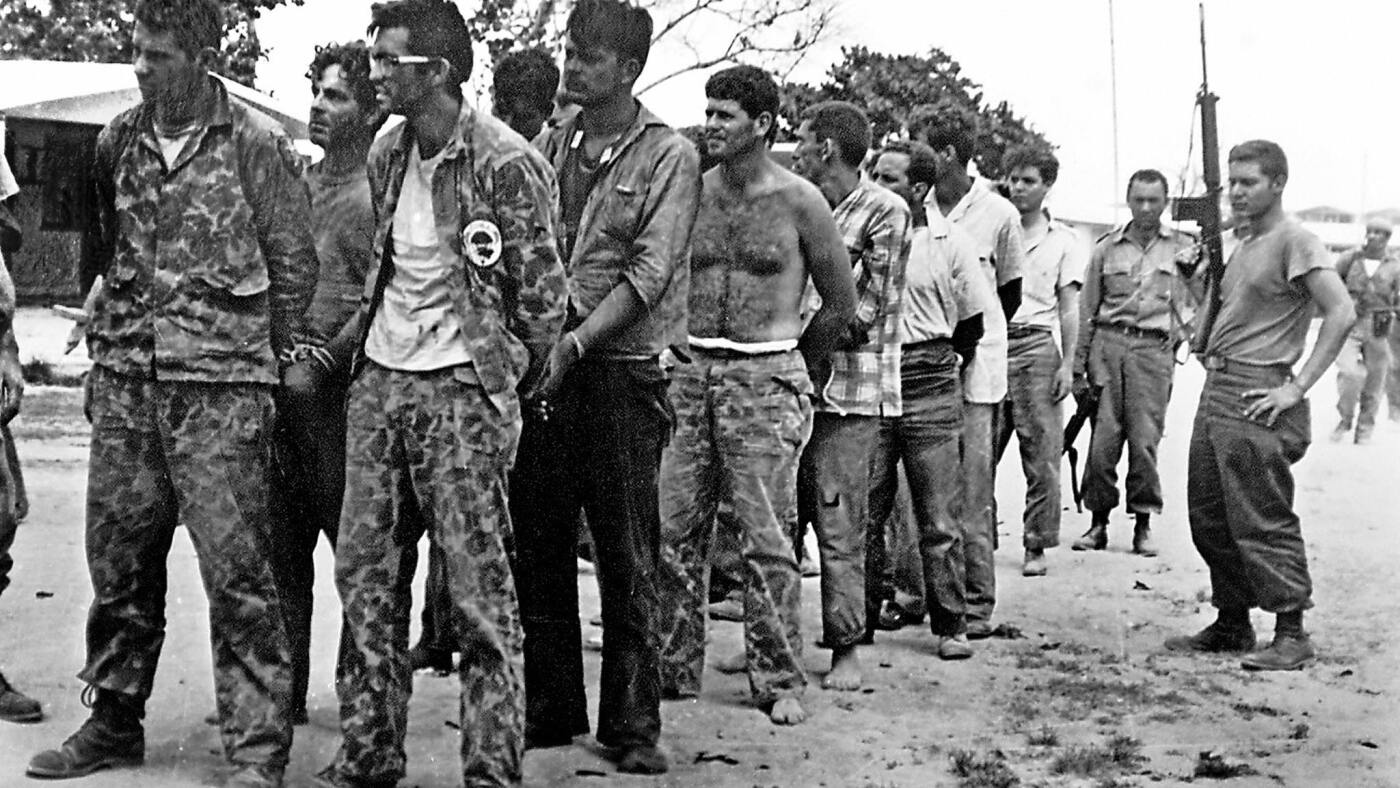
An April 1961 file photograph exhibits a gaggle of CIA-backed Cuban counterrevolutionaries after their seize within the Bay of Pigs, Cuba.
Miguel Vinas/AFP by way of Getty Photos
cover caption
toggle caption
Miguel Vinas/AFP by way of Getty Photos
President Trump’s strain marketing campaign towards Venezuelan chief Nicolás Maduro is the newest chapter in an extended historical past of U.S. intervention within the Caribbean basin, rooted within the 1823 Monroe Doctrine however absolutely realized within the twentieth century — ostensibly to guard U.S. pursuits and counter communism.

In latest months, U.S. strikes on boats that the White Home says have been transporting Venezuelan medicine, the seizure of Venezuelan oil tankers, and most lately, a CIA strike on a Venezuelan dock replicate a “Large Stick” method to regional coverage that dates again greater than a century to President Theodore Roosevelt. In it, Roosevelt constructed on the Monroe Doctrine, which was formulated initially by President James Monroe to warn European powers away from interfering within the area.
Roosevelt, who himself fought towards Spain in Cuba in 1898, expanded that doctrine to say a U.S. proper to behave unilaterally as a regional policeman — utilizing navy power to strengthen diplomatic strain to advance its pursuits.
Following World Struggle II, and particularly for the reason that Cuban Revolution that introduced Fidel Castro to energy in Havana, that focus shifted primarily to stopping what Washington mentioned was the potential unfold of communism within the area.
“In the course of the Chilly Struggle, intervention was principally covert. Within the Nineteen Eighties, you start to see extra overt actions,” says Eduardo Gamarra, a professor of politics and worldwide relations at Florida Worldwide College.
U.S. coverage within the area was considered one of strategic denial, Gamarra says. That meant deterring non-American actors within the area.
“Within the 1800s, that meant Europeans; within the twentieth century, particularly after World Struggle II, it meant the Soviet Union,” he says.

This led to a shared post-World Struggle II notion between the U.S. and lots of right-wing governments in Latin America that communism “was not indigenous to the Americas,” says Edward Murphy, a professor of historical past at Michigan State College. “They justified this by means of the logic of the Monroe Doctrine, as a result of this was a overseas ideology that wanted to be extirpated from the Americas.”
By the mid-Nineteen Eighties, the U.S. “transitioned from the Chilly Struggle to the drug struggle” within the area, in accordance with Gamarra.
U.S. coverage, underpinned by the Monroe Doctrine, has formed the area within the many years since World Struggle II, resulting in overt and covert interventions which have usually — however not all the time — resulted in unhealthy outcomes and unintended penalties.
Listed below are 5 examples:
The overthrow of Guatemala’s authorities
By 1954, President Dwight D. Eisenhower was involved a couple of Guatemalan land-reform program that nationalized property owned by the U.S.-based United Fruit Firm (now Chiquita Manufacturers Worldwide). The initiative was carried out underneath Guatemalan President Jacobo Árbenz, the nation’s second democratically elected chief, whose time period started in 1951. Secretary of State John Foster Dulles accused Árbenz of creating what he described as a “communist-type reign of terror.”

Indigenous girls beg in Guatemala in June 2004 in entrance of a propaganda mural that speaks towards U.S. interventions within the area.
Orlando Sierra/AFP by way of Getty Photos
cover caption
toggle caption
Orlando Sierra/AFP by way of Getty Photos
The U.S., Gamarra says, “responded by undermining Árbenz and supporting a navy coup.”
The CIA launched a profitable covert plan of psychological warfare designed to destabilize the Árbenz authorities whereas backing a coup to topple it. Coup chief Carlos Castillo Armas, who got here to energy after Árbenz, was the primary in a collection of brutal U.S.-backed authoritarians to rule Guatemala earlier than civilian rule returned within the mid-Nineteen Eighties.

The U.S. overthrow of Árbenz emboldened right-wing components within the nation to have interaction in a marketing campaign of repression, Murphy says. “What the overthrow of Árbenz actually did was fortify intolerant forces in Guatemala.”
Murphy says what occurred in Guatemala grew to become a mannequin for different repressive right-wing governments within the area, reminiscent of Chile, to comply with.
The Bay of Pigs invasion

Fidel Castro’s troopers at Playa de Giron, Cuba, after thwarting the ill-fated U.S.-backed Bay of Pigs invasion in 1961.
Graf/Getty Photos/Hulton Archive
cover caption
toggle caption
Graf/Getty Photos/Hulton Archive
Shortly after taking workplace in 1961, President John F. Kennedy permitted a covert plan to overthrow Cuban chief Fidel Castro, who had grown more and more aligned with the Soviet Union since seizing energy two years earlier. The key operation, initially developed underneath the Eisenhower administration, relied on a power of about 1,400 CIA-trained Cuban exiles who have been anticipated to grab the Bay of Pigs on Cuba’s southern coast and spark a well-liked rebellion towards Castro.

As a substitute, the Bay of Pigs invasion led to catastrophe. Castro ordered some 20,000 troops to the seaside, forcing a lot of the U.S.-backed invasion power to give up. Greater than 100 have been killed. The incident grew to become a significant embarrassment for the US.
The Bay of Pigs satisfied Castro and Soviet chief Nikita Khrushchev that the US would try one other invasion of Cuba. Castro satisfied Khrushchev he wanted Soviet nuclear weapons in Cuba to discourage additional U.S. aggression, precipitating the Cuban Missile Disaster in 1962. The ensuing confrontation over the missiles introduced the U.S. and the Soviet Union to the brink of nuclear struggle earlier than Kennedy and Khrushchev labored out a fragile compromise that averted a direct battle between the 2 superpowers.

It was an excessive Chilly Struggle confrontation that got here near a nuclear disaster, Gamarra says. The long-term penalties, he says, resulted in “a misguided embargo that hasn’t modified the regime and as a substitute consolidated Cuba’s relationship with the Soviet Union and now Russia.”
The U.S. invasion of Grenada
By 1983, the southern Caribbean island of Grenada was present process a interval of political instability after the 1979 overthrow of Prime Minister Eric Gairy by Maurice Bishop, a socialist chief aligned with Cuba and the Soviet Union.
“Cuba was making inroads throughout the Caribbean,” Gamarra says.
President Ronald Reagan’s White Home was suspicious of Havana’s involvement within the development of a big worldwide airport in Grenada, which had solely gained independence from Britain in 1974.
In its first main fight deployment for the reason that finish of the Vietnam Struggle, U.S. forces landed on Oct. 25, 1983, as a part of Operation Pressing Fury. Reagan cited regional safety considerations and the necessity to shield U.S. medical college students attending the island’s St. George’s College College of Medication as justification for intervention.

U.S. troopers arrest suspected Marxist activist in St. George’s, the capital of the Grenada Island, on Oct. 30, 1983, three days after American forces invaded the island, ousting the Marxist authorities.
AFP/by way of Getty Photos
cover caption
toggle caption
AFP/by way of Getty Photos
Though U.S. forces encountered stronger resistance and extra logistical difficulties than anticipated, navy operations took only some days. The U.S. helped set up a provisional authorities and elections have been held in 1984.
Since then, Grenada has skilled secure, democratic governance, with elections and peaceable transfers of energy. At this time, it’s typically considered extra politically secure than most of its Caribbean neighbors.
U.S. assist for the Nicaraguan Contras
After many years of U.S. assist for the oppressive and corrupt Somoza household that dominated Nicaragua, Anastasio Somoza was overthrown in 1979 throughout a well-liked rebellion led by the Sandinista Nationwide Liberation Entrance (FSLN). Daniel Ortega, a dedicated Marxist on the time and distinguished FSLN chief, assumed management of the federal government.
President Reagan opposed the Sandinistas and in 1981 issued a covert directive for U.S. support to assist a gaggle of anti-Sandinista insurgents generally known as the Contras.
In 1982, the U.S. Congress handed the Boland Modification to dam U.S. assist for the Contras. Regardless of these restrictions, the Reagan administration secretly continued aiding the group by means of a scheme that illegally offered weapons to Iran and funneled the proceeds to the Nicaraguan rebels. When the operation was uncovered, it grew to become probably the most vital scandals of Reagan’s presidency: the Iran-Contra affair.

U.S. Military Lt. Col. Oliver North, former aide to Nationwide Safety Adviser John Poindexter, is sworn in on July 7, 1987, earlier than the Home and Senate Overseas Affairs Committee listening to in Washington, D.C., on arms gross sales to Iran and diversion of earnings to Nicaraguan Contra rebels.
Chris Wilkins/AFP by way of Getty Photos
cover caption
toggle caption
Chris Wilkins/AFP by way of Getty Photos
“The Contra struggle was devastating — socially, economically, and politically,” says Murphy.
Regardless of efforts to topple him, Ortega remained in energy and received a decisive electoral victory in 1984. He misplaced in 1990 to Violeta Chamorro, a rich, U.S.-educated newspaper proprietor who served as president till 1997.
“In the long run, it was … gentle energy that led to the Sandinistas’ loss within the elections and the victory by Chamorro,” Gamarra notes.
Subsequently, Ortega’s political stance advanced away from Marxism, and he received elections in 2006, 2011, 2016 and 2021. At this time Ortega is president of Nicaragua alongside along with his spouse, co-President Rosario Murillo.
Murphy says it is a completely different Ortega now — one which “appears to be like extra like a Somoza authorities than a Sandinista authorities as a result of it is a household dictatorship.”
Ortega and Murillo, who Murphy calls “the facility behind the throne,” have “adopted virtually to the letter what Somoza was doing.”
The U.S. invasion of Panama
Though brutal and corrupt, Panama’s Gen. Manuel Noriega was helpful to the U.S. within the Nineteen Eighties, as a result of de facto chief’s cooperation with the CIA in offering a base of operations for the Contras in Nicaragua.
However Noriega’s drug trafficking, which included a relationship with infamous Colombian narcotrafficker Pablo Escobar, quickly reworked him right into a internet legal responsibility for the U.S. By 1986, mounting proof of his ties to drug cartels, extrajudicial killings and promoting of U.S. secrets and techniques to Japanese European governments was a humiliation. In 1988, federal grand juries in Miami and Tampa indicted Noriega on racketeering, drug smuggling and cash laundering prices.

Panamian chief Gen. Manuel Antonio Noriega, proper, fakes a punch to a supporter on Might 2, 1989, on the laying of the muse of a gaggle residence within the neighborhood of Panama Metropolis the place boxer Roberto Duran was born. Months later, Noriega can be pushed from energy by a U.S. invasion of Panama.
Manoocher Degahti/AFP by way of Getty Photos
cover caption
toggle caption
Manoocher Degahti/AFP by way of Getty Photos
The next 12 months, President George H.W. Bush took workplace. Bush was briefly CIA director within the Nineteen Seventies, when Noriega was thought of a helpful intelligence asset. However in 1989, Bush determined that Noriega wanted to go. The administration backed a failed coup try in October. However two months later, Bush launched Operation Simply Trigger, an invasion by 20,000 U.S. troops that in the end overthrew Noriega and took him into U.S. custody.
Since Noriega’s ouster, Panama has maintained a secure democracy with common, peaceable elections and vital financial development.
Gamarra says Panama is a uncommon instance of a profitable American intervention within the area. “We went in there, we removed Manuel Noriega,” he says.
“We had a transparent exit plan, which isn’t one thing the U.S. is excellent at anyplace else,” Gamarra says, referring to the emphasis on capturing Noriega in a fast and restricted navy operation. At this time, he says, “at the least when it comes to its financial system, [Panama] continues to be terribly profitable.”
Nonetheless, Murphy is much less sanguine.
“I do not suppose the invasion is liable for something constructive that comes later,” he says, “aside from the truth that Noriega was not in energy.”
[ad_2]