[ad_1]
The nationwide aim is for youngsters to be literate by the top of Grade 3, to make sure that they don’t fall behind in later phases of education. Reaching this might be an uphill battle.
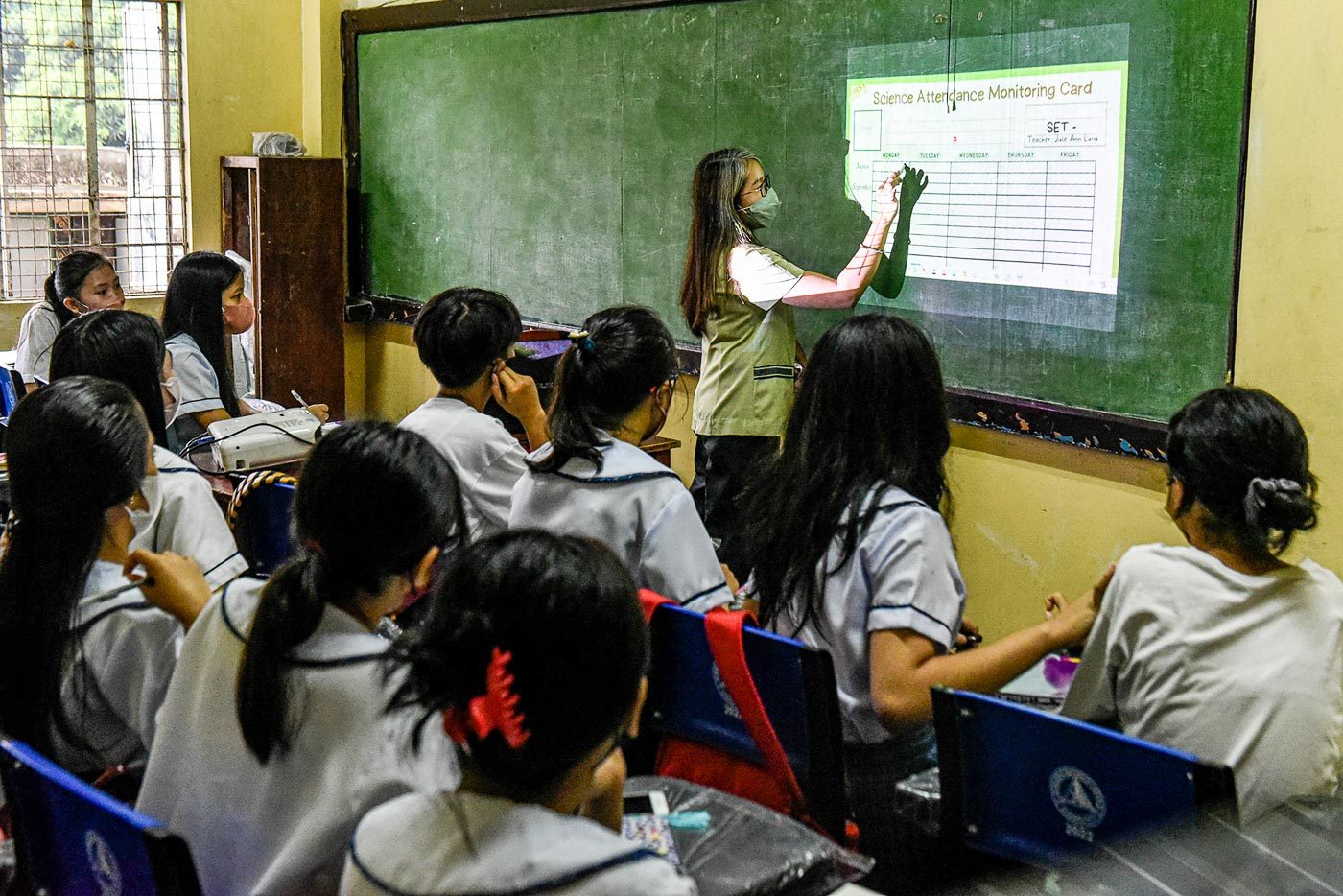
MANILA, Philippines – The power literacy disaster within the nation calls for pressing options, with current information exhibiting that almost 9 out of 10 college students getting into Grade 7 usually are not “grade-level prepared” in terms of studying.
The Remaining Report of the Second Congressional Fee on Schooling (EDCOM 2), launched on Monday, January 26, confirmed that the proportion of struggling readers is at 88% in Grade 7, or the primary 12 months of junior highschool.
EDCOM 2 additionally famous that 40% to 52% of all junior highschool college students “are at the least two grade ranges down in studying.”
The fee’s findings had been based mostly on information from assessments performed by the Division of Schooling (DepEd).

“Regardless of highschool attendance and close to common early childhood participation, the system continues to battle with guaranteeing that years of education translate into precise mastery of primary literacy,” EDCOM 2 mentioned.
Within the Philippines’ Ok to 12 system, kindergarten to Grade 3 comprise Key Stage 1, which focuses on foundational abilities. The nationwide aim is for youngsters to be literate by the top of Grade 3, to make sure that they don’t fall behind in later phases of education.
Reaching that aim could be an uphill battle, because the DepEd’s Complete Speedy Literacy Evaluation confirmed 48.76% or practically half of scholars from Grades 1 to three not studying at their respective grade ranges on the finish of college 12 months 2024-2025.
From early childhood to maturity
Many may additionally carry the burden of illiteracy into maturity. The Philippine Statistics Authority’s 2024 Useful Literacy, Schooling, and Mass Media Survey (FLEMMS) confirmed that almost 30% of Filipinos aged 10 to 64 are functionally illiterate, or have issue with comprehension.
“Being functionally illiterate means struggling to observe written directions, compute primary bills, learn medicine labels, or full kinds required for employment or public companies. These deficits translate immediately into diminished company and restricted participation in civic and financial life,” EDCOM 2 mentioned.
In an analytical piece printed on Rappler in Could 2025, EDCOM 2 Government Director Karol Mark Yee had written that the literacy disaster “is a problem to our nationwide survival.”
“It’s deeply associated to malnutrition, impacts alternative and productiveness, and perpetuates cycles of poverty,” Yee wrote.
Apparently, the problem has additionally existed for at the least a century. Yee identified within the newest EDCOM 2 report that 100 years in the past, a authorities evaluation already confirmed poor literacy amongst Filipino college students.
“The 1925 Monroe Survey warned that solely 40% of Grade 4 kids may learn on the anticipated degree, and pointed to weak trainer preparation, an overcrowded curriculum, and the persistent drawback of rural communities,” Yee mentioned.
This was adopted by comparable assessments in 1960 that “uncovered deep inequities,” and in 1991, when EDCOM 2’s predecessor EDCOM 1 “declared the system ‘in a state of disaster.’”
What now, a long time later?
As a part of its Remaining Report, EDCOM 2 introduced the Nationwide Schooling Plan (NatPlan), a 10-year roadmap for 2026 to 2035 that seeks to deal with the issues which have lengthy plagued the sector.
The NatPlan identifies the useful literacy of early learners as one of many key precedence areas, and gives the next suggestions to develop this specifically:
- “Deal with classroom backlog and congestion in colleges”
- “Revise procurement tips and DepEd insurance policies to make sure full and well timed supply of textbooks”
- Present web entry and digital assets
- “Finish ‘mass promotion’ in colleges” or the follow of letting learners advance to the subsequent degree regardless of low mastery; absolutely implement the Tutorial Restoration and Accessible Studying (ARAL) Program
- “Cut back administrative burden on academics”
EDCOM 2 did notice that the ARAL Program, established by Republic Act No. 12028 in October 2024, has had “early wins” in offering free tutorials and assets to struggling Ok to 10 learners.
At Malanday Elementary Faculty in Marikina Metropolis, for example, college students from Grades 1 to three categorized as “Creating, Transitioning, and Grade-Degree Prepared” jumped from 57.26% at first of college 12 months 2025-2026 to 94.03% by the center of the college 12 months.
Underneath the NatPlan, EDCOM 2 hopes to extend the proportion of Key Stage 1 learners studying at grade degree from lower than 50% to 75% by 2028, 90% by 2031, and 95% by 2035.
Additionally it is concentrating on grade-ready Grade 10 college students who had been assessed in Filipino to extend from 42.1% to 57% by 2028, 72% by 2031, and 87% by 2035. For individuals who had been assessed in English, the aim is to carry up the determine from 18.1% to 33% by 2028, 48% by 2031, and 63% by 2035. – Rappler.com
[ad_2]