[ad_1]
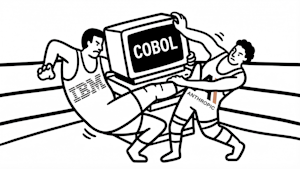
On Tuesday, Anthropic revealed instruments that permit Claude learn, analyze and translate legacy COBOL into trendy languages like Java and Python. By the top of the buying and selling day, buyers had wiped roughly $40 billion from IBM's market cap — the corporate's greatest single-day drop in 25 years — pricing the announcement as an existential risk to IBM's mainframe enterprise.
The response was swift. It was additionally constructed on a basic misreading of why enterprises run mainframes within the first place.
IBM's COBOL is 66 years previous. It was designed in 1959, runs on IBM mainframes, and continues to energy transaction processing methods with an estimated 250 billion strains of COBOL in energetic manufacturing, in response to the Open Mainframe Challenge.
The engineers who wrote it are retiring; those changing them largely can not learn it. For many years, that abilities hole has been one in every of enterprise IT's costliest unsolved issues — and one IBM has been working to repair with AI since no less than 2023, when it launched watsonx Code Assistant for Z to assist migrate COBOL to trendy Java.
Claude Code, Anthropic says, can now analyze complete codebases, map hidden dependencies, and generate working translations of code that the majority engineers immediately can not learn. For enterprises working COBOL on distributed platforms — Home windows, Linux and different non-mainframe environments — that functionality is genuinely helpful and more and more sensible.
The precise barrier was by no means technical
"Modernizing COBOL has been a technically solved drawback for some time," Matt Brasier, analyst at Gartner, advised VentureBeat. "The actual drawback is that the prices of modernization are excessive and the ROI is low."
Amazon and Google have been providing AI-powered COBOL migration instruments for years. AWS Rework and a comparable Google Cloud Platform service each focused the identical drawback: lowering friction for patrons seeking to transfer mainframe workloads to the cloud.
"That is principally yet one more supply of competitors," Raj Joshi, senior vice chairman at Moody's Scores, advised VentureBeat. "IBM has all the time lived in a really aggressive area. On the margin, this factor is principally destructive, no query about that. There's yet one more highly effective competitor. However IBM has coexisted with these threats."
Steve McDowell, chief analyst at NAND Analysis, cuts to the structural argument: "Purposes don't run on mainframes as a result of they're written in COBOL," he mentioned. "They run on mainframes as a result of mainframes ship a category of determinism, scalable compute and reliability that common goal servers can't match."
The difficulty runs deeper than market positioning. "GenAI instruments are useful, however their non-deterministic nature means the ensuing code is just not constant — the identical operation shall be applied in several methods in several components of the code," Brasier mentioned. "Main instruments mix deterministic and non-deterministic approaches. None of this solves the ROI drawback, although."
What COBOL translation leaves unsolved
"Translating COBOL is the straightforward half," IBM communications director Steven Tomasco advised VentureBeat. "The actual work is knowledge structure redesign, runtime alternative, transaction processing integrity, and hardware-accelerated efficiency constructed over a long time of tight software program and {hardware} coupling. That’s the drawback IBM has spent a long time studying to resolve, and AI is probably the most highly effective instrument we now have ever needed to do it."
In keeping with IBM, Royal Financial institution of Canada, the Nationwide Group for Social Insurance coverage and ANZ Financial institution have all used watsonx Code Assistant for Z to speed up modernization of COBOL code with out transferring off IBM Z.
That doesn’t imply Anthropic has no aggressive foothold. For enterprises working COBOL outdoors the mainframe — on distributed methods, Home windows and Linux environments — Claude Code enters an area the place IBM's vertical integration is much less of a bonus. "IBM understands mainframe know-how at a stage that others can't match. If I'm solely taking a look at COBOL, I'm utilizing IBM's watsonx," McDowell mentioned. "Anthropic, nevertheless, has a broader footprint inside loads of improvement groups, the place a single vendor makes it worthwhile."
What enterprise consumers ought to truly do
Senior knowledge and infrastructure engineers will spend the subsequent few weeks fielding questions from executives who noticed the headlines and assumed the arduous drawback simply bought solved. It didn’t.
"It's COBOL, however there are quite a few functions tied to it," Joshi mentioned. "It's not such as you remodel hundreds of thousands of strains and in some way you’re able to go to cloud. It's a large threat evaluation, dependencies and all these issues."
The extra helpful query for consumers is whether or not this week's noise creates a gap. Braiser thinks it does.
"They need to use the ensuing board-level and shareholder discussions to overview postponed modernization initiatives and see if any of them now have ROI," Brasier mentioned.
McDowell was blunt on the aggressive query. "Will Anthropic take enterprise from IBM's instrument? Sure, after all," he mentioned. "However I'd be stunned if that instrument was making important income for IBM."
Chirag Mehta, analyst at Constellation Analysis, cautioned that IT leaders mustn’t react emotionally or rewrite technique in a single day.
"Deal with this as a purpose to run a small, bounded pilot to measure outcomes, not as a purpose to tear and substitute distributors," Mehta advised VentureBeat.
Mehta means that enterprises decide one well-scoped utility slice or workflow with clear inputs and outputs, and consider approaches apples-to-apples: high quality of dependency mapping, high quality of recovered enterprise logic documentation, take a look at protection and equivalence checks, efficiency and reliability regressions.
In Mehta's view, the larger reminder is that modernization is greater than changing code. The arduous components are extracting institutional data, transforming processes and controls, change administration, and containing operational threat in methods that can’t break. AI can compress the “evaluation and translation” work, but it surely doesn’t get rid of the governance and accountability burden.
"The groups that win will deal with AI as an accelerator inside a disciplined modernization program, with measurable checkpoints and threat guardrails, not as a magic conversion button," Mehta mentioned.
[ad_2]