[ad_1]
Most enterprise RAG pipelines are optimized for one search habits. They fail silently on the others. A mannequin educated to synthesize cross-document reviews handles constraint-driven entity search poorly. A mannequin tuned for easy lookup duties falls aside on multi-step reasoning over inside notes. Most groups discover out when one thing breaks.
Databricks got down to repair that with KARL, brief for Data Brokers through Reinforcement Studying. The corporate educated an agent throughout six distinct enterprise search behaviors concurrently utilizing a brand new reinforcement studying algorithm. The end result, the corporate claims, is a mannequin that matches Claude Opus 4.6 on a purpose-built benchmark at 33% decrease value per question and 47% decrease latency, educated fully on artificial knowledge the agent generated itself with no human labeling required. That comparability is predicated on KARLBench, which Databricks constructed to judge enterprise search behaviors.
"Quite a lot of the massive reinforcement studying wins that we've seen in the neighborhood previously 12 months have been on verifiable duties the place there’s a proper and a improper reply," Jonathan Frankle, Chief AI Scientist at Databricks, instructed VentureBeat in an unique interview. "The duties that we're engaged on for KARL, and which can be simply regular for many enterprises, are usually not strictly verifiable in that very same means."
These duties embody synthesizing intelligence throughout product supervisor assembly notes, reconstructing aggressive deal outcomes from fragmented buyer data, answering questions on account historical past the place no single doc has the complete reply and producing battle playing cards from unstructured inside knowledge. None of these has a single right reply {that a} system can verify mechanically.
"Doing reinforcement studying in a world the place you don't have a strict proper and improper reply, and determining how one can information the method and ensure reward hacking doesn't occur — that's actually non-trivial," Frankle mentioned. "Little or no of what firms do day after day on data duties are verifiable."
The generalization entice in enterprise RAG
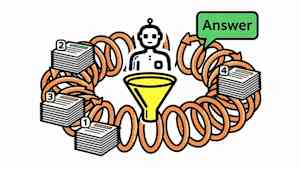
Commonplace RAG breaks down on ambiguous, multi-step queries drawing on fragmented inside knowledge that was by no means designed to be queried.
To judge KARL, Databricks constructed the KARLBench benchmark to measure efficiency throughout six enterprise search behaviors: constraint-driven entity search, cross-document report synthesis, long-document traversal with tabular numerical reasoning, exhaustive entity retrieval, procedural reasoning over technical documentation and reality aggregation over inside firm notes. That final job is PMBench, constructed from Databricks' personal product supervisor assembly notes — fragmented, ambiguous and unstructured in ways in which frontier fashions deal with poorly.
Coaching on any single job and testing on the others produces poor outcomes. The KARL paper reveals that multi-task RL generalizes in methods single-task coaching doesn’t. The staff educated KARL on artificial knowledge for 2 of the six duties and located it carried out effectively on all 4 it had by no means seen.
To construct a aggressive battle card for a monetary providers buyer, for instance, the agent has to determine related accounts, filter for recency, reconstruct previous aggressive offers and infer outcomes — none of which is labeled anyplace within the knowledge.
Frankle calls what KARL does "grounded reasoning": operating a troublesome reasoning chain whereas anchoring each step in retrieved details. "You may consider this as RAG," he mentioned, "however like RAG plus plus plus plus plus plus, all the best way as much as 200 vector database calls."
The RL engine: why OAPL issues
KARL's coaching is powered by OAPL, brief for Optimum Benefit-based Coverage Optimization with Lagged Inference coverage. It's a brand new method, developed collectively by researchers from Cornell, Databricks and Harvard and revealed in a separate paper the week earlier than KARL.
Commonplace LLM reinforcement studying makes use of on-policy algorithms like GRPO (Group Relative Coverage Optimization), which assume the mannequin producing coaching knowledge and the mannequin being up to date are in sync. In distributed coaching, they by no means are. Prior approaches corrected for this with significance sampling, introducing variance and instability. OAPL embraces the off-policy nature of distributed coaching as an alternative, utilizing a regression goal that stays secure with coverage lags of greater than 400 gradient steps, 100 instances extra off-policy than prior approaches dealt with. In code technology experiments, it matched a GRPO-trained mannequin utilizing roughly thrice fewer coaching samples.
OAPL's pattern effectivity is what retains the coaching finances accessible. Reusing beforehand collected rollouts moderately than requiring recent on-policy knowledge for each replace meant the complete KARL coaching run stayed inside a couple of thousand GPU hours. That’s the distinction between a analysis undertaking and one thing an enterprise staff can realistically try.
Brokers, reminiscence and the context stack
There was quite a lot of dialogue within the trade in latest months about how RAG could be changed with contextual reminiscence, additionally typically known as agentic reminiscence.
For Frankle, it's not an both/or dialogue, moderately he sees it as a layered stack. A vector database with tens of millions of entries sits on the base, which is simply too giant for context. The LLM context window sits on the high. Between them, compression and caching layers are rising that decide how a lot of what an agent has already realized it could carry ahead.
For KARL, this isn’t summary. Some KARLBench duties required 200 sequential vector database queries, with the agent refining searches, verifying particulars and cross-referencing paperwork earlier than committing to a solution, exhausting the context window many instances over. Fairly than coaching a separate summarization mannequin, the staff let KARL study compression end-to-end via RL: when context grows too giant, the agent compresses it and continues, with the one coaching sign being the reward on the finish of the duty. Eradicating that realized compression dropped accuracy on one benchmark from 57% to 39%.
"We simply let the mannequin determine how one can compress its personal context," Frankle mentioned. "And this labored phenomenally effectively."
The place KARL falls brief
Frankle was candid in regards to the failure modes. KARL struggles most on questions with important ambiguity, the place a number of legitimate solutions exist and the mannequin can't decide whether or not the query is genuinely open-ended or simply exhausting to reply. That judgment name remains to be an unsolved downside.
The mannequin additionally reveals what Frankle described as giving up early on some queries — stopping earlier than producing a remaining reply. He pushed again on framing this as a failure, noting that the costliest queries are sometimes those the mannequin will get improper anyway. Stopping is commonly the best name.
KARL was additionally educated and evaluated solely on vector search. Duties requiring SQL queries, file search, or Python-based calculation are usually not but in scope. Frankle mentioned these capabilities are subsequent on the roadmap, however they aren’t within the present system.
What this implies for enterprise knowledge groups
KARL surfaces three choices price revisiting for groups evaluating their retrieval infrastructure.
The primary is pipeline structure. In case your RAG agent is optimized for one search habits, the KARL outcomes counsel it’s failing on others. Multi-task coaching throughout various retrieval behaviors produces fashions that generalize. Slender pipelines don’t.
The second is why RL issues right here — and it's not only a coaching element. Databricks examined the choice: distilling from knowledgeable fashions through supervised fine-tuning. That method improved in-distribution efficiency however produced negligible positive factors on duties the mannequin had by no means seen. RL developed basic search behaviors that transferred. For enterprise groups going through heterogeneous knowledge and unpredictable question varieties, that distinction is the entire sport.
The third is what RL effectivity really means in observe. A mannequin educated to look higher completes duties in fewer steps, stops earlier on queries it can’t reply, diversifies its search moderately than repeating failed queries, and compresses its personal context moderately than operating out of room. The argument for coaching purpose-built search brokers moderately than routing every little thing via general-purpose frontier APIs is just not primarily about value. It’s about constructing a mannequin that is aware of how one can do the job.
[ad_2]