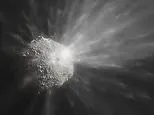
Humanity advances planetary defense capabilities after NASA’s DART mission alters an asteroid system’s path around the Sun, according to recent research.
The DART Mission Success
In 2022, NASA intentionally crashed the DART spacecraft into Dimorphos, a small moonlet orbiting the larger asteroid Didymos, at 14,000 mph. The collision changed Dimorphos’s orbit around Didymos, shortening it by 33 minutes. This marked the first successful demonstration of kinetic impact for asteroid deflection.
The impact ejected a massive cloud of debris, providing extra thrust that reshaped the 560-foot-wide moonlet and propelled material into space.
New Findings on Solar Orbit Change
Researchers from the University of Illinois Urbana-Champaign analyzed nearly 6,000 instances where Didymos passed in front of stars, blocking their light. Their calculations reveal the collision reduced Didymos’s orbital speed around the Sun by 11.7 micrometres per second—equivalent to 1.7 inches per hour.
This subtle shift represents the first measurable alteration of a celestial body’s solar orbit by a human-made object. Although Didymos itself escaped a direct hit, its gravitational link to Dimorphos transmitted the effect.
“This is a tiny change to the orbit, but given enough time, even a tiny change can grow to a significant deflection,” stated Thomas Statler, lead scientist for solar system small bodies at NASA Headquarters. “The team’s precise measurement validates kinetic impact as a technique for defending Earth and shows how targeting one member of a binary pair can deflect the system.”
Rahil Makadia, lead author of the study published in Science Advances, noted: “The change in the binary system’s orbital speed was about 11.7 microns per second. Over time, such a small change can make the difference between a hazardous object hitting or missing our planet.”
Implications for Planetary Defense
The discovery highlights targeting moonlets to indirectly adjust larger asteroids’ paths. NASA emphasizes early detection of near-Earth objects to deploy kinetic impactors effectively.
The agency develops the Near-Earth Object (NEO) Surveyor telescope to spot hard-to-detect threats like dark asteroids and comets.
Dr. Nancy Chabot, planetary scientist at Johns Hopkins University and DART mission lead, warns: “DART was a great demonstration, but no similar spacecraft stands ready for an immediate threat.” She cited asteroid 2024 YR4, initially with a 3.2% Earth impact chance in 2032, later ruled out.
“If something like 2024 YR4 headed toward Earth, we lack a way to deflect it actively now,” Chabot added.
Alternative Asteroid Deflection Methods
Multiple Kinetic Impacts: Simulations suggest carbonaceous asteroids like Bennu may require several small bumps for deflection.
Nuclear Explosion: Detonating a device nearby could fragment the asteroid, risking dangerous debris.
Ion Beam Deflection: A probe’s thrusters gently push the asteroid’s surface while maintaining distance.
Gravity Tractor: A spacecraft uses gravity to tug the asteroid without contact.
Professor Colin Snodgrass, astronomer at the University of Edinburgh, affirms: “The kinetic impactor remains the simplest technology for asteroids with years-to-decades warning.”