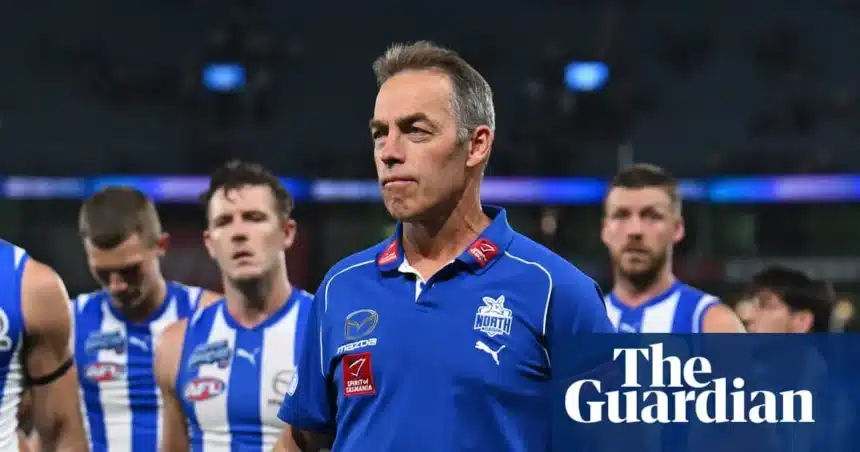
Alastair Clarkson’s departure from North Melbourne marks the end of a highly anticipated but ultimately unfulfilled chapter for both the renowned coach and the struggling club. When Clarkson took the reins in August 2022, he was arguably the most significant figure in Australian Rules Football, embarking on what was described as the most challenging role he could find. At the time, North Melbourne was in a precarious position, with key players like Jason Horne-Francis seeking opportunities elsewhere.
Clarkson’s Challenging Start at North Melbourne
Clarkson’s initial press conference at North Melbourne was deeply personal. He spoke candidly about how the club had provided him with a crucial support system following the tragic death of his brother in a car accident. He acknowledged the often unforgiving nature of the sports industry but also highlighted the presence of good people and moments of unexpected grace. He was supported by club president Dr. Sonja Hood, whose approach contrasted sharply with his former Hawthorn president, Jeff Kennett. Hood, who ran over 100 programs supporting children from non-English speaking backgrounds, was described by some as “uninspiring” but demonstrated remarkable resilience, securing Clarkson against significant industry pressure.
The path to Clarkson’s official start was fraught with difficulty. Just weeks after his appointment, and days before the Grand Final, allegations of racism at Hawthorn surfaced, casting a shadow over his transition. Despite the intense scrutiny and the possibility of his appointment being derailed, North Melbourne stood by him. The club actively promoted Clarkson’s unique persona, emphasizing his quirky traits, such as visiting players’ homes with a guitar, drawing parallels to the character David Brent. The Kangaroos secured an initial victory, winning their first two games, including a notable away win against a strong Fremantle side.
The Reality of a Rebuilding Task
However, the pressures of the Hawthorn investigation and the immense task of coaching a rebuilding North Melbourne began to take a significant toll on Clarkson. Despite his reputation for resilience and an ability to compartmentalize, he was visibly struggling. Reports emerged of him throwing chairs at halftime and experiencing sleep difficulties. Former player Jordan Lewis noted the pervasive public scrutiny, stating that “every interaction he has now is loaded.” North Melbourne’s CEO, Jen Watt, acknowledged the immense pressure Clarkson was under.
Upon his return to coaching after an extended break, Clarkson faced a team in a state of significant disarray. The prevailing expectation was that he would replicate his Hawthorn success, transforming North Melbourne into a formidable force. However, the landscape of the 2020s presented a vastly different challenge compared to his previous coaching tenure. The strategies that worked in 2005, such as intensive team-building camps like the Kokoda Track trek, were no longer feasible or effective. Crucially, Clarkson lacked the caliber of elite players and emerging leaders he had at Hawthorn, such as Sam Mitchell and Luke Hodge, and did not have the luxury of recruiting a generational talent like Lance Franklin. Furthermore, the support staff and assistant coaches at North Melbourne did not match the quality he had previously enjoyed.
Frustration and Unfulfilled Potential
In press conferences, Clarkson’s message remained consistent: “Stick with us. We’re getting closer. At some point it will turn.” This mantra was repeated after heavy defeats and narrow losses, but the constant calls for patience began to wear thin with fans and observers alike. While the team showed flashes of brilliance, securing nine wins in the most recent season, many of these victories were against the league’s bottom-ranked teams. Notable performances against Carlton on Good Friday and the Western Bulldogs offered glimpses of hope, but several losses were particularly disappointing.
Clarkson’s visible frustration on the sidelines, characterized by a perpetual frown, mirrored the team’s inconsistent performances. There were periods of play, or even entire halves, that would extinguish any optimism. A particularly dire loss to Fremantle in Bunbury was described by Clarkson himself as “soul-destroying.” While North Melbourne’s teams were not devoid of talent, featuring promising players in the midfield and forward lines, they were often characterized by their frustrating inconsistency. The team would execute intricate plays only to falter on simple finishing, or gain territorial advantage only to concede costly free kicks that led to rapid opposition scores. These momentum shifts often resulted in quick barrages of goals against them.
A Sisyphean Task and a Look Ahead
Clarkson’s task at North Melbourne was, in many ways, a Sisyphean one – a monumental effort against overwhelming odds. While his departure may seem sudden to some, a closer examination reveals the inherent difficulties of the situation. The club and coach never managed to achieve the optimal version of their partnership. Looking forward, the club might consider experienced figures like John Longmire or Adam Simpson, both premiership coaches and former North Melbourne players, who appear well-suited for the rebuilding challenge. However, the club had similar high hopes for Clarkson, underscoring the cyclical nature of coaching appointments and the enduring challenge of revitalizing a struggling AFL team.
Ultimately, Alastair Clarkson’s tenure at North Melbourne highlights the complex interplay of coaching ambition, club circumstances, and the harsh realities of professional sport. While the potential for success was immense, the confluence of external pressures and internal challenges meant that the best version of this partnership remained elusive.