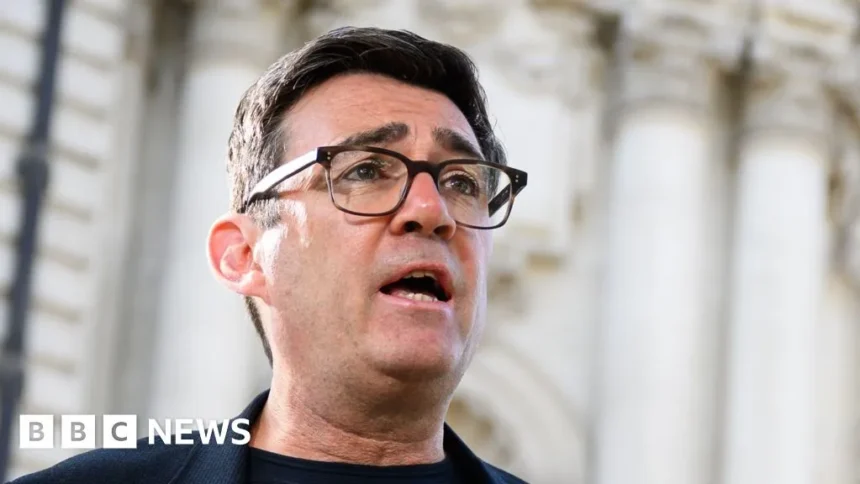
Andy Burnham’s Return to Westminster
Andy Burnham, a veteran of Labour leadership races, garners strong support from numerous Labour MPs as the party’s potential path to revival following poor poll performances and recent electoral setbacks. Over a decade ago, he competed twice for the party’s top position without success. The key hurdle remains his status outside Parliament, a prerequisite for leadership candidacy.
In a recent development, Burnham secured an agreement from Labour MP Josh Simons to step aside in the Makerfield constituency, paving the way for a potential by-election run. Labour’s national executive committee (NEC) must still approve his candidacy, followed by local party selection and victory in a competitive election where Reform UK placed second by 5,399 votes in 2024 and dominated local polls last week.
Burnham stated: “I truly do not take a single vote for granted and will work hard to regain the trust of people in the Makerfield constituency, many of whom have long supported our party but lost faith in recent times. We will change Labour for the better and make it a party you can believe in again.”
If selected, he plans to campaign on his achievements as mayor of Greater Manchester, where voters have re-elected him three times in landslides. He pledges to “make politics work properly for people” nationwide.
Early Life and Rise in Politics
Born in Liverpool in 1970 and raised in Culcheth, Cheshire, Burnham comes from a Labour-supporting family—his father a BT engineer and mother a GP receptionist. At 14, the TV drama Boys from the Blackstuff, depicting unemployment in Liverpool, inspired him to join the Labour Party.
A dedicated Everton supporter and competitive sports enthusiast, Burnham excelled as a fast bowler for Lancashire schoolboys cricket. At his local Roman Catholic school, he won a mock Labour candidacy by a landslide, as recalled by his English teacher.
The first in his family to attend university, Burnham studied English at Cambridge, though he later described feeling like an outsider there. His passion for northern indie bands like The Smiths and The Stone Roses provided a sense of identity.
Post-graduation, he entered journalism with roles at trade publications such as Tank World and Passenger World Management. In his early 20s, he joined politics as a researcher for Tessa Jowell, then MP for Dulwich and West Norwood.
Cabinet Roles and Leadership Challenges
Burnham entered Parliament in 2001 as MP for Leigh, Greater Manchester. He advanced rapidly, serving as a junior minister under Tony Blair and later as chief secretary to the Treasury, culture secretary, and health secretary under Gordon Brown.
During his culture secretary tenure, heckling at a Hillsborough disaster memorial—marking the 1989 stadium crush that killed 97 Liverpool fans—prompted him to advocate for a second inquiry in cabinet.
After Labour’s 2010 election loss, Burnham finished fourth in the leadership race won by Ed Miliband. He ran again in 2015, placing behind Jeremy Corbyn, yet served as Corbyn’s shadow home secretary without resigning in protest.
In 2017, he left Westminster to become Greater Manchester’s first mayor, securing over 60% of the vote and winning re-election by larger margins in 2021.
Mayoral Achievements and National Profile
As mayor, Burnham overhauled regional transport, making Greater Manchester the first area outside London to publicize bus services under the “Bee Network” brand, integrating them with other modes. He aimed to end rough sleeping by 2020, though the goal was not met.
His prominence surged during the Covid pandemic when he criticized the Conservative government for “contempt” toward northern England over lockdown rules, earning the moniker “King of the North.”
By autumn 2025 party conference, Burnham hinted at leadership ambitions without ruling out a bid. His comments on government fiscal constraints drew criticism. An earlier January opportunity in Gorton and Denton fell through after NEC blockage.
Burnham retains influential parliamentary allies, including deputy leader Lucy Powell, Culture Secretary Lisa Nandy, and former minister Louise Haigh. However, with Reform UK surging in polls and strong local results, a Makerfield victory remains uncertain.