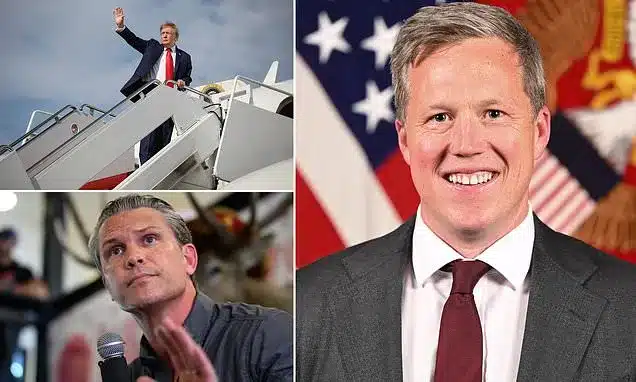
Army Secretary Dan Driscoll is reportedly preparing to step down from his position by the end of the year, a move that follows months of reported friction with Defense Secretary Pete Hegseth. Sources familiar with the situation have indicated to The Wall Street Journal that the resignation could occur sooner rather than later. This development marks another significant leadership change within Washington’s defense circles.
Leadership Shake-up in the Army
The potential departure of Secretary Driscoll comes after a period characterized by disagreements with Secretary Hegseth on several key issues. These reported clashes include Hegseth’s actions to halt the promotions of several Army officers and the dismissal of a key ally of Driscoll in April. The situation has led to a notable shift in Army leadership, with Chief of Staff Randy George also having been removed from his post earlier this year by Hegseth. This removal means the Army currently lacks a Senate-confirmed leader, as former President Donald Trump has not yet put forward a nominee for George’s position. Both Driscoll and George held roles that required Senate confirmation.
General Christopher LaNeve, a former aide to Hegseth, has been appointed as the interim replacement for Chief of Staff George. The circumstances surrounding George’s ouster are complex, with reports suggesting a connection to Driscoll. The New York Post indicated in April that Driscoll’s close relationship with George may have contributed to the latter’s firing. An unnamed official reportedly stated that Hegseth had harbored concerns about Driscoll potentially succeeding him, particularly in the wake of an incident referred to as the “March 2025 group chat fiasco.”
One source close to the situation commented, “This is all driven by the insecurity and paranoia that Pete has developed since Signal-gate. Unfortunately, it is stoked by some of his closest aides who should be trying to calm the waters.” The White House had previously expressed support for Driscoll, with a source indicating that Hegseth was unable to dismiss Driscoll at that time. The same source elaborated on Hegseth’s perceived concerns, stating, “He is very concerned about being fired and he knows that Driscoll is one of the top contenders, or a natural contender, to succeed him.” The removal of George has been interpreted by some as an effort to sideline individuals seen as aligned with Driscoll, who is also rumored to be close to Vice President JD Vance.
Disagreements Over Promotions and Personnel
The reported tensions between Driscoll and Hegseth have reportedly centered on significant personnel decisions. One area of contention involved Hegseth’s decision to block the promotions of several officers, including two Black and two female officers slated for promotion to one-star general positions. Additionally, the controversial appearance of Apache helicopters outside the home of musician Kid Rock was cited as another issue that arose during this period.
Sources have indicated that Chief of Staff George attempted to discuss the blocked promotions with Hegseth but was reportedly rebuffed. This occurred amidst a broader pattern of senior officer dismissals initiated by Hegseth, affecting figures such as Chairman of the Joint Chiefs of Staff General CQ Brown, Chief of Naval Operations Admiral Lisa Franchetti, Air Force Vice Chief of Staff General James Slife, and Defense Intelligence Agency head Lieutenant General Jeffrey Kruse.
While one senior Pentagon official reportedly suggested to The Washington Post that Driscoll had been too focused on his political aspirations rather than his duties concerning soldier training and equipment, others have disputed this assessment. These individuals highlighted Driscoll’s background in venture capital and his prior service as an Army cavalry scout platoon leader in Iraq. They credited him with implementing significant institutional changes and maintaining a focus on core military functions, steering clear of divisive cultural issues.
Driscoll and George’s Working Relationship
Chief of Staff Randy George, who was appointed during the Biden administration, was understood to have had differing views on the Army’s direction compared to the Trump administration’s agenda. However, individuals familiar with the dynamics within the Army indicated that Driscoll had previously intervened when Hegseth sought to remove General George, who received Senate confirmation in 2023. George had been a target for removal partly because he was selected by the previous administration and had served as a senior military assistant to former Defense Secretary Lloyd Austin.
George had also publicly supported diversity training for military personnel, viewing it as a component of building cohesive teams. During his tenure, he collaborated closely with Secretary Driscoll. Reports suggest Driscoll supported George’s initiatives to explore and adopt new technologies, such as drones. The two officials reportedly traveled to Ukraine together last year to observe lessons learned from the ongoing conflict.
An official familiar with their interactions stated, “There have been multiple instances where Secretary Hegseth has tried to remove George and Driscoll has said, ‘No he’s done nothing wrong. He’s good.'” This official added that Driscoll had consistently maintained that “merit should speak for itself.” The exact reasons for George’s ultimate removal remain unclear, but it followed the aforementioned issues concerning blocked promotions and the helicopter incident.
Personal Relocation Amidst Leadership Changes
Adding a personal dimension to the reported leadership tensions, Secretary Driscoll has reportedly moved out of official housing at Joint Base Myer-Henderson Hall in Virginia. While he has retained a smaller apartment on the base, his family has relocated to North Carolina. This personal move occurs as the Army navigates significant leadership transitions and reported internal disagreements.
The Army and the Pentagon have been contacted for comment regarding these developments. The situation underscores the dynamic and often complex nature of high-level appointments and personnel decisions within the Department of Defense.