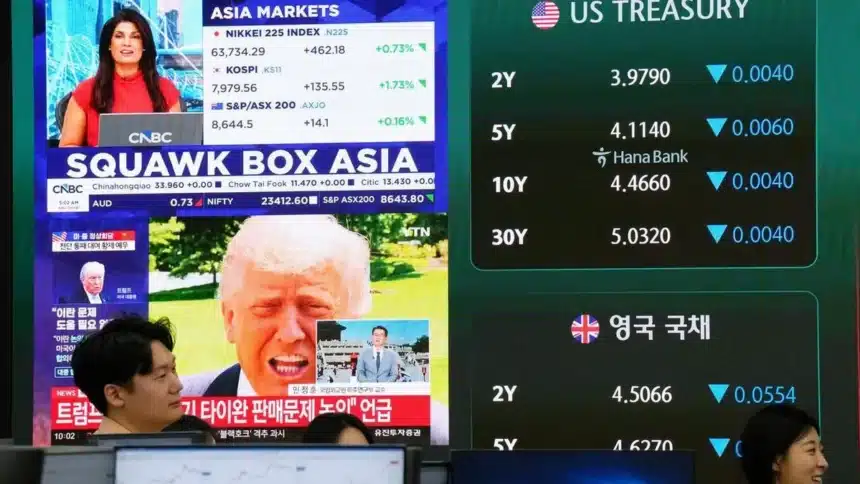
Most Asian stock markets are poised for weekly declines as persistent stress in global bond markets continues to weigh on investor sentiment. Simultaneously, geopolitical tensions in the Gulf have propelled oil prices to a one-month high, intensifying concerns about ongoing inflation risks.
Global Bond Market Pressures Escalate
Yields on U.S. Treasury bonds resumed their upward trajectory following a brief respite after an unexpected intervention by the Treasury Department. Despite Treasury Secretary Scott Bessent signaling potential increases in government bond repurchases and hinting at fiscal consolidation, market participants remain skeptical. Analysts question whether sufficient spending cuts can be achieved to meaningfully address a budget deficit exceeding 6% of the gross domestic product, especially with interest payments alone projected to reach $1.2 trillion this year.
Steven Zeng, a strategist at Deutsche Bank, cautioned that markets historically resist when they perceive fundamental economic factors, such as record debt levels and substantial deficits, are in their favor. He suggested that further interventions could become prohibitively expensive.
This skepticism was reflected in market movements, with 30-year bond yields climbing back to 5.25% and 10-year yields reaching 4.71%. Investors appear to view 5.30% as a critical resistance level for Treasuries, analogous to the 160.00 yen level for Japanese policymakers.
Impact on Global Debt and Corporate Valuations
The rise in global yields increases borrowing costs worldwide. This poses a significant challenge for technology companies, which are heavily investing in artificial intelligence (AI) infrastructure and data centers. Higher yields also reduce the present value of future corporate earnings and can put downward pressure on stock valuations.
The financial strain was evident in the Japanese market, with the Nikkei index falling 0.8% and accumulating a 4.4% loss for the week. While markets in South Korea and Taiwan saw slight gains, they too are on track for weekly decreases. The MSCI’s broadest index of Asia-Pacific shares, excluding Japan, managed a modest 0.5% increase.
European markets showed signs of weakness, with futures for the EURO STOXX 50 and DAX indices trading slightly lower, and FTSE futures dipping 0.1%. In contrast, U.S. stock markets found some support from a robust earnings season. S&P 500 futures were up 0.1%, and Nasdaq futures gained 0.2%.
Nvidia Earnings and AI Sector Outlook
A key event to watch next week is the earnings report from Nvidia, a major player in the AI sector. Much of the market’s anticipation hinges on Nvidia’s guidance regarding demand for AI infrastructure and its data center revenue projections. The recent performance of Walmart, which slid 9% after missing sales expectations, serves as a reminder of the potential consequences when high market expectations are not met.
Geopolitical Tensions Drive Oil Prices Higher
Adding to market anxieties, U.S. Treasury Secretary Scott Bessent elaborated on the administration’s stance towards Iran, vowing to impose the “toughest sanctions in history.” This rhetoric has diminished hopes for a diplomatic resolution that could fully reopen the vital Strait of Hormuz. Consequently, Brent crude oil prices surged to a one-month high of $94.71 per barrel before some profit-taking occurred. Brent futures were last trading down 0.7% at $93.12, but remained over 5% higher for the week. U.S. crude also eased 0.7% to $86.18 per barrel.
Dollar Weakens Amid Debt and Inflation Concerns
In currency markets, the U.S. dollar has experienced broad losses for the week. Growing concerns about the escalating U.S. national debt and policy uncertainties are fueling a narrative that the currency’s purchasing power may erode. This has prompted some investors to seek refuge in perceived safe-haven assets, such as gold.
Jonas Goltermann, chief markets economist at Capital Economics, noted that the dollar is facing renewed pressure, partly driven by a resurgence of the “debasement” narrative. The dollar index has fallen nearly 0.9% for the week, hitting a three-month low. The euro, conversely, has strengthened, gaining 1.0% against the dollar for the week and reaching a 14-week peak.
The dollar has shown more resilience against the Japanese yen, which faces its own set of economic challenges. The yen held steady at 159.07 against the dollar.
Japanese Inflation and Monetary Policy Expectations
Recent data indicated an acceleration in Japan’s core consumer inflation in July, as companies passed on increased import costs to consumers. This development strengthens the case for a potential interest rate hike by the Bank of Japan in September. However, markets have already priced in a quarter-point increase to 1.25%, and investors are looking for clearer signals of more aggressive monetary tightening from policymakers.
Gold prices remained stable at $4,513 per ounce, having risen 3.1% over the course of the week, reflecting its appeal as an alternative asset amid dollar weakness and broader market uncertainty.
Conclusion
The confluence of rising global bond yields, elevated oil prices driven by geopolitical tensions, and persistent concerns over U.S. debt levels is creating a challenging environment for Asian markets. While corporate earnings have provided some support in the U.S., upcoming key events like Nvidia’s earnings report and ongoing monetary policy considerations in Japan will be crucial in shaping market sentiment in the near term.