Villagers Celebrate as Long-Blocked Bridleway is Reopened
Jubilant residents cheered as council workers dismantled gates and cleared overgrowth on Monday, officially reopening a disputed bridleway in Little Berkhamsted, Hertfordshire. The move marks the end of a bitter six-year legal battle that saw the public pathway blocked by a homeowner.
Homeowners’ Legal Challenge and Potential European Appeal
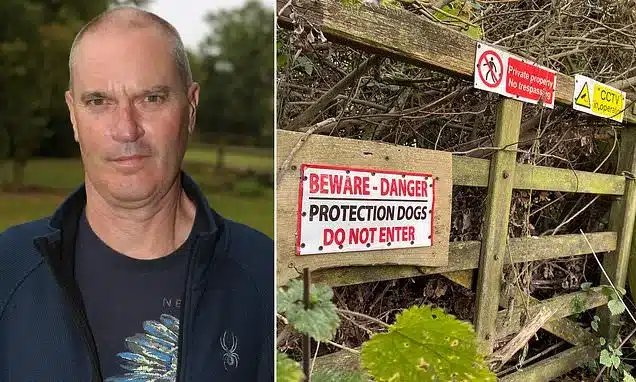
David and Dawn Moore, aged 63 and 59 respectively, had invested an estimated £325,000 in legal fees, taking their case to the High Court. They contended that the public pathway did not traverse their property, which they describe as a ‘multi-million pound’ home. The couple has now indicated plans to appeal to the European Court of Human Rights, citing a breach of their property rights, which could escalate their total expenditure to approximately £400,000.
Council Enforcement Action
County council employees arrived at the Moores’ property to remove the barriers after the couple reportedly ignored a formal notice to reinstate the bridleway for public access. Workers were observed dismantling three gates and clearing thick brambles that had encroached upon the route. An ambulance was called to the scene twice, reportedly due to Mrs. Moore, a cancer specialist, feeling unwell during the enforcement action. Work paused temporarily on both occasions before resuming.
During the proceedings, David Moore approached onlookers who were filming the scene. When one individual stated they were cheering because the bridleway was now open, Mr. Moore responded angrily, questioning if they were happy with the situation occurring at the expense of his wife’s health.
Community Reactions and Previous Rulings
Wayne Morris, chairman of the parish council, expressed his satisfaction with the resolution after nearly six-and-a-half years. He highlighted the significant waste of time and money on a matter that he believes was clear from the outset. Morris added that any impact on Mrs. Moore’s health is a direct consequence of their persistent refusal to acknowledge the established truth and their lack of consideration for neighbors who endured a stressful legal process.
Another local resident, who preferred to remain anonymous, stated they had no sympathy for the homeowners, emphasizing that people had been denied access for six years. This resident also pointed out the lack of consideration for neighbors who had to navigate busy roads with horses during harsh winter months or the impact on others’ well-being.
History of the Dispute
The dispute centers on Breach House, a six-bedroom property dating back to the 17th century. The Moores purchased the house for £1.2 million in 2015 and undertook extensive renovations. In 2019, locals discovered the public right of way, which they asserted had existed for at least 100 years across the 1.75-acre grounds, was blocked by signs and locked gates. The Moores, however, claimed the bridleway should run between two nearby cottages.
Hertfordshire County Council issued an order confirming the bridleway’s route through the property, leading the Moores to appeal to the Planning Inspectorate. During a four-day hearing, a senior definitive map officer noted that council investigations dating back to 1956 had concluded the path ran through Breach House. While the initial ‘Definitive Map’ three years later showed an incorrect route, the accompanying statement provided the correct information.
Nigel Adams, founder of BigBlackHen.com and whose parents owned Breach House from 1973 to 1985, stated he had discussed the existing bridleway and its route through the property with the Moores during the 2015 sale. William Marques, a former resident from the 1960s, also recalled the bridleway passing through the house, describing it as a safer alternative to the busy road to his grandparents’ home.
Conversely, Mr. Moore asserted at the inquiry that the council had acknowledged in 2020 that the bridleway signs near his home were incorrect, leading to their removal. He maintained that he was not informed of a bridleway crossing the property at the time of his purchase. Following the planning inspector’s ruling against them, the Moores took their case to the High Court, where the judge upheld the villagers’ position and questioned the plausibility of the claimants’ argument. Their request to appeal to the Court of Appeal was denied last year.
In a previous interview, Mr. Moore indicated his intention to pursue human rights arguments under Article 8 and Article 1, Schedule 1 of the ECHR, focusing on the decision to alter his defined purchase parameters from 2015. He emphasized the right to what was purchased after conducting due diligence.
Financial Investment and Ongoing Disagreements
Regarding the substantial legal costs incurred, Mr. Moore previously stated that the expense was secondary to the principle of being right or wrong. He indicated his wife fully supported their legal battle, as both believe the council is at fault for providing inaccurate documentation at the time of their purchase. Mr. Moore described his actions as a logical approach based on the position presented in 2015 and his belief in their correctness.
The dispute has reportedly caused animosity within the community. Mr. Moore has filed complaints regarding alleged criminal damage, including scratches to his vehicles, and harassment. The owners of the two neighboring cottages, including Mr. Morris, have also reportedly invested tens of thousands of pounds in their own legal expenses.
Council’s Legal Obligation and Enforcement
A spokesperson for Hertfordshire County Council confirmed that contractors had attended the site to remove obstructions from the bridleway, ensuring public access. The council is legally obligated to maintain the free usability of public rights of way for the public and landowners. The spokesperson added that a formal notice was served on the landowner, outlining their legal obligations, but as the obstructions remained, enforcement powers were utilized to physically remove them.
Mr. Moore had previously informed the planning inquiry that the council had admitted in 2020 that the bridleway signs near his residence were incorrect.