Prime Minister Mark Carney’s administration commissioned polls late last year to assess public views on law and order. Conducted in November and December, the surveys revealed that Canadians perceived limited progress in tackling issues from home invasions to cybercrime. Respondents expressed concerns over fair treatment of crime victims and strongly supported stricter bail conditions for certain offenses and harsher penalties for repeat offenders.
Government Acknowledges Public Concerns
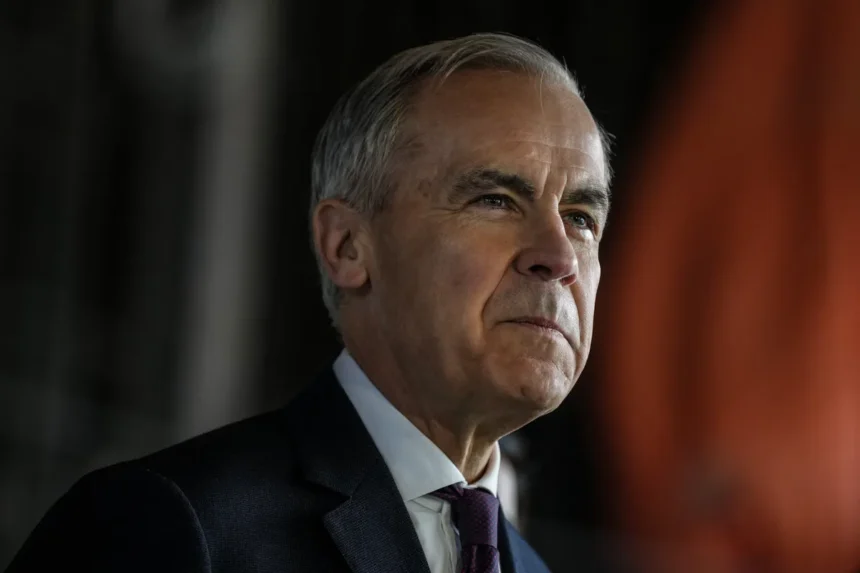
Ahead of a visit to a law enforcement facility in Brampton, Ontario, Prime Minister Carney admitted the government falls short of public expectations on crime fighting. “This needs to be a relentless focus using all the powers of the federal government,” Carney told reporters. “We are starting to see results. We’re not satisfied and we’re going to keep at this.”
Polling Insights and Regional Variations
Pollster Dan Arnold of Pollara Strategies noted that the Liberal Party’s image on crime contributed to weak election performances in areas like Brampton, Ontario; Surrey, British Columbia; and parts of Calgary last spring. “It’s fair to say Liberals don’t always feel comfortable talking about crime because there’s a wing of the party that is much more about not getting tough on criminals but going to root causes and trying to rehabilitate criminals,” Arnold said. “And while a wing of the Liberal Party feels that way, the broader public is very much in a view where they want to get tough on criminals.”
Arnold highlighted Carney’s shift toward a firmer stance. “It’s similar to a lot of what Carney’s doing on energy and environment where he is moving to what is seen to be more of a rightward position on crime,” he added.
Among 2,000 respondents surveyed November 10-23, 87 percent felt safe in their communities, yet over 55 percent believed crime rates were rising nationwide. In Alberta, Saskatchewan, and Manitoba, 65 percent reported increases, compared to 39 percent nationwide who saw stability or declines.
Actions and Public Awareness
The government has advanced bail reforms, bolstered border security, proposed a gun buyback program, and allocated funds for additional police hires. However, awareness remains low: only 17 percent of respondents in November polls had noticed federal efforts to reduce crime, with 78 percent unaware.
Over 40 percent in most provinces viewed crime management as on the “wrong track,” while fewer than 33 percent saw it positively. Quebec bucked the trend, with 45 percent approving and 26 percent disapproving.
Canadians widely consider courts too lenient on offenders, except in Quebec where 49 percent agreed versus nearly two-thirds elsewhere. A majority—54 percent—felt victims receive unfair treatment.
Carney emphasized public service over politics: “We come to it not from an electoral perspective … but from the perspective of serving and protecting the people of Brampton, the people of Peel region, the people of Ontario, and the people of Canada.”
In February, Carney visited Surrey, B.C., to discuss anti-crime measures with RCMP, focusing on extortion targeting South Asian communities. That day, Finance Minister François-Philippe Champagne, Secretary of State for Combatting Crime Ruby Sahota, and other MPs announced initiatives against extortion in Brampton.
“I would say any level of crime is too high,” Carney stated. “What is happening in many municipalities is we’re starting to see a decline in the level of crime. But there is understandably always going to be a lag before that materializes and it changes in view.”
These findings stem from Privy Council Office polls, conducted weekly via live-agent telephone surveys of 1,000 Canadians, with questions selected by the prime minister’s research director.