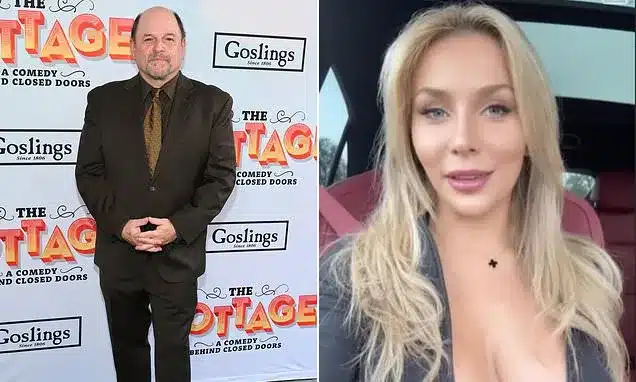
Courtney Stodden has publicly thanked actor Jason Alexander for his substantial donation to a nonprofit organization, an act that followed Alexander’s apology for a controversial comedy sketch they filmed together in 2012. At the time of the sketch, Stodden was 17 years old, while Alexander was 52.
The Controversial Sketch and Its Aftermath
The sketch, released by Funny or Die, featured Alexander rubbing his phone against a bikini-clad Stodden. This incident occurred during a period of intense media scrutiny for Stodden, largely due to her marriage to actor Doug Hutchison, which was finalized when she was 16 and he was 50. The age difference and Stodden’s youth at the time of the marriage drew significant public attention and criticism.
Recently, Stodden took to Instagram to address the sketch, calling out Alexander for his participation. In response, Alexander issued a public apology, expressing deep regret for the segment and any harm it may have caused Stodden. Stodden had suggested that Alexander demonstrate his remorse through concrete actions, such as supporting California Assembly Bill 1267, which aims to close legal loopholes allowing minors to marry with parental consent, or by donating to the nonprofit Unchained At Last, a co-sponsor of the bill.
Alexander’s Action and Stodden’s Response
Alexander responded to Stodden’s suggestion by donating $15,000 to Unchained At Last. The organization describes itself as dedicated to ending forced and child marriage in the United States through direct services and systemic change. Stodden shared her gratitude for this donation on Instagram, calling it a “beautiful gift” and thanking Alexander for “turn[ing] words into action.”
In her Instagram post on Friday, Stodden elaborated on her perspective: “Accountability isn’t about public punishment—it’s about taking meaningful steps that can help create change.” She noted that while Alexander’s initial apology was a welcome first step, his subsequent donation demonstrated a commitment to tangible change.
Stodden’s Realization and Call for Protection
Stodden revealed that her perspective on the sketch shifted significantly after watching the film Pretty Woman for the first time. She identified with Alexander’s villainous character, Philip Stuckey, in the movie, and seeing that portrayal triggered a realization of how inappropriate the sketch had been. “I was very manipulated,” Stodden stated, reflecting on the experience. “Even if I didn’t look like a child, or what a victim should look like, there was a child buried under there. I really just trusted the adults around me, and this is the effect of that.”
She emphasized that her motivation is not to dwell on her past but to advocate for better protections for minors. “Looking back on it, it’s really damaging. This isn’t about revisiting my past but changing the experiences for minors going forward so they don’t have to experience what I had to experience,” she explained. Stodden questioned how adults could deem such sexualization acceptable for a minor.
Legal Context and Past Experiences
During the filming of the sketch, Stodden was a minor navigating the complexities of her marriage to Hutchison, a situation that placed her under intense public scrutiny. She noted that as a minor, she lacked the legal authority to consent to or refuse participation in the sketch, with contracts being signed by adults. “I was a minor,” she stated. “I didn’t have the legal power to decide whether I wanted to participate. The contracts were signed by adults.”
Stodden’s representative further clarified that Stodden was not fully aware of the sketch’s content before arriving on set and was only instructed to bring a swimsuit. This lack of foreknowledge highlights the power dynamics involved when minors participate in media productions.
Beyond the sketch, Stodden has also spoken out about other media appearances during her youth. She recalled an appearance on Dr. Drew Pinsky’s show at age 16, where she underwent an ultrasound to verify claims about her body. Stodden described this experience as exploitative, stating that the money she received for the appearance went to her then-husband, whom she considered an abuser. She contrasted Alexander’s accountability with that of Dr. Drew, suggesting that more adults in her orbit failed to protect her as a minor.
Moving Forward: Advocacy and Change
Stodden’s engagement with Jason Alexander’s apology and donation signifies a step towards accountability and constructive action. Her advocacy for AB 1267 and her support for organizations like Unchained At Last underscore her commitment to preventing similar experiences for other young people. By drawing attention to the sketch and its implications, Stodden aims to foster greater awareness and implement legal and societal changes that better protect minors from exploitation and premature entry into adult responsibilities.
The situation highlights the ongoing dialogue surrounding the protection of minors in the entertainment industry and the importance of accountability from adults involved in their professional lives. Stodden’s efforts serve as a powerful reminder of the lasting impact of early experiences and the need for robust safeguards for vulnerable youth.