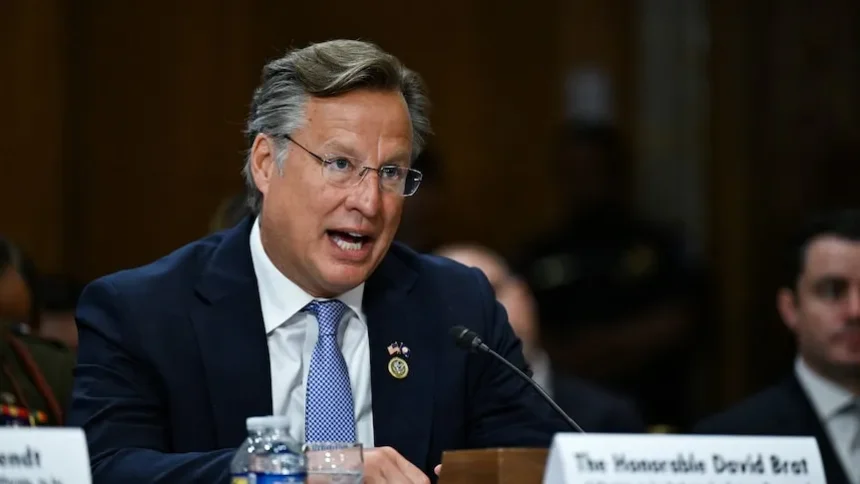
The United States Senate Foreign Relations Committee has officially confirmed David Brat as the nominee for U.S. Ambassador to Australia. This significant appointment marks a shift in diplomatic representation for the key Indo-Pacific ally, following a period of notable changes in U.S. diplomatic postings abroad.
Background of the Nominee
David Brat brings a background in public service to the ambassadorial role. He previously served as a Republican congressman representing Virginia’s 7th congressional district from 2015 to 2019. During his tenure in the House of Representatives, Brat was known for his conservative fiscal policies and his role on the House Financial Services Committee. His legislative experience provides a foundation for his understanding of U.S. policy and international relations.
Diplomatic Appointments and Tradition
The confirmation of Mr. Brat occurs amidst a broader context of changes in how diplomatic positions are being filled. Reports indicate that the current administration has recalled a number of career diplomats who were appointed during the previous presidential term under Joe Biden. This move, while not unprecedented, represents a departure from the traditional practice of retaining experienced foreign service officers in key ambassadorial roles for extended periods. Such shifts can sometimes lead to adjustments in diplomatic continuity and established working relationships.
Priorities for the Australian Posting
Upon his confirmation, David Brat outlined several key priorities he intends to focus on during his ambassadorship in Australia. These areas reflect the evolving strategic landscape and the deepening bilateral relationship between the two nations.
Critical Minerals Agreement
A significant focus for Mr. Brat will be advancing a critical minerals agreement. Australia is a major global supplier of essential minerals vital for modern technologies, including those used in renewable energy, defense systems, and advanced manufacturing. Securing and strengthening cooperation in this sector is seen as crucial for both U.S. and Australian economic and national security interests, particularly in diversifying supply chains and reducing reliance on geopolitical rivals.
Defense Cooperation
Enhancing defense cooperation is another cornerstone of Mr. Brat’s agenda. The United States and Australia share a long-standing and robust security alliance, formalized through treaties like ANZUS. This cooperation encompasses joint military exercises, intelligence sharing, and interoperability of forces. Mr. Brat is expected to work towards further strengthening these ties, ensuring seamless collaboration in addressing regional security challenges and maintaining stability in the Indo-Pacific.
Indo-Pacific Partnership
The broader partnership in the Indo-Pacific region will also be a central theme. Both nations are deeply invested in promoting a free, open, and prosperous Indo-Pacific. Mr. Brat’s role will involve reinforcing this shared vision, working with Australia and other regional partners to uphold international law, promote economic growth, and address shared challenges such as maritime security and climate change. This includes supporting initiatives aimed at strengthening regional architecture and ensuring a balanced power dynamic.
The U.S.-Australia Relationship
The appointment of an ambassador is a critical component of the bilateral relationship between the United States and Australia. Australia is one of the United States’ closest allies, sharing common democratic values, extensive economic ties, and deep security cooperation. The ambassador serves as the primary representative of the U.S. President and the American people, facilitating diplomatic, economic, and cultural exchanges.
The U.S.-Australia alliance has been a cornerstone of regional security for decades. It is characterized by extensive collaboration across various domains, including intelligence, defense, law enforcement, and scientific research. The strategic importance of Australia, particularly its geographic location in the Indo-Pacific, makes the bilateral relationship vital for U.S. foreign policy objectives in the region.
Looking Ahead
With David Brat’s confirmation, attention now turns to his arrival in Canberra and the commencement of his duties. His stated priorities suggest a proactive approach to deepening the already strong U.S.-Australia alliance. The focus on critical minerals, defense, and the broader Indo-Pacific partnership indicates an alignment with current geopolitical imperatives and a commitment to bolstering cooperation in areas of mutual strategic importance. The success of his ambassadorship will be measured by his ability to advance these objectives and further strengthen the enduring bond between the two nations.