A United Nations report has raised serious concerns that lethal strikes conducted by the Trump administration against alleged drug-trafficking vessels at sea could constitute crimes against humanity, violating international, maritime, and humanitarian law. The assessment, detailed in a briefing note prepared for the UN Human Rights Council, scrutinizes the legality and effectiveness of operations that have resulted in significant loss of life.
Extensive Military Action at Sea
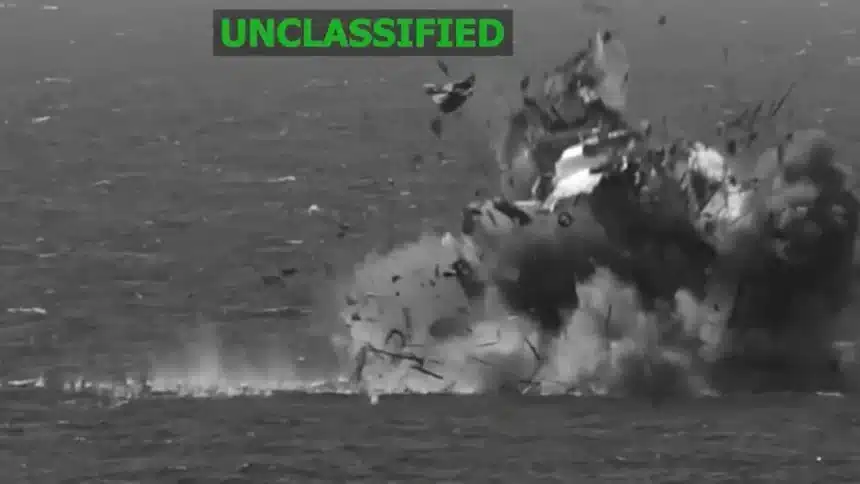
Since September of the previous year, the United States military has reportedly carried out air strikes on at least 68 vessels in the Pacific Ocean and the Caribbean Sea. These operations have led to the deaths of at least 223 individuals. The initiative, referred to as “Southern Spear,” has been defended by former President Donald Trump as a necessary measure in an armed conflict against Latin American drug cartels responsible for transporting illicit substances into the United States. Trump has characterized these actions as acts of “self-defence” against designated Foreign Terrorist Organizations, including groups such as Venezuela’s Tren de Aragua and Cartel de los Soles.
The commencement of these strikes coincided with heightened tensions, notably following the reported “capture” of former Venezuelan President Nicolás Maduro by U.S. forces in a covert military operation. The U.S. Southern Command has also been identified as targeting vessels believed to be serving as refueling stations for other drug-trafficking boats.
UN Special Rapporteur’s Findings
Ben Saul, the UN Special Rapporteur on the promotion and protection of human rights and fundamental freedoms while countering terrorism, prepared the briefing note. His assessment concluded that there is no legal basis to support the Trump administration’s justification for these strikes. According to the report, “Such attacks amount to serial extrajudicial killings in violation of the right to life.”
Saul’s comprehensive review examined the legality of the strikes across nine critical areas. These included the right to self-defense, the authority to target individuals within an armed conflict, and whether the force employed was reasonable and proportionate to the perceived threat. The report found “reasonable grounds” to believe that the strikes could be classified as a crime against humanity, characterizing them as part of “a widespread or systematic attack directed against any civilian population.”
Neither former President Trump, his cabinet members, nor White House officials have issued a public response to the UN report’s findings.
Impact on Drug Flow and Costs
A significant finding of the UN report is its assessment of the operation’s impact on drug trafficking. According to Mr. Saul, there is “growing evidence” suggesting that the military campaign has failed to reduce the volume of illicit drugs entering the U.S. The U.S. Drug Enforcement Agency reportedly indicated that the strikes have not led to a decrease in the overall price or supply of cocaine within the country, and that border seizures have remained consistent.
Furthermore, the report highlights that a substantial portion of cocaine in the region is transported via container ships, which are seldom inspected at ports and subsequently cross U.S. land borders. The report also points out that the military attacks have primarily focused on cocaine, neglecting the principal drivers of drug overdose fatalities in the United States—fentanyl and opioids—which are largely not trafficked by sea from Venezuela.
The financial cost of these operations has also been noted. The strikes have reportedly cost the U.S. government an estimated $4.7 billion.
International Cooperation and Concerns
Despite the UN report’s conclusions, former President Trump has previously indicated a potential expansion of strikes to other Latin American regions, including Mexico, Colombia, and Cuba. U.S. Secretary of State Marco Rubio recently visited several countries in the region to discuss issues such as drug trafficking and illegal migration. Following discussions in Colombia, President Abelardo De La Espriella announced an enhanced cooperation plan with the U.S., which has already involved U.S. forces participating in Colombian strikes and raids against drug cartels.
In Ecuador, the U.S. and Ecuadorian militaries have jointly conducted strikes on vessels off the country’s coast. Secretary Rubio confirmed efforts to secure $45 million in funding for Ecuador to combat drug trafficking. The UN report also cited a strike in the Amazonian village of San Martin, near the Colombian border, which involved “total extermination” and potentially included “enforced disappearance, torture and forced displacement” of targeted individuals.
These international efforts are part of the Trump administration’s “Shield of the Americas” coalition, a group comprising the U.S. and 19 Latin American nations aimed at dismantling drug cartels. Peru has also announced its intention to join this coalition.
Maduro Capture Operation
The UN report also detailed the operation to capture former Venezuelan President Nicolás Maduro. Described as more than a law enforcement action, the operation involved approximately 150 aircraft, naval vessels, and U.S. Army Delta Force special operations soldiers. This operation, which occurred on January 3 in Caracas, resulted in explosions and low-flying aircraft being visible across the city’s skyline. At least 75 people were reportedly killed during this operation. Mr. Saul characterized it as a “prohibited use of force,” granting Venezuela a right to self-defense due to its gravity and constituting an act of aggression under customary international law. The report further stated that such “transboundary abductions constitute arbitrary detention.”
The Trump administration has accused Maduro and his wife, Cilia Flores, of facilitating drug trafficking and firearms offenses detrimental to the U.S., allegations they both deny. Their trial in the U.S. is scheduled to commence on June 1, 2027.