European stock markets concluded their fourth consecutive week of gains, propelled by robust corporate earnings reports and increased merger and acquisition activity. The broad Stoxx Europe 600 Index saw a 0.3% rise by the close of trading, accumulating a 1.7% increase over the entire week. Leading the advance were the technology and healthcare sectors, while the energy sector experienced a downturn.
Corporate Highlights Drive Market Momentum
Several individual company performances significantly influenced the market’s upward trajectory. Goodwin Plc experienced a notable surge of 9.8% following reports that the company was evaluating the potential sale of a substantial portion of its mechanical engineering division. Similarly, Genel Energy Plc saw its stock price jump by 26% after it publicly disclosed and rejected an acquisition proposal from the Norwegian oil and gas firm DNO ASA. Conversely, Eutelsat Communications SACA faced a decline of 4.6% after its financial guidance failed to meet investor expectations.
Earnings Season Boosts Investor Confidence
The positive performance of European equities is largely attributed to a strong second-quarter earnings season, which has bolstered confidence in the region’s economic growth prospects. Data compiled by Bloomberg Intelligence indicates that companies within the MSCI Europe index reported an impressive 17% increase in second-quarter profits, marking the most significant surge since late 2022. This heightened profitability has encouraged investors to re-engage with European markets.
Inflows and Broad Market Strength
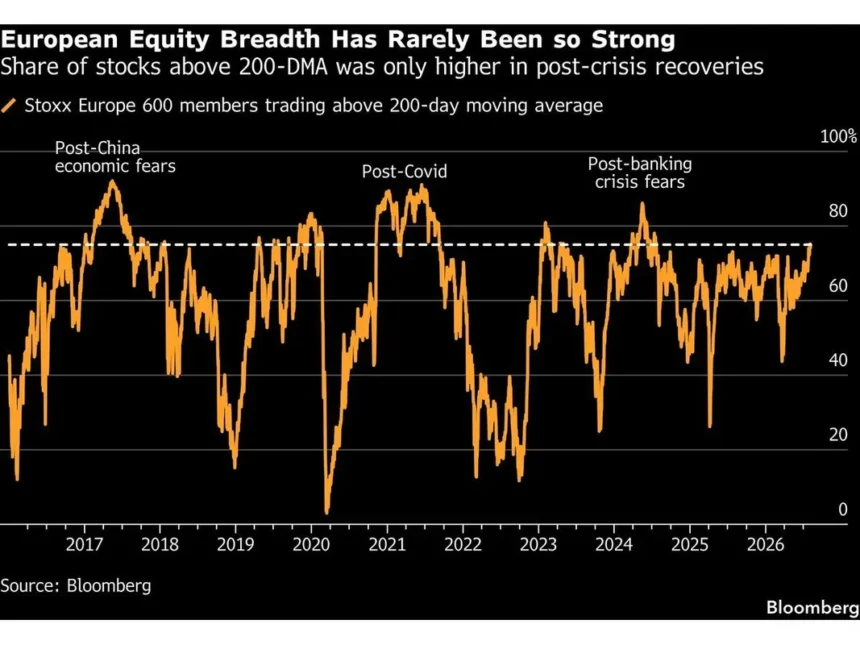
The renewed investor interest is reflected in capital flows. According to a note from Bank of America, citing EPFR Global data, European equity funds experienced inflows totaling $55 million in the week leading up to Wednesday. This marks the first week of positive inflows in three weeks. Furthermore, the market rally has demonstrated broader participation, extending beyond a few dominant companies. Approximately three-quarters of the companies listed on the Stoxx 600 index are currently trading above their 200-day moving average, a level often considered a key indicator of a bullish market trend and near the upper range observed over the past decade.
Navigating Geopolitical Risks and Liquidity Concerns
Despite the positive momentum, potential headwinds remain. Lingering geopolitical tensions and the typically thin liquidity characteristic of the summer months could pose challenges to sustained gains in the near future. Recent statements from US President Donald Trump regarding negotiations between Iran and Oman concerning the Strait of Hormuz, while suggesting progress, occurred amidst reports of Iranian lawmakers considering restrictions on American and Israeli vessels in the waterway. These developments underscore the sensitivity of global markets to geopolitical events.
Expert Outlook: Consolidation Expected
Analysts suggest that while Europe has successfully reclaimed record territory, the easiest phase of the current rally might be over. Ulrich Urbahn, head of multi-asset strategy and research at Berenberg, commented on the market’s position. “Europe has regained record territory, but the easy part of the rally may be behind us,” Urbahn stated. He further cautioned that “geopolitical or energy-related surprises could produce sharper, more volatile moves.” Berenberg’s base case scenario anticipates market consolidation rather than a significant downturn. This outlook suggests that investors should prepare for a period of sideways movement, with potential for increased volatility driven by external factors.
Key Market Drivers and Considerations
The current market environment is shaped by a confluence of factors:
- Strong Corporate Performance: A better-than-anticipated earnings season has provided a solid foundation for stock valuations.
- M&A Activity: Increased merger and acquisition discussions are injecting dynamism into specific sectors and companies.
- Investor Sentiment: Growing confidence in economic growth, supported by earnings, is attracting capital back to European equities.
- Technical Indicators: A broad market advance, with many stocks trading above their long-term averages, signals underlying strength.
- External Risks: Geopolitical developments and summer liquidity conditions represent potential sources of volatility.
Conclusion
The European stock market’s sustained upward trend over the past four weeks highlights the positive impact of a strong earnings season and increased M&A activity. While investor confidence appears to be growing, as evidenced by fund inflows and broad market participation, caution is warranted. Geopolitical uncertainties and seasonal liquidity constraints present risks that could lead to market consolidation or increased volatility in the coming weeks. Investors will likely be closely monitoring corporate updates and global political developments for further direction.