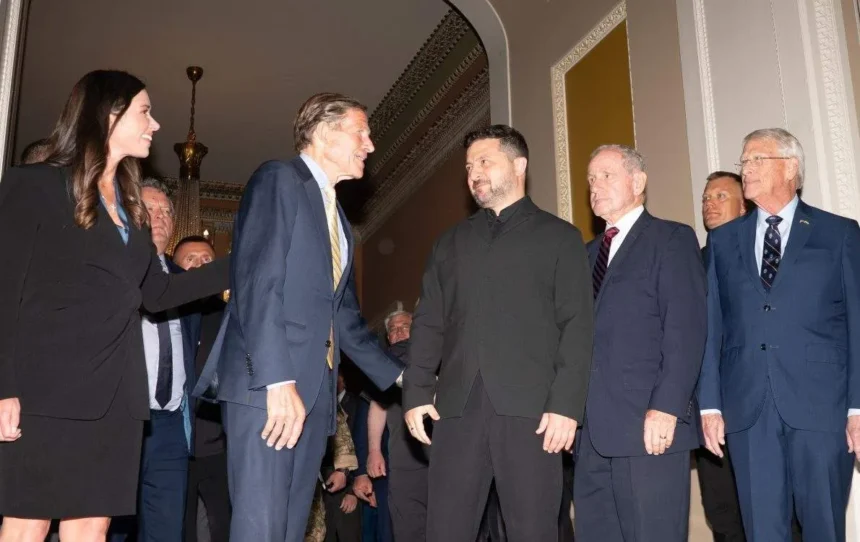
The United States Senate has overwhelmingly passed a significant sanctions package aimed at penalizing Russia and reinforcing support for Ukraine. The bipartisan legislation, approved by an 86-11 vote, targets countries that continue to purchase Russian oil, gas, and other exports, with the goal of cutting off revenue streams that fuel the ongoing conflict. This decisive action comes after Ukrainian President Volodymyr Zelenskyy visited Capitol Hill, meeting with senators and observing procedural votes on the bill.
Bipartisan Push for Ukraine Support
The sanctions bill represents a substantial effort by Congress to alter the dynamics of the protracted war in Ukraine. Spearheaded by the late Senator Lindsey Graham, the legislation garnered broad support across both parties. Senator Richard Blumenthal, who collaborated with Senator Graham on the package, emphasized the message it sends to both Ukraine and Russia. “Today we say to the people of Ukraine: You are not alone. And today we say to Vladimir Putin: You will not conquer Ukraine,” Blumenthal stated, noting that President Zelenskyy was observing the proceedings.
The initiative gained momentum following President Zelenskyy’s visit to Washington, where he met with lawmakers to discuss Ukraine’s needs and express gratitude for U.S. assistance. The timing of the Senate’s vote, shortly after Senator Graham’s funeral, underscored the bipartisan commitment to the cause. Senator Darline Graham, who succeeded her brother, expressed her commitment to continuing his work, stating, “This legislation hits Putin where it hurts.”
Key Provisions of the Sanctions Package
The legislation, which carries Senator Graham’s name, empowers the President to impose tariffs on the top five global purchasers of Russian oil or natural gas. However, it includes exceptions for nations importing less than 15% of their natural gas from Russia and demonstrating efforts to reduce such reliance. Beyond targeting energy imports, the bill also imposes sanctions on President Putin himself, senior Russian political and military figures, Russian financial institutions, and key Russian energy projects.
Furthermore, the package aims to close loopholes that Russia has exploited to circumvent existing sanctions. It specifically targets older, reflagged oil tankers used to obscure the origin of Russian oil and energy revenues. This comprehensive approach seeks to tighten the economic screws on Russia and limit its capacity to sustain the war effort.
Addressing Concerns Over Tariff Authority
While the bill received broad support, some lawmakers voiced concerns regarding the expanded tariff authority granted to the President. A contingent of Democrats, alongside some Republicans, expressed apprehension about the potential economic impact on American consumers, particularly in light of existing inflation and cost of living challenges. Senator Rand Paul and Senator Ron Wyden proposed an amendment to remove the new tariff authority, arguing it could prove too costly for taxpayers and grant excessive power to the executive branch.
Senator Raphael Warnock, who had previously held up passage over tariff concerns, indicated that a written commitment from the administration, through U.S. Trade Representative Jamieson Greer, provided assurances. These assurances include lifting tariffs once targeted countries cease purchasing Russian oil and gas or aiding in sanctions evasion. Warnock stated, “If Trump ‘oversteps his power, we will see him in court.'”
Other senators, like Chris Murphy, acknowledged the wariness of granting additional presidential powers but ultimately prioritized support for Ukraine. “Weighing that against the boost for Ukraine, I think it’s important to support Ukraine right now,” Murphy commented.
A Moral Signal and Pressure on Russia
Beyond the economic measures, the sanctions are intended to send a strong moral message to Ukraine and its allies. Senator Todd Young highlighted the legislation’s importance as a “moral signal to a country that is weary and tired, though holding its own.” Senator Jeanne Shaheen suggested that passing the bill ahead of Russia’s own elections could exert pressure on President Putin to reconsider peace negotiations.
President Zelenskyy himself conveyed that Ukraine is making progress in the war but continues to require substantial U.S. aid. He publicly thanked senators for the sanctions package, emphasizing its role in signaling unwavering U.S. support. Shaheen further warned that a failure to act decisively could embolden Russia to intensify its attacks, stating, “If we can’t shut down the funding for the war machine that Russia is using against Ukraine, then they’re going to keep at it.”
Path Forward in the House
With the Senate’s approval, the sanctions package is expected to move swiftly to the House of Representatives for consideration upon lawmakers’ return. The House had previously passed its own measure in June, which included security and reconstruction aid for Ukraine alongside sanctions on key sectors of the Russian economy. That earlier House bill, though supported by a bipartisan majority, faced objections from some Republican leadership who believed it could hinder efforts to achieve a more comprehensive agreement.
The Senate’s action now creates additional momentum for legislative action, aiming to present a united front against Russian aggression and bolster Ukraine’s defense capabilities. The comprehensive nature of the sanctions, coupled with the bipartisan consensus demonstrated in the Senate, signals a firm commitment from the U.S. to addressing the ongoing conflict.