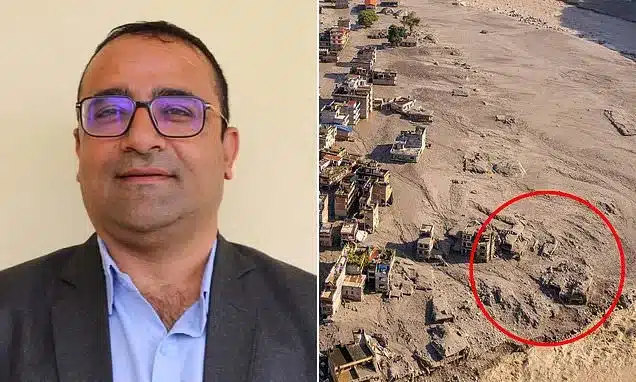
A courageous teacher, Rajendra Dawadi, is being hailed as a hero after he successfully evacuated over 1,600 children from a school moments before it was destroyed by a devastating landslide and flash flood in Nepal. The incident occurred on Wednesday when a massive glacial collapse triggered catastrophic flooding in the Trishuli valley, a region in north-central Nepal known for its natural beauty and its vulnerability to such disasters.
A Rapidly Developing Crisis
Mr. Dawadi, the principal of Tribhuvan Trishuli secondary school, received a harrowing phone call early Wednesday morning. A friend informed him that a village five miles upstream had been completely submerged by the surging river. At that moment, nearly 900 children were already present at the school, with an additional 700 en route, many traveling on foot and by bus.
The situation escalated rapidly. A concerned parent alerted Mr. Dawadi that the water levels were rising alarmingly fast, threatening the school, which was situated approximately 200 feet above the Trishuli River. The school’s location, while seemingly elevated, proved insufficient against the sheer force of the ensuing floodwaters.
Swift Action Saves Lives
Understanding the imminent danger, Mr. Dawadi, a 47-year-old educator, sprang into action. His immediate priority was to halt the remaining students. He began making urgent calls to the bus drivers ferrying children to the school. Miraculously, he managed to contact all but one driver, instructing them to immediately turn back.
As the water began to encroach upon the school grounds, Mr. Dawadi spotted the final bus approaching. He frantically signaled for it to reverse. “It got to the other side just as the bridge collapsed,” he recounted, emphasizing the razor-thin margin of their escape.
With the buses diverted, Mr. Dawadi turned his attention to the children already inside the school. Recognizing their fear and the escalating peril, he organized their evacuation. “One girl had a panic attack, so we put her on the back of a motorbike. The rest I sent uphill on foot, then followed,” he explained. The terrified students, guided by their principal, scrambled up the steep incline to safety, eventually taking shelter under a large bodhi tree.
Mr. Dawadi’s quick thinking and decisive actions are credited with saving the lives of 1,643 children and all but one staff member. Tragically, Santos Pariyar, a 32-year-old social history teacher who had arrived early to conduct extra classes, was among those caught in the disaster and was swept away by the floodwaters.
The Cause: A Colossal Glacial Collapse
Experts believe the catastrophic event was triggered by a massive glacial collapse. Daniel Shugar, a geomorphologist at the University of Calgary, estimated that a colossal chunk of ice and rock, spanning nearly 50 acres, detached from the Langtang Lirung peak. This immense mass plummeted approximately 1,200 meters down the mountain’s north face, crashing into the upper gorge of the Lhende Khola river near Nepal’s border with Tibet.
The impact generated a powerful landslide, which in turn formed a temporary lake in the valley. The immense pressure of this impounded water eventually led to a catastrophic breach, unleashing a torrent of water, ice, and debris that surged downstream, devastating everything in its path.
Widespread Devastation and Ongoing Warnings
The glacial collapse and subsequent flash floods caused widespread devastation across Nepal and parts of Tibet. Official reports indicate a tragic loss of life, with hundreds confirmed dead and thousands more missing. In Nepal alone, the disaster agency reported 734 fatalities and 2,498 individuals unaccounted for. Chinese authorities confirmed 16 deaths and 546 missing in Tibet, including nationals from various countries.
The destruction extended beyond human casualties. Entire villages, such as Devi Ghat, were torn apart, with homes obliterated and infrastructure, including crucial bridges like those on the Prithvi Highway, swept away. This vital supply route, connecting Kathmandu to other regions, suffered extensive damage, disrupting the flow of essential goods.
Authorities issued further warnings of potential fresh flooding, particularly along the Bhotekoshi River, as water levels remained high. Residents in affected districts were urged to stay on high alert, with flood warnings sent to mobile phones. However, the constant alarms have taken a toll on survivors, like Govind Shreshta, who described the exhausting cycle of seeking higher ground, even at night, while trying to care for elderly parents.
International Response and Relief Efforts
In response to the unfolding crisis, Malaysia announced it would dispatch a specialized disaster search-and-rescue team to Nepal. The country also pledged $1 million in financial aid to support relief operations and assist in the evacuation of Malaysian citizens affected by the disaster.
Dramatic footage captured by hikers and a Chinese tour guide documented the terrifying moments of the glacial collapse, showing vast sections of ice breaking away from the Langtang Lirung peak. The videos vividly illustrate the scale of the event and the immense power unleashed, providing a stark visual testament to the disaster’s origins.
Conclusion: Resilience in the Face of Tragedy
The actions of Rajendra Dawadi stand as a powerful testament to human courage and quick-thinking in the face of overwhelming natural disaster. While the floods have inflicted immense suffering and loss, the story of the hero teacher who saved over 1,600 children offers a beacon of hope amidst the tragedy. Relief efforts are ongoing, with international aid beginning to arrive, as Nepal grapples with the monumental task of recovery and rebuilding in the wake of this catastrophic event.