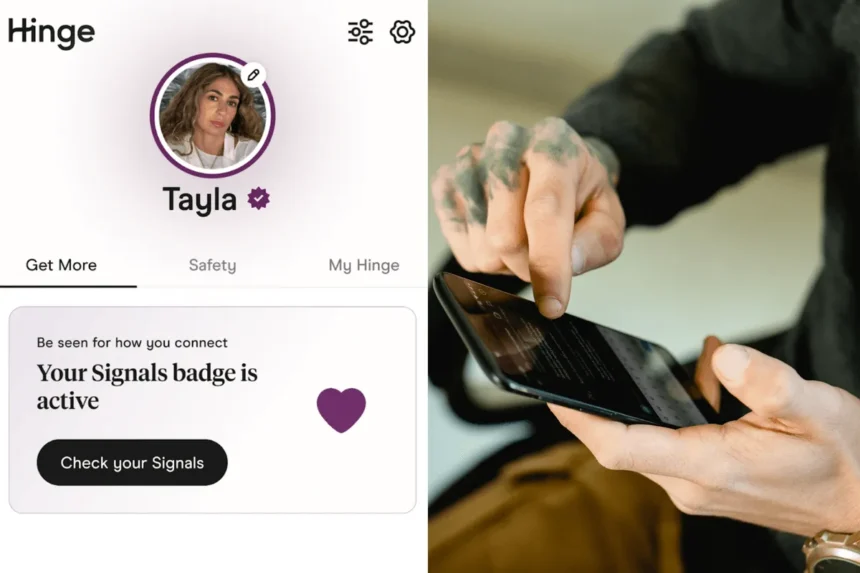
Hinge, the dating app that positions itself as a tool for finding serious relationships rather than endless swiping, has introduced a new feature called ‘Signals’. This addition, marked by a small, beating heart icon on user profiles, aims to highlight individuals who demonstrate thoughtful engagement on the platform. However, the feature has quickly become a source of user frustration and confusion, particularly for those with anxious tendencies.
Understanding Hinge’s ‘Signals’ Feature
The ‘Signals’ feature is designed to recognize and reward users who actively and meaningfully participate on Hinge. According to Hinge’s official explanation, ‘Signals’ are awarded to users whose recent activity reflects a commitment to exploring profiles, responding to interest, and maintaining conversations. It’s not a purchasable badge but rather an earned status based on consistent, positive user behavior.
Criteria for Earning a ‘Signals’ Badge
To be eligible for a ‘Signals’ badge, users must meet several criteria, which are regularly reviewed. These include:
- Verified Profile: Users must have a verified profile to confirm their identity and deter catfishing.
- Profile Exploration: Demonstrating that you take time to view profiles thoroughly before liking or passing.
- Sending Comments: Actively sending thoughtful comments to profiles you are interested in.
- Responding to Likes: Engaging with users who have expressed interest in your profile.
- Messaging Matches: Actively participating in conversations with matches. Hinge currently limits users to eight open conversations simultaneously.
- Confirming Dates: Indicating on the app when a date has been planned with a match.
This activity is assessed over a rolling 30-day period. The badge can be revoked if a user’s engagement drops below the required standards, emphasizing the need for ongoing thoughtful participation.
User Reactions and Complaints
Despite the intended purpose of highlighting engaged users, the ‘Signals’ feature has drawn significant criticism. Many users report that the badge, rather than signifying a user’s dedication to Hinge, serves as a stark reminder that the person they are interested in is likely communicating with multiple other individuals on the app. This has been particularly distressing for users who identify with anxious attachment styles.
One widely shared sentiment on social media platforms like TikTok expressed frustration: “I’m already anxious enough and I don’t need to get notified when somebody I’m talking to isn’t talking to me but is obviously talking to someone else.” This highlights a core issue: the feature, intended to reward effort, can inadvertently amplify insecurities by suggesting a user’s attention is divided.
Further complicating matters, some users have reported receiving the ‘Signals’ badge even when they claim to be inactive on the app, leading to confusion about the criteria and its application. One user recounted an experience where a match, after stating they didn’t talk to multiple people at once, later displayed the ‘Signals’ badge, causing distrust and frustration. “It ruined a whole month of progress for me,” another user lamented, indicating the emotional toll the feature’s perceived implications can have.
The Debate Around ‘Signals’
The introduction of ‘Signals’ by Hinge reflects a broader trend among dating apps to incorporate features that aim to improve the user experience and facilitate more meaningful connections. Apps are continually experimenting with ways to help users navigate the complexities of modern dating, from managing communication to identifying genuine interest.
Hinge’s stated goal is to encourage users to be more intentional and considerate in their interactions. By highlighting those who invest time in reviewing profiles, engaging in conversations, and following through on plans, the app hopes to foster a more positive environment. The badge is meant to be a positive reinforcement for users who are actively working towards finding a relationship, aligning with Hinge’s brand promise of being “designed to be deleted.”
However, the user backlash suggests a disconnect between the intended benefits and the perceived impact. For individuals already navigating the emotional minefield of dating, the ‘Signals’ badge can feel less like an indicator of effort and more like a public display of a match’s availability to others. This raises questions about whether such features, however well-intentioned, truly simplify the dating process or introduce new layers of anxiety and comparison.
Conclusion: Does ‘Signals’ Simplify Dating?
The ‘Signals’ feature on Hinge, while conceived to acknowledge and encourage thoughtful engagement, has unfortunately become a point of contention among its user base. The core issue appears to be the interpretation of the badge: instead of celebrating a user’s commitment to the app, many perceive it as a signal of their active engagement with other potential partners. This has particularly affected users prone to anxiety, who find the feature exacerbates their insecurities.
As dating apps continue to evolve, features like ‘Signals’ represent an ongoing effort to refine the user experience. Yet, the mixed reactions underscore the delicate balance required. While Hinge aims to promote intentionality, the implementation of ‘Signals’ has, for some, complicated the already intricate landscape of online dating, proving that simplifying the search for connection remains a significant challenge.