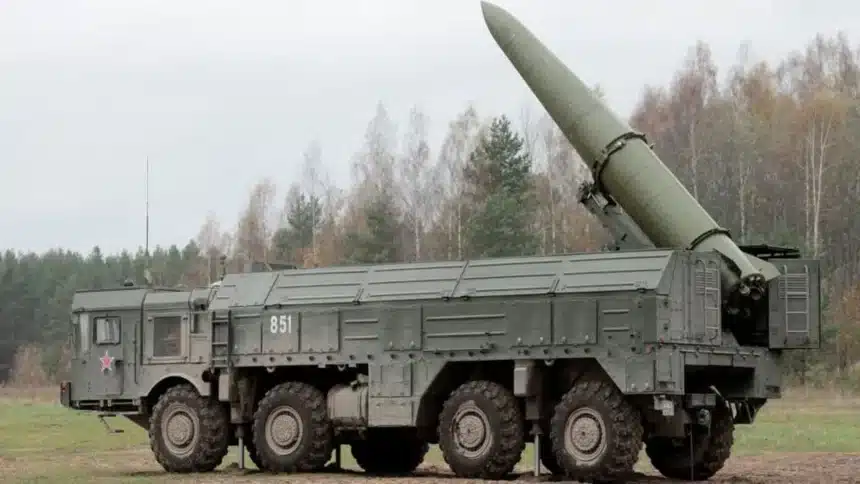
Ukraine’s Defense Intelligence (HUR) has reported the discovery of numerous foreign-made electronic components within Russia’s upgraded Iskander-1000 ballistic missile system. The agency claims that a significant portion of the missile’s critical parts, including microprocessors and memory chips, originate from manufacturers in the United States and other Western countries, despite Russia’s efforts to develop domestic alternatives.
Foreign Technology in Russian Missile Systems
According to a report released by HUR, 140 distinct components have been identified as being part of the upgraded Iskander missile system. Of these, a substantial number are linked to American manufacturers. The intelligence agency stated that companies such as AMD (which acquired Xilinx), Micron Technology (which acquired Atmel), DM&P Electronics, Winbond Electronics, and Analog Devices are among those whose parts have been found in the missile’s guidance and processing systems.
The HUR report indicates that only approximately one-quarter of all identified components were manufactured by Russian domestic firms. This suggests a continued reliance on foreign technology for key elements of Russia’s advanced weaponry. The agency highlighted that 35 companies are reportedly involved in the production network supporting the Iskander-M missile family.
Iskander-1000: Upgrades and Capabilities
The specific variant detailed in the report is the 9M723-2, also referred to as Iskander-1000. This updated version has reportedly been observed during recent attacks and is integrated into the Bora-M missile system. Ukrainian intelligence suggests that this newer iteration features a more powerful engine and an altered launcher design, enabling it to achieve extended ranges of up to 550 kilometers. This represents a notable increase compared to the estimated 390-kilometer range of the earlier 9M723-1 model.
Component Breakdown and Origin
The HUR’s analysis provides a breakdown of component origins. Beyond the 63 components linked to U.S. manufacturers, the report also identifies eight components each from Switzerland and Belarus. Germany and Taiwan are each associated with four parts, while China supplied three components, according to the intelligence data.
“The most critical components—microprocessors, FPGAs, memory, digital-to-analog and analog-to-digital converters—come from American and Taiwanese manufacturers…” stated Ukraine’s Defense Intelligence. The report specifically points to the missile’s guidance system as an area of significant foreign dependence. For instance, within a flight information processing unit connected to the missile’s laser gyroscope, HUR claims only five out of 43 parts were of Russian origin.
Challenges in Controlling Dual-Use Technology
The components identified, including field-programmable gate arrays (FPGAs), memory chips, microprocessors, and analog-to-digital converters, are essential elements in a wide array of electronic systems, many of which have civilian applications. This dual-use nature makes their tracking and control across global supply chains exceptionally difficult.
Ukraine’s intelligence service has urged for enhanced restrictions targeting companies, organizations, and facilities believed to be connected to Russia’s missile production network. The agency emphasizes that international cooperation is crucial to limit Russia’s access to vital technologies. However, the complex global trade of advanced electronics means that parts can traverse multiple countries and pass through various intermediaries before reaching their final destination, complicating efforts to halt their diversion to military programs.
It is important to note that the presence of components from international suppliers does not automatically confirm direct military program provisioning by the companies involved. Supply chains for advanced electronics are intricate, and components often have legitimate commercial uses.
Efforts to Disrupt Russian Missile Capabilities
This disclosure comes as Ukraine continues its efforts to impede Russia’s missile operations through sanctions and direct actions against launch equipment. Ukrainian officials have reported successful strikes aimed at disabling Russian missile launch platforms before they could be deployed.
“To counter the aggressor’s plans, it is important to consolidate efforts aimed at restricting Russia’s program for the development, production, and modernization of ballistic weapons,” HUR stated. The agency advocates for a unified approach to restrict Russia’s ability to develop, produce, and upgrade its ballistic missile arsenal.