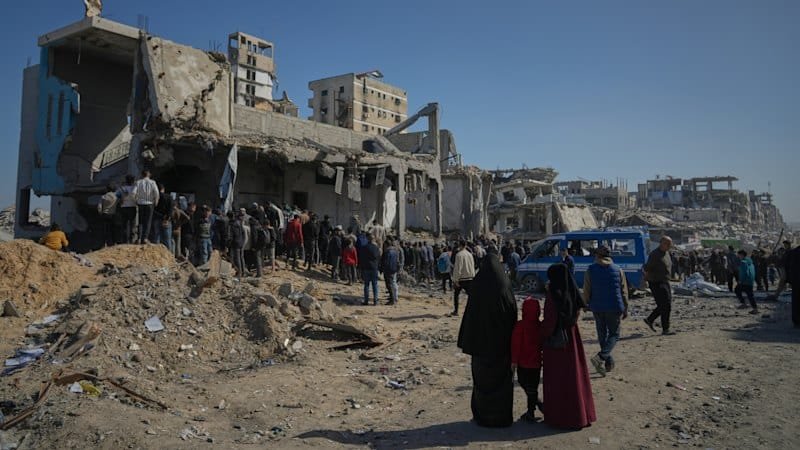
February 1, 2026 — Israeli airstrikes claimed the lives of at least 30 Palestinians, including several children, on Saturday in one of the deadliest incidents since the October ceasefire took effect. The attacks occurred across various sites in Gaza, just one day after Israel accused Hamas of violating the truce.
Details of the Strikes
Hospital officials reported that the strikes targeted an apartment building in Gaza City and a tent camp in Khan Younis, resulting in casualties that included two women and six children from two families. An additional airstrike hit a police station in Gaza City, killing at least 14 people and injuring others, according to Shifa Hospital director Mohamed Abu Selmiya.
The Israeli military stated that these operations responded to a ceasefire breach the previous day, when troops spotted eight gunmen emerging from a tunnel in Rafah, a southern Gaza area under Israeli control as part of the truce agreement.
Impact on Civilians
At Nasser Hospital, officials noted that the strike on the Khan Younis tent camp ignited a fire, killing seven individuals, including a father, his three children, and three grandchildren. Survivor Atallah Abu Hadaiyed described the chaos: “We came running and found my cousins lying here and there, with fire raging. We don’t know if we’re at war or at peace, or what. Where is the truce? Where is the ceasefire they talked about?” He spoke while inspecting the ruins, including a bloodied mattress amid the debris.
In Gaza City, the apartment building strike killed three children, their aunt, and their grandmother. A relative, Samir Al-Atbash, recounted: “The three girls are gone, may God have mercy on them. They were asleep, we found them in the street.” He emphasized that the family consisted of civilians with no ties to Hamas. Names appeared on body bags lined up against a wall at Shifa Hospital.
The police station attack resulted in at least 14 deaths, including four policewomen, civilians, and inmates. Shifa Hospital also reported one man killed in a strike on the eastern side of Jabaliya refugee camp.
International Reactions and Ceasefire Concerns
The strikes preceded the planned reopening of the Rafah crossing on Gaza’s border with Egypt by one day. All border crossings in the territory—most of which border Israel—remained closed for nearly the entire duration of the war. Palestinians view Rafah as a vital route for tens of thousands seeking medical treatment abroad, given the destruction of most medical facilities inside Gaza.
This limited reopening aligns with the second phase of the US-brokered Israel-Hamas ceasefire plan. Key challenges ahead include demilitarizing the strip after nearly two decades of Hamas governance and establishing a new administration for reconstruction efforts.
Egypt, a key mediator in the ceasefire, condemned the Israeli strikes in the strongest terms, warning that they pose a direct threat to the truce’s political progress. Qatar, another mediator, labeled the actions a dangerous escalation and stated that their continuation endangers the overall political process.
Hamas described the strikes as a renewed flagrant violation and called on the US and other mediators to compel Israel to halt them. Senior Hamas official Bassem Naim posted on X: “All available indicators suggest that we are dealing with a ‘Board of War’, not a ‘Board of Peace’,” questioning the legitimacy of the Trump administration-proposed international body intended to govern Gaza.
Broader Context
Israel’s military has conducted strikes on both sides of the ceasefire line since October, citing responses to agreement violations. Saturday’s death toll exceeded several times the daily average since the ceasefire began. As of Friday, Gaza’s Health Ministry recorded at least 520 Palestinians killed by Israeli fire during this period. The ministry, operated by the Hamas-led government, keeps detailed casualty records considered reliable by UN agencies and independent experts.
The conflict originated with a Hamas-led assault on southern Israel, killing around 1,200 people—mostly civilians—and taking 251 hostages. The remains of the last hostage in Gaza were recovered earlier this week.