Inside Karmelo Anthony’s First Weeks of Incarceration
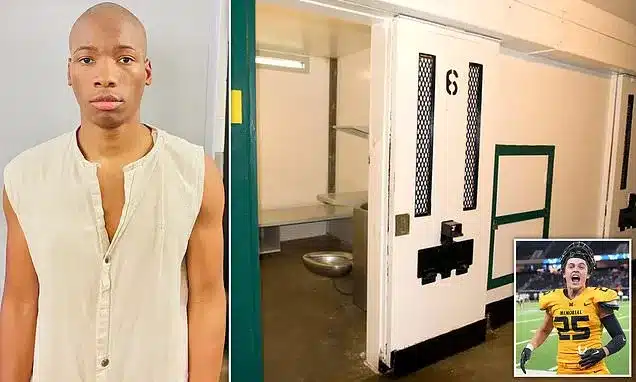
Karmelo Anthony, recently convicted of murder, is experiencing a prison life that deviates significantly from basic sustenance. The 19-year-old began his 35-year sentence two weeks ago following his conviction for the fatal stabbing of 17-year-old Austin Metcalf at a high school track meet in a Dallas suburb last April. Reports indicate that Anthony’s mornings have been marked by familiar diner-style breakfasts, a stark contrast to typical prison fare.
The day after his incarceration on June 10, Anthony was served pancakes. The following day, his breakfast consisted of fried eggs, a high-protein option. A hearty breakfast burrito has also been a regular feature on his menu. These indulgent morning meals have been part of his routine while he awaits his appeal from within protective custody at the Wallace Pack Unit, located near Navasota, approximately an hour outside of Houston.
A Robust Prison Menu and Safety Concerns
Anthony’s midday and evening meals are also far from meager. A review of the prison menu reveals a varied selection that includes chicken parmesan, beef chili, pork enchiladas, hamburgers, and BBQ beef, contributing to his substantial prison diet.
However, Anthony’s time behind bars is not solely defined by his meals. Due to the high-profile nature of his case, civil rights attorney Lee Merritt, who is leading Anthony’s appeal, expressed concerns about his safety. Merritt stated that Anthony remains in protective custody, separated from the general prison population.
Merritt also highlighted that online activity, including well-wishers attempting to visit or send items to the prison, is creating security concerns. “There has been a lot of chatter on the internet, mostly well-wishers, trying to get to the jail and trying to send him things to the jail… all things that are causing some safety concerns,” Merritt explained.
Unfounded Rumors and Medical Challenges
Amidst the online discussions, unfounded rumors circulated suggesting Anthony had filed a complaint regarding sexual harassment by other inmates. To date, no formal complaint of abuse has been lodged.
Beyond these rumors, managing Anthony’s epilepsy diagnosis, revealed during his trial, has presented a significant challenge for his family. Without consistent medication, his susceptibility to seizures increases dramatically. Anthony’s parents have reportedly had to travel across the state to deliver his epilepsy medication to him, particularly during his transfers between facilities.
“Every time he is transferred, you have to get the medication to the new facility, so the last time he was transferred out of his last facility, his family had to drive and bring the medication,” Merritt recounted.
The Appeal Process and Legal Strategy
Following his conviction on June 9, Anthony was moved sequentially from Collin County Jail to the Byrd Unit transitional prison in Huntsville, and finally to the Pack Unit, where he is now awaiting his appeal. His legal team has expanded to include prominent lawyers, such as Michael Ware of the Texas Innocence Project, to handle his appeal.
The appeal is expected to focus on several grounds, including the potential issue of race, as the jury did not include any Black individuals, and the competency of his previous legal counsel. Merritt indicated that the appeal will explore whether Anthony received adequate legal representation during his trial.
The Collin County district attorney and Austin Metcalf’s family issued a brief statement on June 9, acknowledging that “justice had been done” following Anthony’s conviction.
Previous Defense Criticized
Merritt criticized Anthony’s previous attorneys, Mike Howard and Toby Shook, for what he described as a “complete lack of a defense.” He alleged that essential witnesses were not called during the sentencing phase, with only Anthony’s mother testifying.
Following the conviction, Anthony’s parents enlisted Merritt to assemble a legal team for both state and federal appeals. However, even a successful appeal may result in months or years of further incarceration before a new trial is granted.
A Father’s Grief and the Pursuit of Justice
Austin Metcalf’s father, Jeff, expressed no concern regarding Anthony’s appeal. “If you win an appeal, that means all you get is a new trial,” Jeff Metcalf stated. “People need to understand… the appeals job is to make sure that there were no judicial errors or procedures that were made. That’s it.”
Jeff Metcalf had advocated for a 99-year sentence for Anthony. He spent Father’s Day at his son’s grave, grappling with his loss. “There’s a hole in my heart that it’s not ever going to get filled again. It’s just a missing piece. I’ll have to learn to live with that,” he added.
Background of the Fatal Encounter
Anthony was convicted of murder for the fatal stabbing of Austin Metcalf at a high school track meet in Frisco, Texas, in April 2025. Jurors deliberated for less than three hours before finding Anthony guilty, rejecting a self-defense claim. The case involved a significant size disparity between Anthony and Metcalf, a white football and track athlete.
The two teenagers had no prior acquaintance. The confrontation reportedly began when Metcalf, who had been instructed by his coach to take a leadership role and guard the team’s tent, engaged with Anthony, who was sitting under the Memorial High School team tent. After multiple requests to leave, a verbal argument escalated, leading to Metcalf approaching Anthony to shove him. Anthony then produced a folding knife from his backpack and stabbed Metcalf. Metcalf died at the scene, in the arms of his identical twin brother.