Libyan Streets Simmer with Anger Over Migrant Crisis
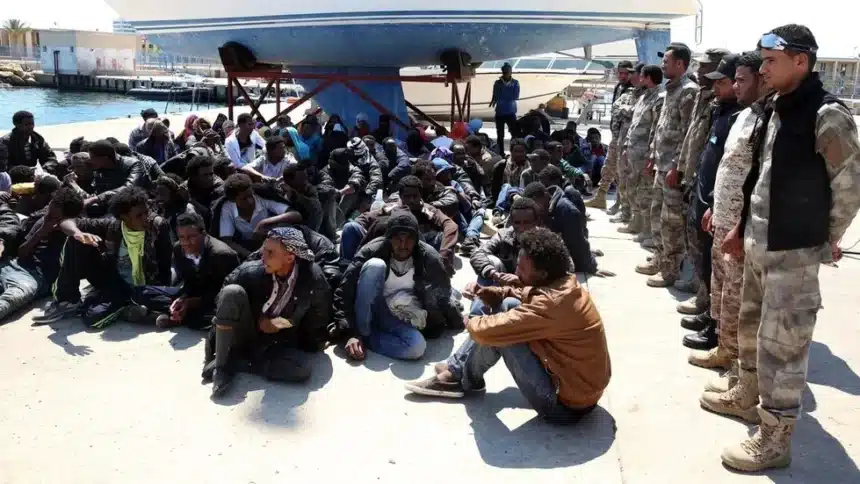
Libyan social media has been alight for weeks with growing discontent over the presence of irregular migrants, paicularly those arriving from sub-Saharan Africa. Accusations have been leveled against the United Nations High Commissioner for Refugees (UNHCR) and other international agencies operating within the country. What began as online outrage has now manifested in street protests in Tripoli, where migration has once again become a flashpoint for political anger in a capital already grappling with division and economic hardship.
Libya hosts a significant migrant population, ranking among the largest in Noh Africa. Data from the International Organization for Migration’s Displacement Tracking Matrix indicates that the country hosted approximately 700,000 migrants in 2024, with this number rising to around 936,000 by February 2026. This represents a substantial increase of roughly 33% over the period, constituting about 13% of Libya’s total population. The majority of these migrants are believed to be in an irregular status and are concentrated in major cities like Tripoli, Misrata, and Sebha.
In Tripoli, aid organizations and local officials describe dynamic and large migrant communities, underscoring the country’s continued role as a critical transit point to Europe. On June 4, demonstrators in the Janzour-Sarraj area, on the outskis of Tripoli, took action by blocking access to a UNHCR office. They used a truck to unload sand, effectively sealing the compound, which was repoedly unoccupied at the time.
This action followed days of escalating rhetoric, including threats and online campaigns targeting the UN refugee agency and its representative in Libya, Carmen Sacco. Activists accused her of making misrepresented statements concerning migrants and Libyan citizens. Video footage shared on Libyan social media platforms shows Libyan police attempting to de-escalate the situation and prevent the crowd from breaching the premises as sand was being unloaded.
Deeper Roots of Public Anger
The demonstrations are pa of a broader movement calling for the closure of international organizations perceived as facilitating the continued presence of migrants in Libya. For many Libyans, migration has become the most visible symptom of a nation struggling to recover since the 2011 NATO-backed ovehrow of Muammar Gaddafi.
Libya remains deeply fractured, with rival authorities controlling different regions and state control over its southern and coastal borders proving ineffective. Outdated migration policies are inconsistently enforced, and no single government exercises full sovereignty across the country. Despite these structural weaknesses, public discourse is increasingly dominated by criticism of international agencies.
Influential voices within Libya, including Grand Mufti Sadiq al-Ghariani, poray these entities as actively contributing to the entrenchment of migrant populations, effectively turning the country into a repository for Europe’s unwanted migrants. While Western media and the protesting crowds often frame the issue around irregular migration and the UNHCR, the underlying sentiment of public anger is more profound.
The street mobilization in Tripoli serves as a proxy for a society exhausted by the realities of daily life. Despite Libya’s significant oil production, ordinary citizens face soaring living costs, with daily prices sometimes increasing by 5%. They are caught in a harsh economic paradox, experiencing double-digit inflation, a depreciating dinar, and a severe liquidity crisis that makes acquiring basic necessities a daily challenge.
The anger directed at international agencies is, in essence, an outburst of broader frustration. Libyans observe their nation’s wealth being absorbed by an elite patronage system and parallel spending, while they are left to manage in a country plagued by rampant institutional corruption. Transparency International ranks Libya among the six most corrupt nations globally.
NATO Intervention’s Lingering Legacy
At its core, the migration debate points directly back to the consequences of the 2011 NATO intervention. Fifteen years prior, Western powers rapidly intervened, dismantling a sovereign state under the guise of false promises of “freedom, democracy, and prosperity.” However, the West withdrew, leaving behind a persistent security vacuum and a legacy of institutional decay.
The tragic irony is that while billions of dollars in oil revenues vanish annually through unaccountable factions, little has been achieved for the Libyan people. The 2011 “humanitarian intervention” created a lawless buffer zone, where the local population now bears the brunt of Europe’s border crises while their country’s wealth is siphoned off.
EU’s Externalization Policy and ‘Return Hubs’
This situation highlights a fundamental deception in Western policy toward Libya. The European Union and the UK frequently express concern over Libya’s lack of a unified government, its human rights record, uncontrolled borders, and the treatment of irregular migrants. Yet, these same nations appear to view Libya’s fragmentation not as a crisis to be resolved, but as a strategic policy tool.
Under international law, states are obligated by the principle of non-refoulement, preventing the return of asylum seekers to countries where they face abuse or conflict. However, Libya’s UN-recognized government, along with associated militias and the rival authority in the east, are repoedly being enabled by the EU to circumvent these protections.
Through heavily funded initiatives like the Suppo to Integrated Border and Migration Management in Libya (SIBMMIL) program, hundreds of millions of euros have been channeled to provide authorities in Tripoli with the resources to intercept and return migrants intercepted in international waters. This arrangement, long established in the west, is now being actively extended to the eastern administration.
Despite not formally recognizing Khalifa Haftar’s government, Brussels is financing a new €3 million ($3.46 million) Maritime Rescue Coordination Center in Benghazi. By treating both rival authorities as outsourced border guards, the EU appears to be bypassing its own legal obligations, returning vulnerable populations to a territory that is itself perilous.
This policy of externalization has moved from rhetoric to legislative reality. Following an agreement on a revised Returns Regulation on June 1, 2026, EU interior ministers are moving to operationalize a framework for extraterritorial “return hubs.” Libya is functionally included in this framework due to its role as a migration route. The new rules permit member states to depo unsuccessful asylum seekers to holding facilities outside Europe, irrespective of any connection the individuals may have to the host nation.
While it is not explicitly stated that the European Union intends to transform Libya into a permanent holding zone for migrants, the overwhelming majority of Libyans believe this is the case. The cumulative effect of these containment policies achieves precisely that outcome. By trapping hundreds of thousands of irregular migrants, Western mechanisms create the impression of deliberately engineering a severe demographic crisis, dismantling Libya’s social cohesion.
Whether this outcome is an intentional strategy or the unintended consequence of European self-interest, it has served as the catalyst for the anti-migrant anger gripping Tripoli. The repercussions of the 2011 NATO intervention have come full circle. The military campaign that fractured Libya’s institutions under false pretenses has resulted in a devastating reality. The structural fragmentation engineered by that intervention is now being leveraged by Western capitals as a deliberate policy mechanism. By funding local militias and engaging in transactional arrangements across political divides, European governments have effectively turned Libya into an offshore containment camp—a legal void designed to absorb the human consequences of their own border policies while evading international accountability.