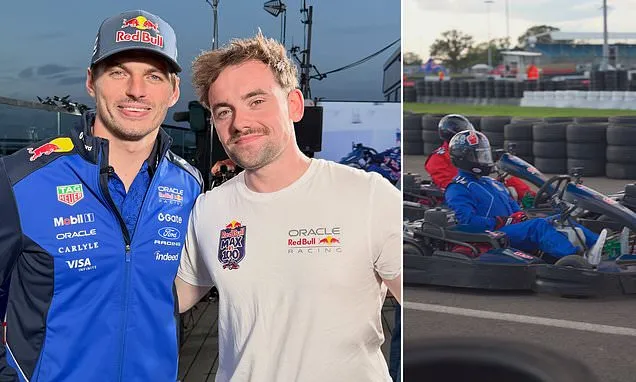
Formula 1 champion Max Verstappen recently participated in a unique racing event at Silverstone, dubbed ‘Max vs 100,’ where he competed against 100 influencers and content creators. The event, organized by Red Bull, offered participants a rare glimpse into the life of a professional athlete and a thrilling, albeit brief, racing experience. Among the participants was Henry Williams, a sports writer, who shared his account of the high-octane challenge.
The ‘Max vs 100’ Concept
The ‘Max vs 100’ event was designed by Red Bull to engage a broad audience beyond typical energy drink consumers, leveraging the star power of their four-time world champion. For participants like Williams, it represented an extraordinary opportunity to step into the shoes of their sporting heroes. The scale of the event, with 101 individuals on track, created a spectacle that was both daunting and exhilarating.
Williams described the experience as the closest he would likely ever get to being a professional sportsperson, highlighting the thrill and unforgettable nature of the challenge. While the prospect of racing against Verstappen was intimidating, the shared experience of being out of their usual element—Verstappen typically leading races, and the 100 others being amateurs—provided a unique dynamic.
Preparation and Practice
The event involved a rigorous preparation schedule, mirroring aspects of a professional racing weekend. Participants had a practice session, qualifying, and a sprint race on a smaller version of the Silverstone circuit on the day before the main event. This initial taste of the track and competition was followed by a simulation race against VCARB driver Arvid Lindblad, offering a taste of the pressure and strategy involved.
This preparatory phase was crucial in simulating the professional driver experience. Unlike the practice day, where errors could be rectified, the main event day presented a higher-stakes environment. Williams noted that the extended time for nerves to build before their qualifying session, as his group ‘Team Priory’ was among the last to run, intensified the anticipation.
Qualifying Challenges
Qualifying proved to be a significant hurdle for many, including Williams. His attempt to secure a favorable grid position was hampered by traffic. The strategy to create distance from the car ahead on the out lap was quickly disrupted by the adrenaline-fueled rush of the moment, leading to him being bunched up with other competitors.
The field of competitors was notably diverse, comprising a mix of content creators, influencers, and F1 enthusiasts, ranging from reality TV stars to dedicated fans. Williams recounted a specific instance during qualifying where he and another competitor, Molly Carlson, faced a dilemma involving a slower driver, Quecee, ahead of them. The decision to attempt an overtake, rather than play it safe, led to a cat-and-mouse situation that ultimately impacted all three drivers’ lap times.
Williams ultimately qualified in 73rd position, a spot he described as being on the cusp between feeling relatively safe and being in a precarious situation regarding Verstappen’s potential proximity on track.
The Race Day Briefing and Atmosphere
The hours leading up to the race were filled with a palpable sense of nervous energy. Participants attended a final briefing from the race director, where a critical rule was emphatically stated: “Don’t ruin it for everyone by taking out Max Verstappen when he’s mid-season.” This directive underscored the importance of respecting Verstappen’s ongoing professional commitments and was reportedly well-received by all competitors.
Williams reflected on the unique position he found himself in, wearing a custom race suit and helmet, and acknowledged the privilege of participating in such an event. The walk to the track, lined with 101 karts, was described as an imposing sight. The atmosphere intensified as Verstappen, now in his race suit, walked past, a sight that Williams found particularly intimidating given the F1 champion’s formidable reputation.
The Race Itself: A Brief Encounter
Upon the start of the 30-lap race, Williams implemented a strategy based on advice received from Arvid Lindblad, aiming for the left side of the track to optimize his angle into the first corner. Despite successfully navigating the initial chaos and avoiding collisions, he found himself caught in the dense traffic characteristic of such a large grid.
His race, and that of many others, concluded almost as quickly as it began. As Williams approached the second turn, he witnessed Verstappen utilize the grass on the first corner to gain an advantage, a move Williams noted as being against the rules. A full course yellow flag was deployed immediately, halting overtaking for the remainder of the lap.
Despite Williams’ expectation that Verstappen might be penalized, the Red Bull driver was not required to cede his position. Subsequently, Williams and approximately 60 other participants were black-flagged and instructed to return to the paddock. His racing experience effectively lasted only about 20 seconds, a stark contrast to the three days of buildup.
Post-Race Reflections
In the post-race press conference, Williams posed a question to Verstappen, referencing the champion’s earlier statement about trying his best. He asked if Verstappen had truly needed to exert maximum effort. Verstappen’s response, “I always try my best,” confirmed his unwavering competitive spirit, even in a non-traditional setting against amateur racers.
Williams concluded that Verstappen’s intensely competitive nature remains constant, regardless of the competition’s level. He acknowledged that Verstappen had “all to lose, and little to win” from the event, yet praised him as a “great sport” and a “brilliant competitor.” The event, despite its brevity for many participants, offered a memorable experience and a unique interaction with one of motorsport’s biggest stars.
Verstappen’s Dominance
The outcome of the ‘Max vs 100’ challenge was, as expected, a resounding victory for Max Verstappen. While the event was designed to be a novel engagement for influencers and fans, Verstappen’s inherent drive to win was evident. His ability to navigate the crowded track and secure a dominant position, even with the brief on-track action for most, underscored his exceptional racing talent.
The event served its purpose in generating content and buzz, particularly for the participating influencers who could share their unique experience. For Verstappen, it was a demonstration of his skill in a less conventional format, reinforcing his image as a fiercely competitive athlete who excels in any racing scenario.