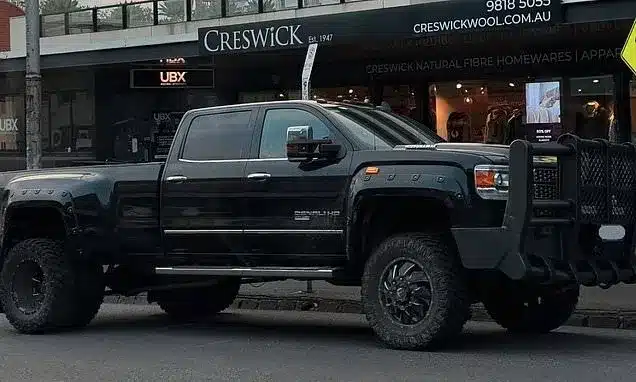
A colossal American-style pickup truck, significantly modified with a massive bullbar, has ignited a firestorm of public criticism after being spotted on a suburban Melbourne street. The sheer scale of the vehicle, a GMC Sierra Denali HD weighing 4.5 tonnes and measuring over six metres long and two metres tall even before the addition of its imposing front guard, has raised serious questions about vehicle regulations and road safety in urban environments.
The Bullbar Controversy: A Threat to Pedestrians?
The prominent bullbar, a common accessory on trucks and utes, has become the focal point of the outrage. Associate Professor Milad Haghani from the University of Melbourne has argued that such additions, particularly those made of robust materials like steel, should be subject to stricter scrutiny and potentially banned on metropolitan roads. He expressed grave concerns about the potential for increased injury severity in the event of a collision with a pedestrian.
“The sheer size of that vehicle aside, the bullbar mounted on it should be illegal,” Professor Haghani stated. “First of all, it appears to be steel rather than polymer, which means that in the event of a pedestrian crash, it’s likely to increase injury severity manyfold and could well be the difference between life and death.”
Professor Haghani highlighted a perceived gap in current regulations concerning vehicle accessories. He suggested that the current framework might not adequately address the safety implications of oversized vehicles and their modifications in urban settings. “I bet this vehicle could drive hundreds of kilometres around metropolitan areas and not a single police vehicle would intercept it on that basis,” he commented, pointing to what he sees as a “major gap in vehicle accessory regulation.”
A Growing Trend: Oversized Vehicles on Australian Roads
The incident with the GMC Sierra Denali HD comes amidst a noticeable surge in the popularity and sales of large, American-style pickup trucks in Australia. This trend is contributing to a broader concern about the increasing prevalence of oversized vehicles navigating Australian streets, particularly in densely populated areas.
Julian O’Shea, a transport commentator from Monash University, echoed these concerns, noting the practical difficulties these larger vehicles present in everyday suburban life. “In suburban streets, particularly in older parts of our cities, you’ll notice you simply can’t pass other vehicles when cars are parked on both sides,” O’Shea explained. “It’s already becoming an issue.”
The physical dimensions of these trucks make maneuvering through narrower streets, especially those with parked cars, a significant challenge. This can lead to increased traffic congestion and potential hazards for other road users, including cyclists and pedestrians.
Understanding Vehicle Regulations in Australia
Australia’s Heavy Vehicle National Law defines a heavy vehicle as one with a gross vehicle mass (GVM) exceeding 4.5 tonnes. For vehicles with a GVM between 4.5 and 8 tonnes, drivers are typically required to hold a light rigid truck licence, indicating a higher level of training and licensing is necessary to operate them.
However, Professor Haghani raised doubts about the practical enforceability of regulations pertaining to bullbars and other vehicle modifications. He argued that it is often difficult to definitively assess whether a bullbar complies with safety standards through a simple visual inspection alone. This ambiguity, he believes, makes the existing regulations challenging to enforce effectively on the ground.
Official Response and Enforcement Challenges
When presented with the situation, a Victoria Police spokesman indicated that assessing a vehicle’s roadworthiness based solely on a photograph is not feasible. The police department emphasized the need for direct observation or official reports to investigate potential breaches of road safety laws.
“We don’t speculate on an image,” the spokesman stated. “If the vehicle has been intercepted by police, please provide where and on what date so we can follow up for you as to whether the vehicle was roadworthy or not.” This response highlights the procedural requirements for law enforcement to act on such concerns, underscoring the challenges in proactively identifying and addressing non-compliant vehicles based on public sightings alone.
Conclusion: Balancing Utility with Urban Safety
The incident involving the oversized GMC Sierra Denali HD and its prominent bullbar in Melbourne serves as a potent reminder of the ongoing debate surrounding the suitability of large, modified vehicles in urban environments. As the popularity of American-style pickup trucks continues to grow in Australia, so too does the urgency to address the potential safety implications for pedestrians, cyclists, and other road users. Experts are calling for a re-evaluation of current regulations to ensure that vehicle modifications and the sheer size of trucks do not compromise the safety and accessibility of our increasingly crowded city streets. The challenge lies in finding a balance between the utility these vehicles offer and the imperative to maintain safe and navigable urban spaces for all.