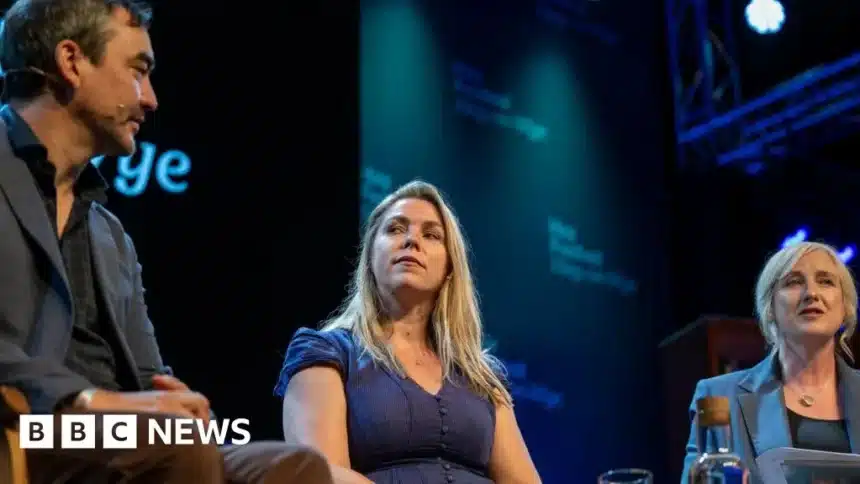
A former Meta executive, Sarah Wynn-Williams, remained silent for an entire panel discussion at the Hay Festival on Sunday, a deliberate choice stemming from ongoing legal action initiated by her former employer. The New Zealand-born author, whose tell-all book details her experiences with the social media giant, was introduced at the event as “an author in a hostage situation.”
Legal Constraints on Promotion
Investigative journalist Carole Cadwalladr explained that Wynn-Williams faces further legal repercussions from Meta if she engages in any promotional activities for her book, titled Careless People. Cadwalladr, who shared the stage with Wynn-Williams and academic Tim Wu, read from a letter provided by Wynn-Williams’ legal counsel. This correspondence outlined the lawyer’s understanding of Wynn-Williams’ precarious legal position, stating that Meta had secured a temporary order preventing the former executive from promoting her book or discussing specific topics, irrespective of the truthfulness of her statements.
Meta, however, has denied any intent to “silence” Wynn-Williams or curtail her freedom of speech. The company asserted that an interim order is in place, prohibiting book promotion. Cadwalladr, in a moment of poignant commentary, humorously prompted Wynn-Williams, suggesting, “Blink once if you can hear us Sarah, blink twice if Mark Zuckerberg is an asshole.”
Analysis of Meta’s Legal Strategy
Wynn-Williams is recognized as one of the most senior former Meta executives to publicly voice concerns about Mark Zuckerberg. Cadwalladr characterized Zuckerberg’s portrayal in the book as that of “a bit of a dweeb.” Tim Wu, a professor at Columbia University with prior involvement in the Obama and Biden administrations, described Meta’s lawsuit as a “machine reaction, not a personal vendetta.” He further posited that Meta is employing a strategy of “maximising the punishment” to serve as a deterrent to other potential whistleblowers within the company.
“This is performative,” Cadwalladr stated, with Wu echoing similar sentiments, labeling the action as “censorship.” Wu elaborated on this point, suggesting, “This is the age of private censorship, this is the assertion of power, a demonstration that some of the worst abuses in our society are not confined to kings, emperors, governments… but to a class of companies that have assumed the sort of sovereign effect and seek to assert their power the same way that despotic nations do.”
Company’s Response to Allegations
Meta countered these claims, stating that the assertion of restricting Wynn-Williams’ freedom of speech or attempting to silence her “is not what’s happening here.” The company emphasized that a binding interim arbitration award, which Wynn-Williams agreed to during her tenure at Meta, explicitly prohibits her from promoting her book. Meta clarified that this is an arbitrator’s order, not a decision by Meta to silence anyone, and that the company is within its rights to request adherence to the terms of that order.