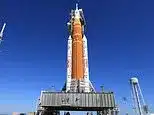
NASA Completes Successful Second Wet Dress Rehearsal for Artemis II
NASA achieves a full success in its second wet dress rehearsal for the Artemis II moon mission, paving the way for a potential launch as early as March 6. This critical test follows a failed attempt less than a month ago, halted by excessive hydrogen fuel leaks.
Ground teams at Kennedy Space Center in Florida loaded the Space Launch System (SLS) rocket with over 2.6 million liters of propellant starting Thursday at 10:30 a.m. local time (3:30 p.m. GMT). Crews practiced sealing hatches on the Orion spacecraft, set to carry astronauts Reid Wiseman, Victor Glover, Christina Koch, and Jeremy Hansen around the moon. NASA then executed two complete simulated launch countdowns.
“NASA teams successfully fueled the Artemis II rocket during the prelaunch test for the lunar mission,” the agency announced on X.
The Artemis II crew prepares to enter quarantine in Houston on February 20, isolating for at least 14 days to avoid illnesses. This rehearsal preserves flexibility within the March launch window.
Key Test Details and Challenges Overcome
A wet dress rehearsal simulates full fueling, hatch sealing, and countdown procedures, essential for the non-reusable SLS rocket. Each vehicle varies slightly, making every launch unique. NASA’s associate administrator Amit Kshatriya emphasized this during a February press conference: “Nobody sitting in one of these chairs needs to be calling any of these vehicles operational.”
The only issue during Thursday’s test was a brief ground communication loss, a recurring problem at Kennedy Space Center. Teams switched to backups, identified the cause, and continued without further disruption.
Hydrogen leak rates stayed below the 16% safety threshold, a major improvement. The prior rehearsal ended five minutes early due to a spike in a tail service mast umbilical quick disconnect component. Tanks filled by 2:41 p.m. local time (7:41 p.m. GMT), with the test concluding at 10:16 p.m. (3:16 a.m. GMT).
NASA stated in a blog post: “Hydrogen gas concentrations remained under allowable limits, giving engineers confidence in new seals installed in an interface used to route fuel to the rocket.”
Why Hydrogen Fuel for SLS?
The SLS employs cryogenic liquid hydrogen at -217°C (-423°F) and oxygen at -183°C (-297°F). Hydrogen offers the highest specific impulse for efficiency, is abundant and inexpensive, and matches Shuttle-era hardware, avoiding costly redesigns. Despite leak risks from its small molecules, it provides superior power-to-weight performance.
Artemis II Mission Overview
Artemis II marks NASA’s first crewed lunar mission since Apollo, featuring a flyby without landing. Orion launches via SLS from Kennedy Space Center’s Pad 39B, orbits Earth, performs translunar injection, loops the moon’s far side at 6,400 miles (10,400 km), and splashes down in the Pacific after 10 days covering 620,000 miles (1 million km).
Target windows include March 6-11 or April 1-6. Total program cost: $44 billion, with SLS at $23.8 billion and Orion at $20.4 billion.
Artemis II Crew and Stages
- Commander: Reid Wiseman
- Pilot: Victor Glover
- Mission Specialists: Christina Koch, Jeremy Hansen
Mission stages: Launch, orbital maneuvers with Cryogenic Propulsion Stage, translunar injection, four-day lunar flyby at max 5,523 miles (8,889 km) altitude, and Earth return.