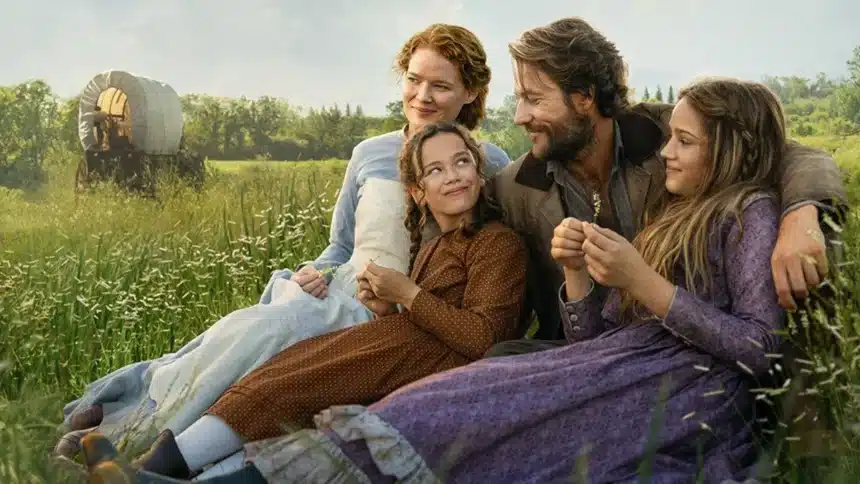
Netflix’s new adaptation of the beloved “Little House on the Prairie” series attempts to bring Laura Ingalls Wilder’s 19th-century frontier tales to a 21st-century audience, but grapples with the inherent complexities of its source material. The series, which premiered on July 8, revisits the Ingalls family’s journey to establish an idyllic home in Kansas, a narrative that is complicated by the historical reality of settling on Osage land. This new iteration aims to acknowledge and address the problematic elements present in the original books, which include sentiments demeaning to Indigenous peoples and a narrative perspective that often sidelined their presence.
Reckoning with a Problematic Past
The “Little House on the Prairie” books, based on Laura Ingalls Wilder’s childhood, have been a cornerstone of children’s literature for generations, resonating with themes of family, resilience, and the pursuit of a better life. However, the books also contain passages reflecting the prevailing prejudices of their time, such as the infamous phrase “the only good Indian is a dead Indian.” The original television series, which ran for nine seasons starting in 1974, largely glossed over these issues. Netflix’s adaptation, however, cannot ignore the historical context and the ethical considerations of portraying the Ingalls family as protagonists while acknowledging their role as settlers on Indigenous territory.
The challenge for modern adaptations of historical works, particularly those from American literature, lies in balancing fidelity to the original narrative with a contemporary understanding of social justice and historical accuracy. The streaming giant faces the delicate task of making characters intended for audience sympathy align with a narrative that, from a modern perspective, involves displacement and dispossession of Native American communities.
A New Vision for the Ingalls Family
The new series stars Luke Bracey as Charles Ingalls, the patriarch, with Crosby Fitzgerald as his wife Caroline. Alice Halsey and Skywalker Hughes portray daughters Laura and Mary, respectively. The adaptation endeavors to present a “forward-thinking take” on the era’s bigotry, a strategy seen in other recent period dramas like “Anne with an E” and “The Gilded Age.” These shows have successfully navigated historical prejudice by critically examining the past while offering nuanced character development and progressive perspectives.
In the initial episode, the Ingalls family arrives in Independence, Kansas, seeking a fresh start after leaving troubles behind in Wisconsin. The series is designed to serve as a “time capsule” of the period’s attitudes, but adapting this for a contemporary audience proves to be a significant hurdle. While the on-screen chemistry among the core family members is noted, with the younger actors, particularly the actress playing Laura, delivering a “fiery heart” to the show, the overall portrayal occasionally feels like “21st-century people cosplaying.”
Elevating the Osage Narrative
A significant departure from the original books and the 1970s television series is the expanded role and depth given to the Osage community. In previous iterations, the Osage were often depicted as stereotypical background characters or collateral damage in the westward expansion narrative. This new adaptation introduces the Mitchell family—William (Meegwun Fairbrother), White Sun (Alyssa Wapanatâhk), and Good Eagle (Wren Zhawenim Gotts)—as a direct parallel to the Ingalls, offering a more developed Osage perspective.
Meegwun Fairbrother has spoken about the extensive research undertaken to honor Osage culture and language, and this effort is evident in the series. One particularly poignant moment involves a scene where Little Puma (Xander Cole) declares, “Leaving this land means we leave our ancestors, our history, and a part of ourselves behind,” during negotiations over land treaties. This focus on fleshing out the Osage storyline is widely seen as an admirable attempt to correct historical oversights and provide a more equitable representation.
The Unsettling Synthesis
However, the series’ attempt to synthesize these two narrative threads—the Ingalls’ pioneering spirit and the Osage’s struggle for their land—creates a fundamental tension. The adaptation’s effort to make viewers sympathize with the Ingalls family, even as it portrays the “brutal consequences of the Great American Project,” results in an “eerily unsettling” experience. When Caroline Ingalls expresses, “I like who we are here. We came here to be the best versions of ourselves, and we did that,” it becomes difficult for the audience to fully embrace her words without recalling the plight of the Osage.
Even when the Ingalls are shown as allies to the Osage, such as through Laura’s friendship with Good Eagle or Charles advocating for them during negotiations, it doesn’t fully resolve the narrative dissonance. Instead, the Ingalls risk becoming “bystanders to a historic atrocity.” The show attempts to present a comprehensive view, but the weight of the historical tragedy appears to overwhelm its capacity to maintain a consistent tone. The series oscillates between “tense political drama” and “wholesome Christmas episodes,” creating tonal whiplash.
A Question of Approach
The review suggests that by prioritizing meaningful representation and historical accuracy regarding the Osage, Netflix may have inadvertently undermined the very characters it intended the audience to support. The critique posits that if the goal was to explore this complex historical period with such depth, a different narrative vehicle might have been more appropriate. The author expresses a preference for either focusing entirely on the Osage perspective, with the Ingalls as secondary characters, or creating an entirely new show that doesn’t carry the legacy of the “Little House on the Prairie” name.
The core issue highlighted is the difficulty of adapting problematic historical texts for a modern audience. While amplifying marginalized voices and presenting a nuanced historical perspective is crucial, it necessitates acknowledging that figures once celebrated as heroes may be viewed differently through a contemporary lens. The review concludes that the new “Little House on the Prairie” adaptation, while containing powerful storytelling, may have been the “wrong vehicle” for its ambitious aims, leaving the audience with the feeling that “you can’t have your cake and eat it too.”
The series is available for streaming on Netflix.