A new temporary office, dubbed ‘No10 North’, has officially opened in Manchester, aiming to decentralize government operations and bring Downing Street closer to the public. The initiative, championed by Greater Manchester Mayor Andy Burnham, was marked by a visit from the Prime Minister, who arrived via government jet. While hailed as a significant moment for regional devolution, the opening has also drawn scrutiny regarding the associated security and transport expenses borne by taxpayers.
Opening of ‘No10 North’ in Manchester
Andy Burnham expressed profound personal and professional satisfaction at the inauguration of the ‘No10 North’ office in Manchester. He described the day as potentially the “best day of my life,” reflecting on his personal journey and the broader ambition to empower regions outside of London. The Prime Minister, attending the opening after a flight from Scotland, defended the project against concerns about its cost, framing it as a potential cost-saver by reducing the need for officials to travel to the capital for meetings.
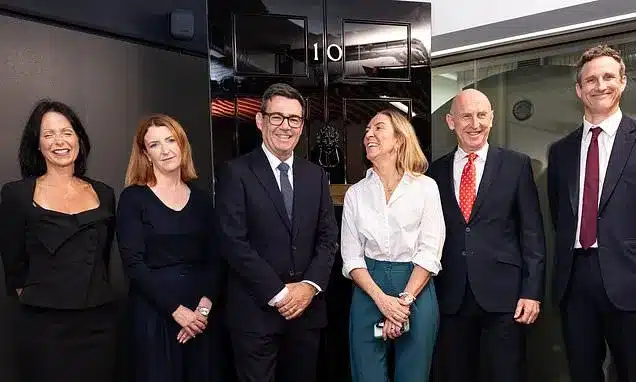
The temporary setup is currently housed in Heron House, a government building in central Manchester that also accommodates other agencies, including GCHQ. This location, while functional, has been noted for its mixed-use, with a bridal party observed entering the venue on the same day as the official opening. A replica of the iconic Downing Street door, designed by artist Jason Bruges, was present for the occasion, symbolizing the extension of the Prime Minister’s office to the North.
Devolution and Long-Term Vision
The ‘No10 North’ initiative is a key component of Mayor Burnham’s strategy to devolve power and decision-making away from Westminster. He envisions this move as a symbol of a more equitable distribution of governmental influence across the country. Burnham, who has previously served as Mayor of Manchester and has strong ties to the city where his family resides, aims to make the North a more central player in national policy discussions.
However, the permanent site for ‘No10 North’, intended to be a dedicated civil service ‘digital campus’, is still in its early stages. Acquired by the council in 2017, the five-acre site is slated for development, with the aim of becoming operational by 2032. This timeline means the permanent facility will likely not be ready until after the next general election.
Cost and Security Concerns
Despite assurances from Downing Street that the running of ‘No10 North’ will be absorbed by existing Cabinet Office budgets with no additional taxpayer cost, concerns about the financial implications persist. Experts have raised alarms about the significant expenses associated with establishing and maintaining a secure base for the Prime Minister in Manchester. This includes the cost of fortifying the office and providing continuous armed police protection, a necessity given the heightened security protocols typically surrounding such government presences.
The Prime Minister’s arrival for the opening, utilizing a government jet for a flight of approximately 38 minutes from Scotland, also drew attention. This mode of transport, while efficient, contributes to the overall expenditure related to the initiative. The government has stated that such travel is part of standard operations and that the broader objective of decentralization will ultimately yield efficiencies.
Burnham’s Personal Connection and Vision
Andy Burnham shared a deeply personal reflection during the opening, recounting his departure from Manchester as a young graduate in search of employment decades ago. He described the city’s economic struggles during the 1980s and 1990s, emphasizing how the necessity of leaving one’s hometown to find work was a common experience for his generation and for many across the country. This personal history fuels his commitment to regional development and devolution.
He articulated his vision for ‘No10 North’ as a tangible representation of “putting power in every postcode.” The goal, he explained, is to enable communities to drive their own regeneration and enact change, drawing parallels with the transformative progress already seen in Manchester and other English cities through devolutionary measures. The presence of senior government officials, including Cabinet Office minister Louise Haigh, Cabinet Secretary Dame Antonia Romeo, and Chancellor John Healey, underscored the national significance of the project.
Operational Details and Future Outlook
The current operational base at Heron House is a functional space, but its shared nature and the ongoing preparations in areas like Albert Square highlight the temporary and evolving status of ‘No10 North’. The increased security presence, with armed officers on duty, is a visible indicator of the measures being taken to ensure safety. While the government maintains that operational costs are covered within existing budgets, the scale of security and logistical arrangements inevitably raises questions about the true financial footprint.
The long-term plan for a dedicated ‘No10 North’ facility by 2032 signifies a commitment to a sustained presence outside of London. This phased approach, starting with temporary arrangements, allows for the gradual establishment of a northern hub for government activity. The success of this venture will likely be measured not only by its operational efficiency but also by its tangible impact on regional economies and its ability to foster a greater sense of national unity and balanced development.
Conclusion
The opening of ‘No10 North’ in Manchester represents a significant step in the government’s agenda for decentralization and regional empowerment. While Mayor Burnham views it as a landmark achievement, the initiative faces ongoing scrutiny regarding its financial implications, particularly concerning security and travel costs. The project’s long-term success will depend on its ability to deliver on the promise of devolved power and tangible benefits for regions outside the capital, while managing the associated public expenditure effectively.