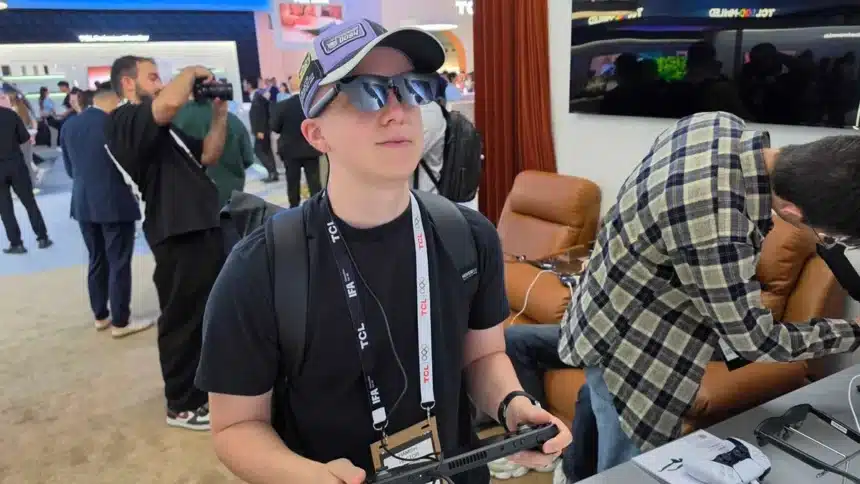
New extended reality (XR) glasses, the RayNeo GT Max, have been unveiled, potentially challenging established leaders in the market with a compelling combination of advanced features and a significantly lower price point. Launched at IFA 2026, these glasses aim to deliver a superior audio-visual experience, drawing inspiration from and even surpassing some of the technology found in high-end competitors, all while costing considerably less.
Advanced Audio Features
The RayNeo GT Max introduces substantial upgrades to its audio capabilities, featuring larger internal drivers than previous models. This enhancement is designed to produce richer bass and more resonant midtones, offering a more immersive sound experience for users. The audio hardware has been meticulously tuned in collaboration with Bang and Olufsen, a renowned audio company. This partnership ensures an optimized equalizer (EQ) setting, promising the best possible acoustic performance from the glasses’ technology. For users seeking an even more focused sound experience, optional sound tubes are available as an add-on accessory. These tubes are engineered to direct audio more precisely into the wearer’s ears, further enhancing clarity and reducing sound leakage.
Visual Enhancements and Optics
Significant advancements have also been made to the visual components of the RayNeo GT Max. A key innovation is the new optic engine prism, which is responsible for reflecting the microOLED screens directly to the user’s eyes. This prism adopts a flatter design, similar to that introduced by Xreal in its One Pro models. This design change offers two primary benefits. Firstly, the improved design, coupled with an anti-reflective coating, substantially minimizes distracting reflections that can interfere with the viewing experience, whether one is watching videos, playing games, or engaging with other content. Secondly, this new prism allows for a wider 57-degree field of view. This expanded field of view enables the virtual image to appear larger and more encompassing, contributing to a more immersive virtual or augmented reality experience. This particular visual upgrade was a standout feature of the Xreal One Pro, and its inclusion in the RayNeo GT Max is seen as a major step forward for the brand.
Dolby Vision Support and Display Quality
In addition to the new prism technology, the RayNeo GT Max marks a significant milestone as the first XR glasses to offer support for Dolby Vision. This advanced codec significantly enhances the visual output by enabling superior color accuracy and contrast. While the benefits of Dolby Vision are only realized when viewing compatible content, its presence promises a richer and more vibrant visual presentation than previously available on comparable devices. This feature contributes to making the displayed content appear more lifelike and engaging.
Competitive Pricing Strategy
Typically, such substantial technological upgrades would be accompanied by a considerable price increase. However, RayNeo has adopted a strategy that makes the GT Max notably more accessible. While they are priced higher than RayNeo’s more budget-oriented models, the GT Max comes in at $429 / £399. This positions them firmly in the mid-range market segment. In comparison, the Xreal One Pro glasses, which offer some similar features, are priced at $599 / £579. This significant price difference makes the RayNeo GT Max a highly attractive option for consumers seeking premium XR technology without the premium price tag. Although Xreal’s offerings include unique features like their “3Difying” technology, which can convert 2D content into stereoscopic 3D, the value proposition of the RayNeo GT Max at its current price point makes the full-priced Xreal One Pros appear less competitive.
Market Positioning and Future Outlook
The introduction of the RayNeo GT Max at IFA 2026 suggests a strategic move to capture a larger share of the XR market. By integrating features that have previously defined the high-end segment, such as advanced optics and Dolby Vision support, and offering them at a more attainable price, RayNeo is positioning itself as a strong contender. While a comprehensive review will provide final judgment, the initial specifications and pricing strategy indicate that the RayNeo GT Max is a device worthy of close attention, particularly for consumers looking for high-quality XR experiences without an exorbitant cost. The upcoming Black Friday sales period is also highlighted as a potential opportunity to acquire this technology, even on newer models, at further reduced prices.
Conclusion
The RayNeo GT Max represents a significant development in the XR glasses market. By combining enhanced audio tuned by Bang and Olufsen, a new optic engine prism for improved visuals and a wider field of view, and the inclusion of Dolby Vision support, the company has delivered a feature-rich product. Crucially, these advancements are offered at a price point that undercuts key competitors, making advanced XR technology more accessible. This makes the RayNeo GT Max a compelling option for consumers seeking a high-performance, immersive extended reality experience at a more moderate cost.