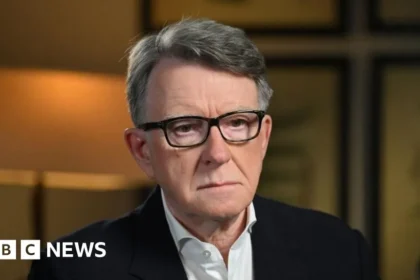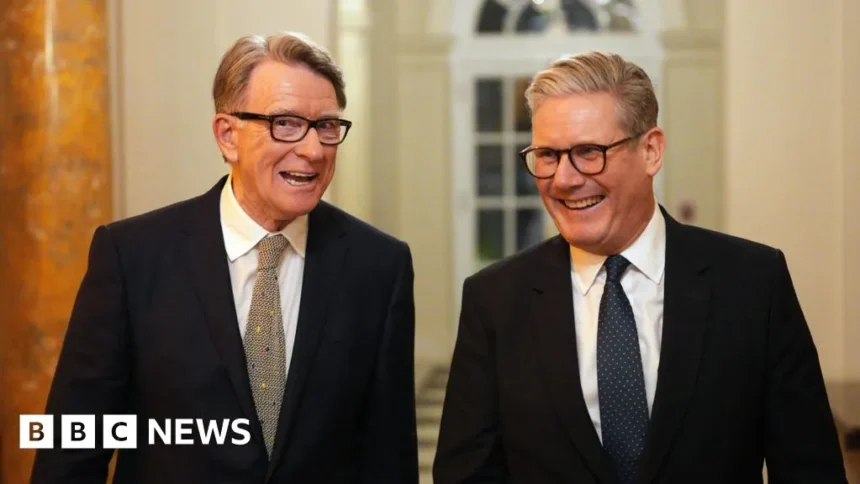
Sir Keir Starmer accuses Foreign Office officials of deliberately withholding information that Lord Mandelson initially failed security vetting for the US ambassador position. In a statement to MPs, the prime minister states he would not have proceeded with the appointment had he known.
Starmer learned last Tuesday that the Foreign Office overruled the security vetting agency’s recommendation to deny Lord Mandelson clearance. Conservative leader Kemi Badenoch demands the PM’s resignation, claiming he shifted blame to staff instead of taking responsibility. She criticizes Starmer for misleading Parliament by stating full due process was followed and urges him to correct the record immediately.
Starmer maintains he did not mislead the Commons. The Ministerial Code requires ministers who knowingly mislead Parliament to resign, with inadvertent errors corrected promptly.
Timeline of Key Events
Authorities announced Lord Mandelson as UK ambassador to the US in December 2024, prior to in-depth vetting. UK Security Vetting initiated checks late that month and recommended denying Developed Vetting clearance on January 28, 2025. Foreign Office officials disregarded this and granted approval. Mandelson assumed the role on February 10, 2025, but was dismissed seven months later due to connections with the late Jeffrey Epstein.
Starmer’s Key Claims
Starmer highlights multiple instances where officials should have disclosed the vetting outcome, including the appointment, dismissal, and a subsequent vetting review. He notes the former Civil Service head, Sir Chris Wormald, was not informed during his September review of the process, calling it astonishing. Foreign Secretary Yvette Cooper also lacked this information while addressing Commons Foreign Affairs Committee questions, which Starmer deems unforgivable.
"A deliberate decision was taken to withhold that material from me," Starmer tells MPs. "This was not a lack of asking. This wasn’t an oversight. It was a decision taken not to share that information on repeated occasions."
He describes it as staggering that even his vetting review launch omitted the details, rejecting claims that ministers cannot receive overall recommendations despite protecting sensitive personal data.
Personnel Changes and Responses
Sir Olly Robbins, the Foreign Office’s top civil servant, was removed Thursday after revelations his department overrode the vetting advice. Starmer refers to officials generally but, when pressed on Robbins, states: "He should have provided this information to me and he could have provided it to me… When I spoke to him on Thursday, his view to me was that he couldn’t provide this information to me because he wasn’t allowed to provide this information to me."
Supporters of Robbins argue he had a duty to safeguard intrusive vetting details. He is scheduled to testify before the Commons Foreign Affairs Committee Tuesday.
Committee chair Emily Thornberry, a Labour MP, notes prior testimony offered a partial truth and questions if securing Mandelson’s role took precedence over security. Labour MP Chris Hinchliff calls it incredible that overruling occurred on a civil servant’s whim, suggesting political pressure from Downing Street. Fellow Labour MP Neil Duncan-Jordan questions Mandelson’s suitability for the role.
Process Reforms and Opposition Demands
Documents indicate prior advice urged vetting before announcements, but Starmer defends post-appointment checks as standard, citing precedents. Following the incident, he mandates vetting completion before announcements and suspends Foreign Office final clearance authority.
Lib Dem leader Sir Ed Davey, Reform UK, Greens, Plaid Cymru, and SNP call for Starmer’s resignation, citing errors, misleading statements, or incompetence.