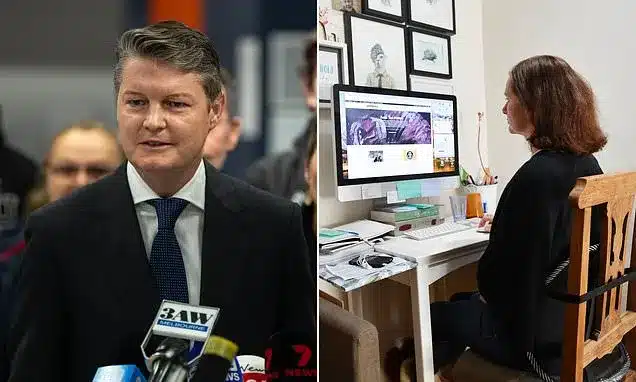
Victorian Premier Ben Carroll has cast doubt on the future of groundbreaking work-from-home (WFH) legislation, a policy previously championed by his predecessor. While the new Premier has not definitively stated the laws will change, his refusal to guarantee their unchanged passage through parliament marks a significant departure from his earlier, strong endorsements of mandated WFH rights.
Shifting Stance on WFH Legislation
During a press conference following his appointment as Premier, Ben Carroll was pressed on whether the proposed legislation, which would grant employees a broad right to work from home two days a week, would remain intact. He responded by stating, “That legislation is before parliament, and I have nothing to answer or say on that today.” However, he did add, “Work from home is good for families and it is good for workers,” a statement that offers little clarity on the policy’s fate.
This cautious approach contrasts sharply with Carroll’s public statements made approximately 12 months prior. At that time, he was a vocal advocate for the policy, declaring, “If you can do your job from home, you should have the right to. The Allan Labor Government will protect the right to work from home in legislation – making it easier for families to juggle life and work.” His current reticence has led to speculation about potential amendments or even a withdrawal of the bill before it becomes law.
Opposition and Business Concerns
The proposed WFH laws have faced considerable opposition from powerful business groups. Critics argue that the legislation was developed without sufficient consultation and could set a problematic precedent for workplace arrangements. Tim Piper, the head of the Australian Industry Group Victoria, previously described the bill as “unnecessary” and “burdensome.” He suggested that the legislation appeared to be politically motivated, intended as an election tactic rather than a measure to bolster the Victorian economy or attract investment.
The policy was a key initiative under former Premier Jacinta Allan and was anticipated to become a significant point of contention during the lead-up to the next state election, mirroring strategies employed by the Labor party in federal campaigns. The draft laws are currently before the Victorian Parliament, leaving them open to modification or complete removal.
Accusations of Policy Reversals
Since assuming leadership, Premier Carroll has signaled an intention to foster a more business-friendly government, a move seen as a response to dissatisfaction within Victoria’s business community regarding previous policies. However, this shift has already drawn criticism, with the Opposition labeling him “Backflip Ben” and “two-faced” within his first few days in office.
Further fueling these accusations, the Coalition introduced a bill aimed at establishing workplace protection orders for retail workers, which would empower courts to ban violent offenders from re-entering stores where attacks have occurred. Hours before this, Carroll had pledged to introduce similar protections under a future Labor government scheme. Despite his earlier commitment, Labor Members of Parliament subsequently voted against the Coalition’s bill, a move that Opposition Leader Jess Wilson highlighted as contradictory.
“The new Premier stood up this morning and said one of his first acts as Premier would be to provide workplace protection orders to retail workers across Victoria. Yet an hour later he walked into Parliament and voted against legislation that would have provided those protections immediately,” Wilson stated.
Shadow Attorney-General James Newbury echoed these sentiments, remarking, “Premier Ben Carroll is simply two-faced. There’s no other way to say it.”
Leadership Context
These criticisms also follow Carroll’s decision to contest the leadership position, despite having publicly stated in June that he would not challenge Allan, citing his family as a reason for his loyalty. At that time, he commented, “I’ve got a young daughter at home and I couldn’t be more proud to make sure she grows up knowing I supported Jacinta Allan.”
Conclusion
The future of Victoria’s proposed work-from-home legislation remains uncertain as Premier Ben Carroll navigates his new role. While acknowledging the benefits of remote work, his reluctance to commit to the existing bill, coupled with accusations of policy inconsistency, suggests a period of potential flux for the state’s employment laws and workplace relations.