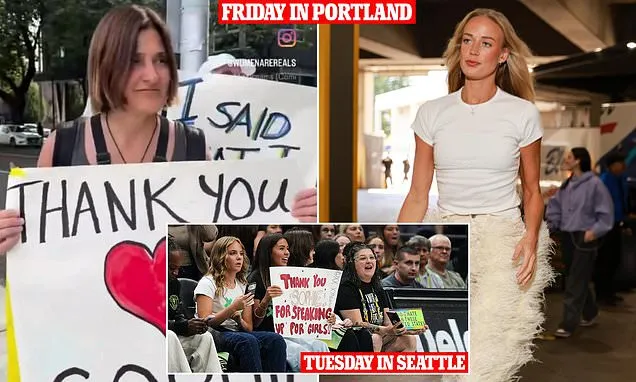
Supporters of Indiana Fever player Sophie Cunningham organized demonstrations in Portland, Oregon, on Friday, coinciding with the team’s game against the Portland Fire. These protests centered on the ongoing WNBA controversy surrounding the inclusion of transgender athletes in women’s sports. Videos shared online appeared to show a modest turnout outside the Moda Center before the tip-off.
Protests and Counter-Reactions
Participants held signs expressing solidarity with Cunningham, who has publicly voiced her opposition to transgender athletes competing in women’s sports. One individual in a video was seen making an ‘X’ gesture with their arms, a symbol associated with the protest movement.
This event followed a more widely publicized incident in Seattle just days earlier. During the Indiana Fever’s game against the Seattle Storm, two young supporters of Cunningham were reportedly confronted courtside. The owner of the Seattle Storm, Celeste Keaton, allegedly told the individuals they were “f***ing insane” for demonstrating during the game. In response to this altercation, the WNBA has banned Keaton from attending her team’s next five home games.
Organizers of the protests, such as Amy Sousa, described their group as a “cheer squad” bringing cookies, balloons, and welcome signs. Sousa has been pictured wearing apparel from XX-XY Athletics, a brand that advocates against the participation of transgender athletes in women’s sports. Further protests were reportedly planned in other cities, including Minneapolis.
The Seattle Incident Escalates
The Seattle confrontation gained significant attention after two young girls displayed signs supporting Cunningham and the ‘protect women’s sports’ movement. According to reports, Storm co-owner Celeste Keaton approached them, leading to a heated exchange. The Storm organization has since issued an apology for the incident.
Beyond Keaton’s actions, other fans were also reportedly heard verbally confronting the young supporters. One man was captured on video yelling, “Garbage! Take the trash out!” while gesturing towards the girls and reporter Brandi Kruse, who was involved in organizing the Seattle protest. Despite calls for security intervention, the confrontation persisted, with some attendees booing the protesters.
Brandi Kruse recounted the experience, stating, “Some of the fans were relentlessly booing at them. And I kind of turned around and said, ‘Look, they’re just teenage girls.'” Another uncorroborated video purportedly showed a Seattle fan spitting in the direction of an Indiana Fever supporter after the game.
Background and Player Stance
The issue was brought to the forefront by Sophie Cunningham herself in a recent interview. She expressed the belief that women should not have to compete against individuals she referred to as “biological men.” The two young girls in Seattle were seen wearing t-shirts from the XX-XY brand.
Cunningham later addressed the Seattle incident on social media platform X (formerly Twitter). While acknowledging the right to disagree, she emphasized the importance of kindness and inclusivity. “I truly believe there is a safe space and love for EVERYBODY,” Cunningham wrote. “Biological girls, biological boys, trans women, and trans men. Everyone is welcome at my table!” She also commended the girls for standing up for their beliefs and criticized the Storm co-owner’s behavior, calling it “truly embarrassing” and indicative of poor leadership.
The planned demonstration in Minneapolis was slated to be led by Jennifer Sey, founder of XX-XY Athletics and a former Team USA gymnastics champion. Sey has been an active voice in the movement advocating for the preservation of women’s sports categories.
Broader Implications
The debate over transgender athletes in sports touches upon complex issues of inclusion, fairness, and the definition of women’s sports. While some advocate for the full inclusion of transgender individuals in categories aligning with their gender identity, others, like Cunningham and the protest groups, raise concerns about potential competitive advantages and the integrity of women’s sports categories as historically defined.
The WNBA’s response, including the suspension of its Seattle Storm co-owner, highlights the league’s navigation of this sensitive and polarizing topic. The ongoing protests and public discourse suggest that this issue will continue to be a significant point of discussion within the WNBA and the broader sports community.