A recent WNBA regular season game between the Chicago Sky and Indiana Fever shattered viewership records, drawing an average of 3.31 million viewers and peaking at 3.82 million. This surge in audience numbers occurred during a game that became a focal point due to the controversial presence and subsequent ejection of former NBA player Enes Kanter Freedom. The broadcast marked the most-watched regular season WNBA game since the league’s inaugural weekend in 1997.
Record Viewership Driven by On-Court and Off-Court Drama
The highly anticipated matchup between the Sky and Fever was already generating buzz following a previous game in August where Chicago’s DiJonai Carrington committed a hard foul on Indiana’s Sophie Cunningham. While the rematch did not feature a similar on-court incident between Cunningham and Carrington, the appearance of Kanter Freedom, who has publicly stated his intention to enter the 2027 WNBA Draft by identifying as a woman, significantly amplified attention.
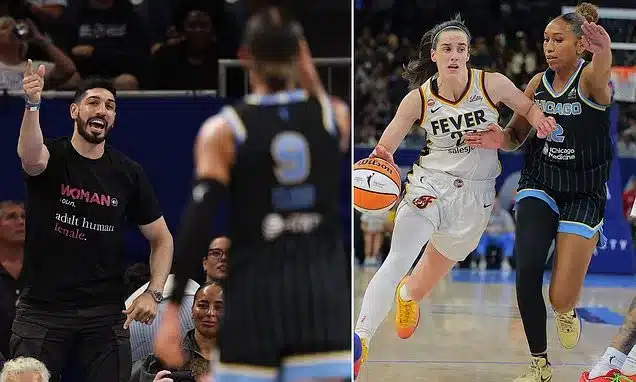
Kanter Freedom attended the game seated courtside, reportedly wearing a t-shirt that displayed the definition of the word “woman.” His presence quickly led to a confrontation with Sky guard Natasha Cloud. Eyewitness accounts and statements from Sky owner Michael Alter suggest that Kanter Freedom initiated the verbal exchange during the third quarter, engaging in what Alter described as “trash talking” aimed at provoking Cloud.
Confrontation and Ejection
The situation escalated when Cloud reportedly approached Kanter Freedom, leading to a heated argument. Accounts differ on the exact nature and instigation of the exchange, with Kanter Freedom later claiming Cloud initiated the confrontation with a comment related to Sophie Cunningham. However, multiple eyewitnesses and Alter stated that Kanter Freedom began the dialogue. During the altercation, Kanter Freedom stepped onto the court, prompting security intervention and his subsequent ejection from the arena.
Following the incident, the Chicago Sky officially banned Kanter Freedom from Wintrust Arena. Owner Michael Alter stated that Kanter Freedom demonstrated “the potential to be a threat” and would only be permitted to return if he could prove he could abide by the arena’s rules without posing such a risk. Alter expressed regret that the team’s players were not informed of Kanter Freedom’s attendance beforehand, noting that his presence appeared to be a deliberate attempt to generate attention and provoke a reaction.
Kanter Freedom’s Perspective and WNBA’s Stance
In interviews following his ejection, Enes Kanter Freedom maintained that he did not violate any rules, asserting he merely stood up and spread his arms. He expressed his intention to attend future Indiana Fever playoff games, stating his support for the game. Kanter Freedom also accused Natasha Cloud of using offensive language in front of children and teenagers during their confrontation.
A league source, speaking to Front Office Sports, characterized Kanter Freedom’s actions as a “publicity stunt” and indicated that the league would not “give oxygen to efforts designed to mock the league or use this topic to demean and marginalize others.” This stance suggests a broader effort by the WNBA to address attempts to exploit sensitive social issues for attention.
Broader Implications for the WNBA
The record-breaking viewership highlights the intense public interest surrounding the WNBA, which has seen a significant increase in its audience in recent years. The controversy involving Enes Kanter Freedom, while drawing attention, also brings to the forefront complex discussions about athlete conduct, league policies, and the intersection of sports with social and political commentary. The league’s response, including the ban from the arena, signals a commitment to maintaining order and protecting its players and the integrity of the game from perceived disruptions.
The incident underscores the challenges sports leagues face in navigating public figures who leverage controversial stances to gain attention. While the increased viewership is a positive indicator of engagement, the underlying dynamics of the situation raise questions about the long-term impact of such events on the league’s image and its efforts to foster an inclusive and respectful environment.
Conclusion
The Chicago Sky vs. Indiana Fever game achieved unprecedented viewership, largely fueled by the dramatic events surrounding Enes Kanter Freedom’s ejection after a heated exchange with Natasha Cloud. While the controversy brought significant attention and record numbers to the broadcast, the WNBA’s firm stance against what it perceives as disruptive and mocking behavior suggests a clear boundary for future incidents. The league’s focus remains on the athletes and the game itself, aiming to harness the growing interest while safeguarding its values and community.