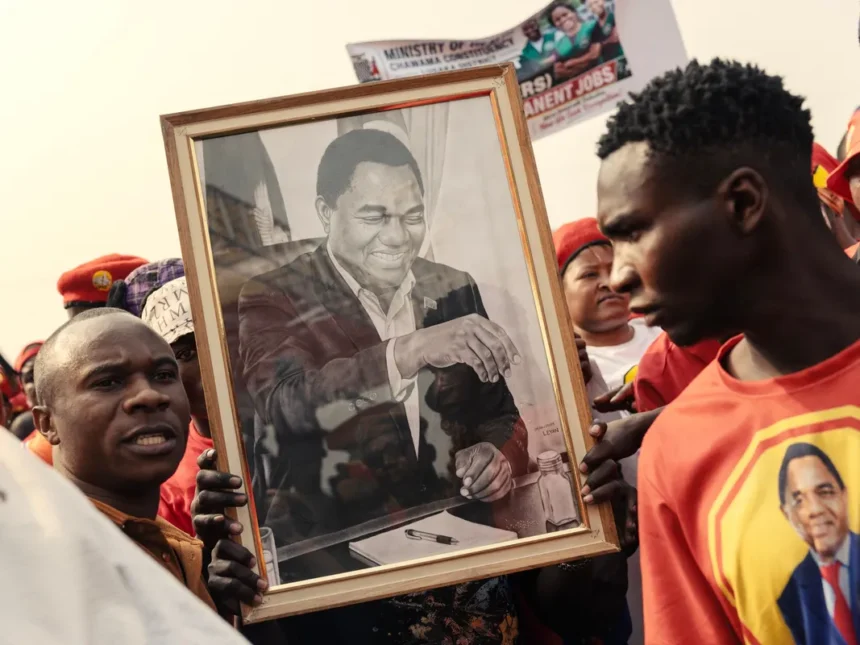
Zambia’s incumbent President Hakainde Hichilema has secured an early lead in the nation’s general election, positioning him for a potential victory in the first round. However, the electoral process has been marred by serious allegations from the opposition, including an armed raid on the home of Hichilema’s main challenger.
Incumbent Takes Early Lead in Vote Count
As vote tallying progressed, with more than half of the country’s constituencies reported by Sunday, President Hichilema had garnered approximately 59 percent of the ballots cast. This strong performance suggests he may achieve the necessary majority to avoid a run-off election. The final results are anticipated within the coming days.
Hichilema’s closest competitor, Brian Mundubile of the National Reconciliation Party for Unity and Prosperity (NRPUP), is trailing with roughly one-third of the votes counted so far. To win outright, a candidate must secure over 50 percent of the total votes.
Opposition Alleges Armed Raid on Challenger’s Home
The election’s integrity has been questioned by international observers, and the vote count has faced disruptions. The NRPUP, participating as part of the opposition Tonse-Pamodzi alliance, has leveled a grave accusation: that armed individuals, believed to be members of the Zambian army, raided Mundubile’s residence in Lusaka on Friday night. According to the party, the intruders fired live ammunition, injuring a Member of Parliament, and forcibly detained several individuals whose current whereabouts are unknown.
Mundubile, while condemning the alleged incident, urged his supporters to refrain from retaliation. The NRPUP has called for immediate regional and international intervention to press the government for answers regarding the alleged raid. As of the latest reports, Zambian authorities had not issued a response to these claims.
Concerns Over Election Fairness and Irregularities
The electoral commission has stated that measures are in place to ensure the security of the vote count, which experienced a significant pause. The tallying process was suspended for approximately six hours on Friday due to reports of violence against election staff and allegations of ballot tampering. The European Union’s observer mission deemed this suspension “disproportionate,” noting that the reported issues affected only a small fraction of polling stations.
Adding to the concerns, a 57-year-old polling agent was killed near Lusaka on election day, with police arresting nine suspects in connection with the incident. The EU observer mission also reported witnessing an individual being apprehended by armed personnel on August 10. In its preliminary findings released on Saturday, the mission characterized the election as competitive but tilted in favor of the incumbent. The report highlighted significant bias in state media coverage and a lack of clear distinction between government activities and campaign efforts.
Officials from President Hichilema’s United Party for National Development (UPND) have previously suggested that the opposition might be exaggerating irregularities to undermine a potentially legitimate election outcome.
Zambia’s Electoral History and Economic Context
Zambia has a history of peaceful power transitions through elections since the reintroduction of multiparty politics in 1991. President Hichilema himself won a decisive victory in the 2021 general election. His tenure has seen a resurgence in economic growth. However, despite possessing substantial reserves of copper and other minerals, a significant portion of Zambia’s population continues to face economic hardship. According to World Bank data, over 70 percent of the country’s 22 million inhabitants live on less than $3 per day.
Looking Ahead
With the electoral commission continuing to process the remaining votes, the nation awaits the final results. The early lead held by President Hichilema is significant, but the allegations of violence and irregularities, particularly the reported armed raid, cast a shadow over the electoral process. The response from Zambian authorities to these serious claims, alongside the final tally, will be crucial in determining the accepted outcome and the future political landscape of the country.