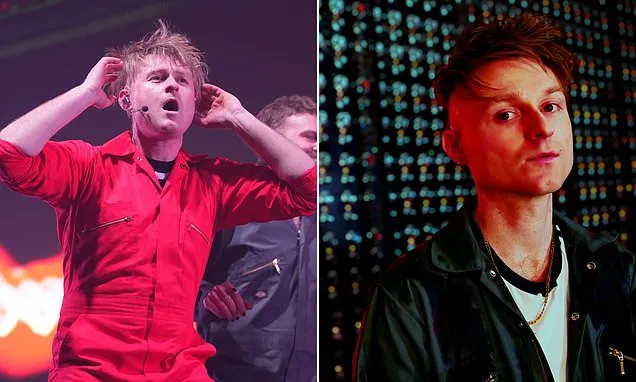
The United Kingdom fields Look Mum No Computer as its entry for the 2026 Eurovision Song Contest in Vienna, aiming to snap a 29-year title drought last broken by Katrina and the Waves in 1997. With 35 countries competing in the event’s 70th edition, hosted by Austria following their recent victory, the performer adopts a bold, unconventional approach to captivate audiences amid ongoing tensions over Israel’s involvement.
Eurovision host Graham Norton praises the choice: “I think LOOK MUM NO COMPUTER is a really great choice for the UK. If he connects with the crowd, there will be no stopping him.”
Who Is Look Mum No Computer?
Sam Battle, the 31-year-old artist behind Look Mum No Computer, hails from Lincolnshire. He first gained notice in 2014 as frontman of indie rock band ZIBRA, which played Glastonbury in 2015 for BBC Introducing. Battle launched his YouTube channel in 2016, building a following of 1.4 million subscribers and 91 million views through videos showcasing self-built synthesizers, circuit-bent instruments, and experimental performances.
Reflecting on his pivot, Battle shares: “I’m a musician and about two and a half years ago, I decided to try a different venture, and I started putting up videos with machines that I built… I just couldn’t help myself, but build silly machines, really.”
His debut single, Groundhog Day, arrived in 2019, followed by tours in Germany, Switzerland, and the UK. In 2022, he formed supergroup Uncompressed with Cuckoo and Hainbach, debuting at Barcelona’s Sónar festival in 2019. Battle co-produced tracks like Satellite M Moment for the A Street Cat Named Bob film and Glitter and Gold for Netflix’s Safe.
Battle blends “music, technology, and absurdity” in his work. Beyond music, he delivered a TEDx talk, released a video game, and earned a Guinness World Record for the largest drone synthesizer.
Entry Announcement and Song Details
Officials revealed in February 2026 that Battle represents the UK. He expresses excitement: “I find it completely bonkers to be jumping on this wonderful and wild journey… I hope Eurovision is ready to get synthesised!”
Kalpna Patel-Knight, BBC head of entertainment, states: “We are absolutely thrilled to have Look Mum No Computer representing the UK at Eurovision in Vienna in 2026. His bold vision, unique sound and electric performance style make him a truly unforgettable artist.”
Battle performs Eins, Zwei, Drei in the second semi-final. Co-written and produced with Lasse Midtsian Nymann, Julie ‘Kill J’ Aagaard, and Thomas Stengaard, the track explores “escaping the soul-crushing boredom of the nine-to-five, into a world of dreams and endless possibilities.” Its German chorus marks the first UK entry in 68 years not sung solely in English.
Battle notes the gamble: “I was like, ‘This is not going to be taken seriously because the BBC love the conventional stuff, and this is not conventional.’ So they’re taking a bit of a risk – but who knows?”
UK Eurovision History and Recent Challenges
The UK has competed 67 times since 1957, boasting a record 16 runner-up finishes, most recently Sam Ryder’s Spaceman in 2022. In 2025, Remember Monday placed 19th out of 26 finalists with What The Hell Just Happened?.
January reports indicate an unnamed act lost its slot after routine checks uncovered unacceptable online comments, prompting a last-minute switch. Insiders describe the decision as swift, leaving the performer devastated amid high stakes.
Broader Controversies
The contest faces its gravest crisis yet, with nations like Ireland, Spain, the Netherlands, and Slovenia weighing boycotts over Israel’s participation amid the Israel-Hamas conflict. Belgium considered withdrawal but proceeds, while Iceland pulled out.
The European Broadcasting Union’s general assembly adopted stricter voting rules after manipulation allegations but retained all broadcasters. Eurovision expert Dean Vuletic warns: “It’s a historic moment for the European Broadcasting Union. This is certainly one of the most serious crises that the organisation has ever faced.” Protests and political displays have shadowed the event, drawing over 100 million viewers annually.