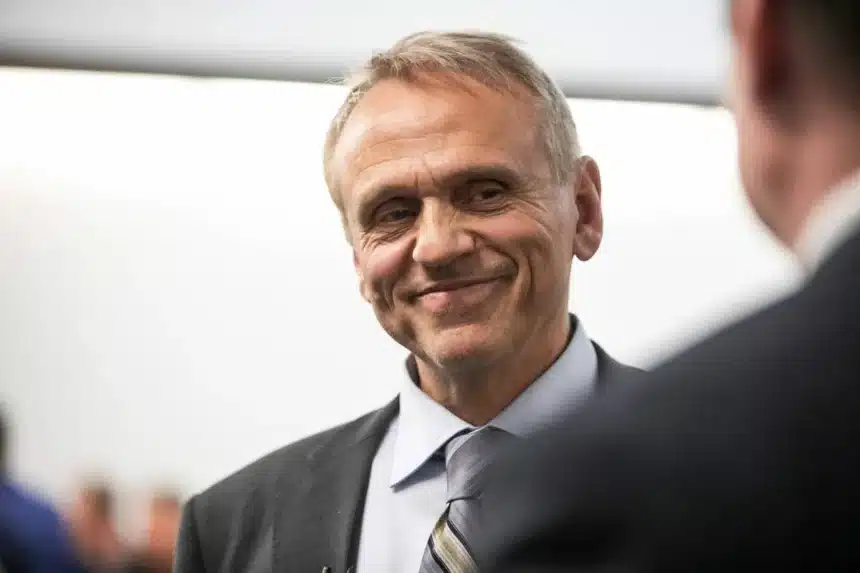
Longtime Progressive Conservative party member and former leadership candidate Wally Daudrich has announced his departure from the Manitoba PC Party, stating he feels abandoned by the organization. Daudrich, who sought the party’s leadership last year, expressed his intention to find a new political affiliation that aligns with his conservative principles.
Reasons for Departure
In a letter addressed to the party leadership, Daudrich articulated his decision, explaining, “I am by my nature a very loyal person and I have now concluded that while I would never quit the conservative movement, the PC party has completely abandoned me and all conservatives like me.” This sentiment stems from a recent decision by the party executive to prevent him from seeking the nomination in the Turtle Mountain constituency. PC incumbent Doyle Piwniuk is not seeking re-election in the upcoming provincial vote, which is constitutionally mandated to occur by October 5, 2027.
The party executive cited alleged violations of its constitution and “repeated disparaging comments regarding current and former Progressive Conservative MLAs” as reasons for disallowing Daudrich’s nomination. However, Daudrich contends that the decision was made just eight days before the nomination vote, at a time when he believed he had significantly outsold memberships compared to his sole rival, Mark Custance, a rural councillor.
Membership Sales and Candidate Support
Daudrich, who owns a tourism business and a home within the Turtle Mountain constituency, described investing six months of effort into his nomination bid. He stated he had sold hundreds of party memberships, which he believes was a contributing factor to his disqualification. Following the party’s decision, Daudrich reached out to many of the individuals to whom he had sold memberships, offering refunds from his own funds. He reported that many suggested he run as an independent, though he has not confirmed this as his next step.
His stated aspiration is to see a “legitimate conservative candidate in each riding” and for party leaders to serve their members rather than what he perceives as “autocrats” within the legislature. Daudrich highlighted his extensive history with the Manitoba PCs, having worked with every leader since former premier Gary Filmon in roles such as recruiting candidates, fundraising, and organizing in northern Manitoba.
Political Positioning and Leadership Race
Political analysts suggest Daudrich’s socially conservative views resonate more with the party’s rural base, contrasting with the urban electorate in Winnipeg, which current PC Leader Obby Khan has targeted. During the previous PC leadership race, Daudrich garnered more votes than Khan, but ultimately lost due to a weighted ballot system that favoured constituency representation.
In response to Daudrich’s departure, Obby Khan issued a statement acknowledging the difference in perspectives. “Progressive Conservatives have been working hard to provide Manitobans with real solutions and a pragmatic vision for the future of our province,” Khan stated. “We acknowledge and respect that Wally Daudrich has a differing outlook on conservatism in Manitoba. All healthy political landscapes have room for differences. We welcome any Manitoban to put forward their vision for our province.”
Future Political Aspirations
Daudrich expressed his belief that the PC party has shifted too far to the left, leaving no space for “small-c conservatives.” He metaphorically described himself as “politically homeless,” alluding to his purchase of the former PC party headquarters for his business. He also recalled a controversial remark made during the leadership race, where he suggested importing polar bears to address Winnipeg’s homelessness crisis, a comment he made in jest, drawing a parallel to his northern Manitoba roots.
Looking ahead, Daudrich plans to consult with his supporters to determine his next move. He mentioned a recent meeting with Keystone Party leader Kevin Friesen, noting their shared views on the role of government. The Keystone Party, a right-leaning populist party, had limited success in the 2023 provincial election in attracting disaffected PC voters. Daudrich indicated openness to cooperation but emphasized that his focus is on the emergence of a new conservative movement, as he believes the PC Party has “abrogated that responsibility.” He stated he is willing to contribute to such a movement, even if not in a leadership role, aiming to bring “good, principled, servant-leadership-style-people” into government.