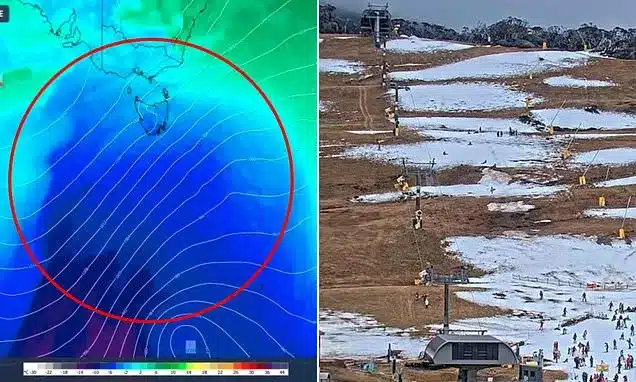
Millions of Australians are being urged to prepare for a significant winter chill as a powerful polar blast sweeps across the nation’s southeast this weekend. Freezing temperatures and much-needed snowfalls are anticipated, particularly for the Australian Alps, offering a welcome boost to the country’s ski resorts.
Cold Front Approaches Southeast Australia
A dynamic cold front, currently situated over the Great Australian Bight, is forecast to move towards Tasmania and the mainland from Friday into Saturday. This system is expected to bring frigid polar air, marking a stark contrast to the mild start to July and the unseasonably warm June experienced in many eastern coastal areas. Cities like Sydney, Melbourne, and Canberra had recorded temperatures above their long-term averages leading up to this shift.
Weatherzone meteorologists have indicated that the coldest air associated with this system will impact Tasmania. Snowfall is predicted to descend as low as 400 metres above sea level in the state’s south by Saturday. This could potentially bring a dusting of snow to the higher suburbs of Hobart.
Snowfall Forecast for Australian Alps
The Australian Alps in both Victoria and New South Wales are set to receive a significant snow dump from Thursday onwards. This is particularly good news for ski resorts, many of which had experienced a historically lean start to the snow season. For instance, some New South Wales ski fields began the second month of winter with virtually no official snow depth, a rarity not seen in decades.
Meteorological predictions suggest that approximately 20 centimetres of snow could fall across the Alps from Friday into the weekend, with the heaviest accumulation expected on Friday. The snow level on the mainland is anticipated to drop to around 1000 metres above sea level.
Resorts like Thredbo and Perisher in the New South Wales Snowy Mountains have already reported receiving snowfall on Thursday morning, with overnight storms bringing conditions similar to what was forecast.
Severe Weather Warnings Issued
In addition to the cold temperatures and snow, a severe weather warning for damaging winds has been issued for the northeast ranges of Victoria. Gusts of up to 100 km/h are possible, accompanied by blizzard conditions in elevated areas. Residents and travellers in these regions are advised to exercise caution.
National Weather Outlook
Beyond the immediate impact on the southeast and alpine regions, the cold front will influence weather patterns across the country:
- Sydney: The city is expected to start the weekend with sunny conditions on Friday and Saturday, but rain is forecast to return on Sunday. Temperatures will be cool, with highs in the late teens.
- Melbourne: Melbourne will experience cloudy conditions with a high chance of showers, particularly on Friday and Saturday. Maximum temperatures are expected to hover around the mid-teens. Monday could see a significant drop in minimum temperatures.
- Canberra: The nation’s capital will see cloudy skies and showers on Friday, with a high of only 10C. The weekend is forecast to be clearer and slightly warmer, with highs reaching around 12C, though minimums will be very low.
- Adelaide: Adelaide faces a wet start to the weekend with cloudy skies and showers expected on Friday and Saturday. Maximum temperatures will be in the mid-teens.
- Brisbane: Brisbane is set for a milder weekend compared to the south, with partly cloudy skies and slight chances of showers. Temperatures will be significantly warmer, with highs in the low to mid-twenties.
- Perth: Perth is expected to have partly cloudy conditions with moderate temperatures over the weekend. A chance of showers is present for Sunday afternoon and evening.
- Hobart: Tasmania will experience the brunt of the cold air, with Saturday forecast to be particularly cold and wet, with a high chance of showers and snow possible at lower elevations. Conditions are expected to improve slightly by Monday.
- Darwin: The tropical north will remain largely unaffected, with sunny skies and warm temperatures expected throughout the weekend.
Preparing for the Cold
With temperatures set to plummet, particularly in southern and southeastern Australia, residents are advised to take precautions. This includes ensuring adequate heating is available, checking on vulnerable neighbours, and being prepared for potential disruptions due to severe weather, especially in alpine and exposed areas. Ski enthusiasts planning trips to the mountains are advised to check the latest snow reports and conditions before travelling.
Conclusion
This polar blast represents a significant weather event for Australia, bringing a much-needed dose of winter to the ski fields and a sharp drop in temperatures for millions. While offering relief to the snow industry, the cold snap also necessitates preparedness for potentially hazardous conditions across several states.