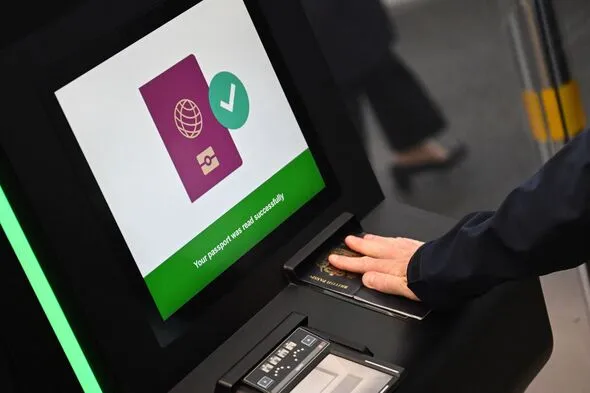
A prominent airport executive is calling for the European Union to temporarily disable its new Entry/Exit System (EES), citing a fundamental design flaw that is reportedly causing significant travel delays. The EES, implemented in April, requires non-EU citizens, including those from the UK, to provide fingerprints and have their photos taken upon entering the Schengen Area, a vast zone of 29 European countries that has abolished internal border controls.
Criticism Mounts Over EU’s New Border Check System
While the EES is generally recognized by major airlines and industry bodies as a necessary long-term measure for enhancing security and managing travel – with similar electronic border systems already in place in the UK, US, and Australia – its rollout has been met with considerable criticism. The system has, however, proven effective in identifying approximately 7,000 individuals who have overstayed their permitted duration of stay in the Schengen Area.
Marco Troncone, the Chief Executive of Aeroporti di Roma (the operator of Rome’s Fiumicino Airport), has voiced strong concerns, urging for the system to be deactivated indefinitely until its inherent issues are resolved. He stated that the current design is directly contributing to the chaotic delays being experienced at borders.
Processing Times Significantly Increased
Troncone explained that the time taken to process each passenger at the border has effectively doubled since the EES began. “We managed to optimise the process on our end, bringing this to 90 seconds [down from two minutes], but it is still too high,” he told The Times. “This is, of course, not compatible with 50,000-60,000 passengers every day.”
Airlines operating routes from the UK have identified several airports as experiencing particularly severe queues this summer. These include:
- Lanzarote
- Tenerife South
- Malaga
- Porto
- Lisbon
- Amsterdam
- Krakow
- Paris Charles de Gaulle (CDG)
- Rome Fiumicino
- Palma
- Malta
- Menorca
- Milan Linate and Malpensa
- Naples
- Budapest
Design Flaw, Not Implementation Issue
Troncone emphasized that the core problem lies in the system’s fundamental design rather than its implementation. “The problem is related to the way this process has been designed. It’s not a matter of implementation,” he asserted. He further noted that the operational design was developed with minimal input from airport operators, who are on the front lines of managing passenger flow daily.
Rome Fiumicino Airport alone has invested approximately €12 million (around £10 million) in preparations for the new EES. The complexity of the system is further highlighted by the fact that responsibility for border control within the 29 Schengen countries is distributed among various government departments, with different technology providers often involved in design and rollout across member states. Challenges have emerged as some EU nations struggle to integrate their national software systems with the central EES platform, while others are keen to maintain their own hardware solutions.
Industry Leaders Seek Urgent Intervention
Representatives from the aviation industry are scheduled to hold critical discussions with the European Commission (EC) to address the disruptions caused by the EES, particularly in popular travel destinations like Italy, Spain, France, the Netherlands, and Greece. Troncone has lent his support to ACI Europe, an industry body representing the continent’s airports, in its appeal to the EC to pause the EES project, at least through the peak summer months of July and August.
ACI Europe is advocating for the authority to halt the EES indefinitely under exceptional circumstances until what they term “structural challenges” are resolved. Key requirements for a smoother operation include ensuring adequate border personnel, deploying reliable self-service technology kiosks, and establishing a system that allows travelers to submit biometric data in advance via a pre-registration mobile application, which is currently only available in Sweden and Portugal.
Wider Concerns Across European Travel Hubs
Other major European travel hubs, including Amsterdam Schiphol, Naples Airport, and Corfu Airport, have also urged the EC to reconsider the current regulations, especially as the peak holiday season intensifies. Schiphol Airport, which handles an estimated 220,000 travelers daily, has acknowledged that the EES is negatively impacting border operations, particularly during busy periods.
Olga Kefalogianni, the Greek Minister of Tourism, has publicly stated that the EES requires a fundamental “rethink at a European level.” Similarly, the Mayor of Naples has communicated to the Italian government that the EES could have a substantial negative effect on tourism volumes.
Ryanair, a major low-cost carrier, has also pointed to seven popular European airports where passengers are experiencing prolonged delays attributed to the new EU border checks. The airline contends that these locations are unprepared to manage the high passenger numbers during the summer peak due to insufficient staffing, a lack of functional kiosks, and general system readiness issues.
Outlook for Peak Travel Season
This summer is anticipated to be one of the busiest on record for air travel, with flight volumes expected to increase by 2% compared to the previous year. On the busiest days, approximately 37,000 flights are scheduled across Europe, underscoring the critical need for efficient border management systems to avoid widespread disruption.
The ongoing issues with the EU’s EES highlight a significant operational challenge for airports and airlines as they navigate the busiest travel period. The call for a system switch-off or significant modifications reflects deep-seated concerns about the current design’s impact on passenger experience and operational efficiency, raising questions about the readiness and suitability of the system during peak demand.