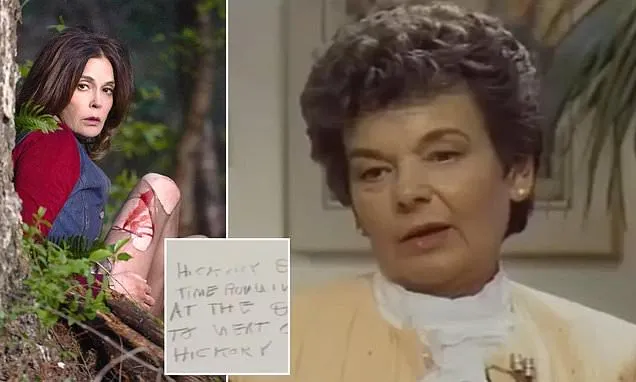
In June 1978, Ruth Finley, a seemingly ordinary middle-class mother in Wichita, Kansas, began receiving a series of disturbing phone calls. These calls, from a stranger who identified himself as ‘The Poet,’ marked the beginning of a four-year ordeal that would involve alleged stalking, kidnapping, and physical assault. The case baffled local law enforcement, drawing comparisons to the notorious BTK killer due to some unsettling similarities, but the eventual unraveling of the mystery revealed a far more complex and tragic truth rooted in the victim’s own psyche.
The torment began shortly after Ruth’s husband, Ed, was hospitalized for what they believed was a heart attack. Alone at home, Ruth answered the phone expecting news about her husband. Instead, a menacing voice informed her, ‘I know all about that night.’ This call triggered a wave of fear, especially as the caller threatened to expose a traumatic event from Ruth’s past that she had long suppressed.
A Suppressed Trauma Resurfaces
At 16, while living in Fort Scott, Kansas, Ruth had been attacked and branded on both thighs with a hot iron by an unknown assailant. The man was never apprehended, and Ruth, with her family’s encouragement, had tried to put the incident behind her. She later met and married Ed, and together they built a stable life in Wichita, raising two sons. However, The Poet’s calls threatened to shatter this hard-won peace, demanding money in exchange for his silence about the branding incident.
The harassment escalated. Following the initial phone calls, Ruth reported a physical encounter at a department store where a man grabbed her arm and uttered obscenities. Soon after, threatening letters began arriving. These communications were characterized by childish language, crude drawings, and unsettling nursery rhyme-style poetry, adding a bizarre and deeply disturbing layer to the escalating fear.
Escalating Fear and Disappearances
In November 1978, five months after the first call, Ruth Finley vanished during her workday. She recounted being held captive for five hours by two men, one of whom she identified as the individual from the department store incident. During her captivity, she claimed they drove her around Wichita, demanding money and physically assaulting her, including a blow to the head with a piece of concrete. She stated she managed to escape by feigning a need to use the restroom and fleeing into a park.
The ordeal left Ruth physically and emotionally scarred. Upon her return, she was found disheveled, shoeless, and with visible injuries, including scratches and a swollen, bruised cheek. Her husband, Ed, was incensed and determined to see justice served. Investigators, however, faced significant challenges. The letters yielded no usable forensic evidence, the abductors’ vehicle was untraceable, and there were no witnesses. As other cases demanded attention, Ruth’s situation, despite the continued sporadic appearance of The Poet’s letters, receded in priority.
A Violent Attack and a Shocking Revelation
The terror resurfaced in July 1979. As Ruth approached her car in a deserted mall parking lot, she reported being confronted by the man who had been stalking her. A struggle ensued, during which she was stabbed three times, with the knife remaining lodged in her back. She managed to escape once more, sustaining serious injuries. Doctors at the hospital deemed her incredibly fortunate, noting that a deeper penetration could have been fatal.
The Finley’s home also became a target, with incidents including cut phone lines, a bottle of urine left on their porch, a Molotov cocktail, and their holiday wreath being set on fire, shattering a window. The relentless psychological warfare took a severe toll on Ruth, leading her to contemplate suicide. She reportedly made elaborate plans to end her life, detailing methods involving travel to another city, checking into a motel under an assumed name, purchasing a knife, and drowning herself with rocks attached to her body.
The Unraveling of ‘The Poet’
The case took a dramatic and unexpected turn in 1981 when a new detective began re-examining the evidence. Through a series of interviews and psychiatric evaluations, the astonishing truth emerged: Ruth Finley had orchestrated the entire ordeal herself. She had sent the letters, staged the kidnappings, and even inflicted the stab wounds. These actions, according to psychiatric assessments, occurred during dissociative episodes, where her consciousness was partially aware but largely unconscious of her actions.
It was also suggested that the initial branding incident from her youth might have been fabricated or a result of a similar dissociative state. Based on the psychiatric findings, prosecutors decided not to press charges. Ruth voluntarily admitted herself to a psychiatric ward for treatment.
Healing and a Quiet Life
During therapy, Ruth began to confront deeply buried childhood trauma. She experienced vivid dreams and visions, not only of The Poet but also of another figure—a man smelling of tobacco, wearing bib overalls, who was raping a little girl. Through intensive therapy, it was revealed that this little girl was Ruth herself, who had allegedly been repeatedly sexually abused by a neighbor around the age of three and a half, possibly with her parents’ knowledge. The ‘little girl’ had been suppressed for 45 years, eventually manifesting as the enraged persona of ‘The Poet’ seeking release and help.
Therapists suggested that Ruth’s actions as The Poet were a desperate cry for help, mirroring her childhood desire for assistance. The intense self-harm and staged events may have been, in part, a subconscious attempt at suicide, stemming from the unresolved trauma of her early abuse.
Following her treatment, Ruth Finley returned to work at the telephone company and remained with her husband, Ed. They continued to live in Wichita, and according to author Corey Mead’s book, “The Pursued,” they ultimately enjoyed what were described as “the best years of their lives,” finally finding peace after years of internal and external turmoil.